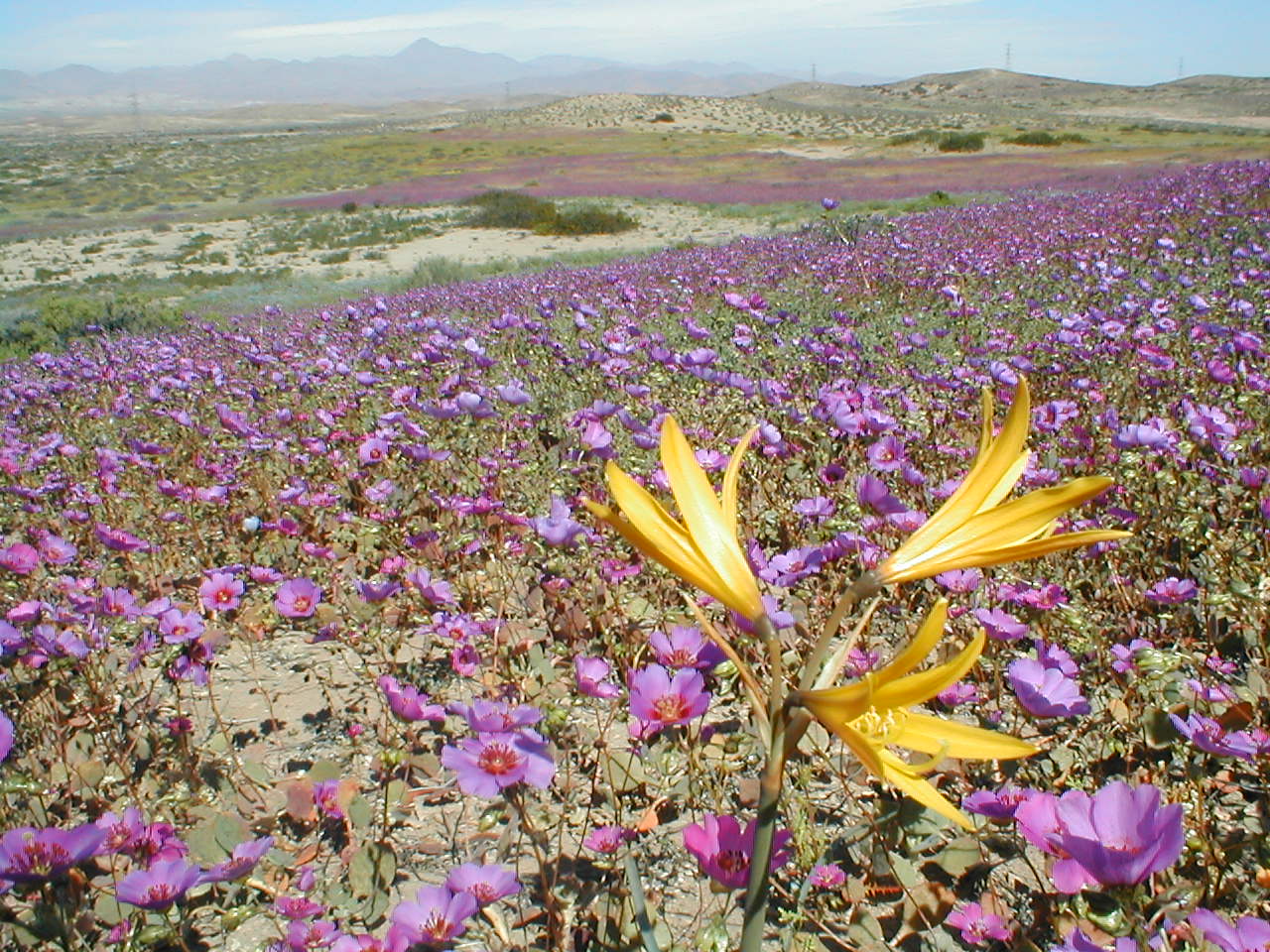
Desert Bloom
For most of the year, the Atacama Desert looks like a place where nothing could survive. The cracked hardpan stretches from the Chilean Coast Range to the foothills of the Andes, receiving less than 12 millimeters of rain annually in some stretches -- less precipitation than parts of Antarctica. Yet buried beneath that parched surface, seeds and bulbs lie dormant, some for years, some for decades, waiting for a signal. When the rains finally come -- irregular, unpredictable, often driven by the warm ocean currents of El Nino -- the Atacama answers with one of the most astonishing natural spectacles on Earth. The desert blooms.
A Patience Measured in Decades
The mechanism is ancient and elegant. Seeds of more than 200 flowering species, most of them endemic to the Atacama region, lie suspended in a state of dormancy just below the surface. When rainfall exceeds the threshold needed to penetrate the soil crust -- enough to reach those buried reserves but not so much that it washes them away -- germination begins. The timing is exacting. Too much rain can actually suppress the bloom; in 1997, Copiapo received rainfall 978% above average, yet the desert produced only minimal flowers. The phenomenon requires a narrow band of conditions: enough moisture to trigger life, not enough to drown it. Between September and November, when the conditions align, the desert floor transforms from lifeless brown to rolling fields of pink, purple, white, and gold.
The Lion's Claw and the Guanaco's Foot
The flowers themselves carry names as vivid as their colors. The Garra de Leon -- Lion's Claw -- extends scarlet petals that curl like talons. The Pata de Guanaco, named for the soft pad of a guanaco's foot, spreads in dense mats of magenta across the valleys. The Ananuca, a delicate lily in shades of red and yellow, carpets entire hillsides. Each species germinates at a different point during the bloom window, creating a slow-motion wave of color that shifts week by week across the landscape from just south of Vallenar to just north of Copiapo. Insects arrive first, then birds, then small lizards -- the entire food chain awakened by the same pulse of rain. The Tuco-tuco, a burrowing rodent, emerges to feed. The Four-Eyed Frog hunts among the stems. For a few weeks, the Atacama is as alive as any tropical forest.
El Nino's Gift
The bloom's trigger lies thousands of kilometers out in the Pacific. El Nino -- the periodic warming of ocean surface temperatures off South America's western coast -- increases evaporation and drives moisture inland over a desert that has no business receiving it. The coastal valleys and ranges of the Atacama Region catch this anomalous precipitation, funneling it into the same drainages where seeds have been accumulating since the last significant rain. The connection between a Pacific temperature anomaly and a wildflower explosion in one of Earth's most barren landscapes is one of climate science's more poetic cause-and-effect chains. Tourists descend on the region during bloom years, traveling from Huasco, La Serena, Copiapo, and Caldera to walk among the flowers. The spectacle has become a significant economic event for the Atacama Region, boosting tourism by as much as 20 percent in bloom years.
Guarding What Blooms
Success has brought pressure. Environmental organizations have raised concerns about the trampling of fragile bloom sites by tourists, the illegal collection and trade of native flower species, and damage from motorsport events crossing the desert. The Chilean government responded with a series of protections: the Comision del Desierto Florido de la Region de Atacama was created in 1997 and relaunched in 2015 to coordinate conservation efforts. In October 2022, Chile announced the creation of the Desierto Florido National Park to formalize protections. The challenge is preserving access to a phenomenon that, by its nature, is temporary and unpredictable -- a spectacle that rewards those who arrive at the right time but punishes the landscape if too many of them come at once. The seeds will wait. They have been waiting since long before humans walked the Atacama. Whether the conditions they need will continue to arrive is a question the desert answers on its own schedule.
From the Air
Located at 27.95S, 70.55W in the Atacama Desert of northern Chile. The bloom zone stretches along the coastal valleys between Vallenar and Copiapo. Best viewed from 3,000-5,000 feet AGL during September-November of El Nino years when the normally brown desert floor transforms into visible patches of color. Nearest airports: Copiapo Desierto de Atacama (SCAT/DAT), La Serena La Florida (SCSE). The Chilean Coast Range provides useful terrain reference to the west.