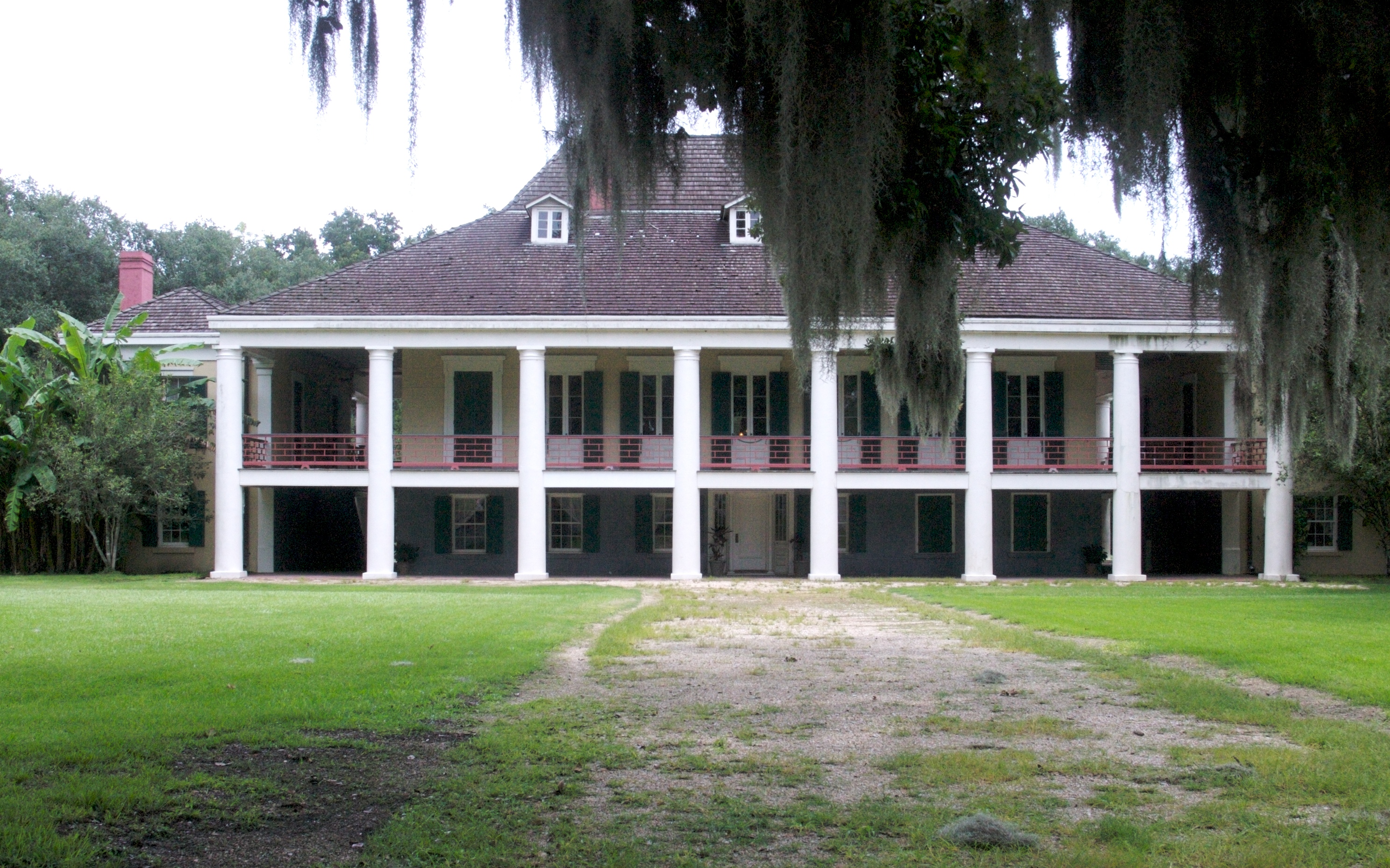
Destrehan Plantation
The building contract is still on file at the St. Charles Parish courthouse in Hahnville. Dated 1787, it records the agreement between Robert Antoine Robin de Logny and Charles Pacquet, a free man of color, to construct a raised house in the West Indies style along the banks of the Mississippi. For his labor, and the use of six enslaved workers, Pacquet received a cow, a calf, one hundred bushels each of corn and rice, one hundred dollars in cash, and one enslaved person. That contract makes Destrehan Plantation the oldest documented house in the lower Mississippi River Valley, and its unsettling terms capture the contradictions that would define this place for the next two and a half centuries.
From Indigo to Sugar and Statehood
Completed in 1790 during the period of Spanish rule over Louisiana, the house passed to Robin de Logny's son-in-law, Jean-Noel Destrehan, in 1792. Destrehan married into the family, fathered fourteen children, and transformed the operation. When indigo blight devastated crops in the 1790s, he pivoted to sugarcane after his brother-in-law Etienne de Bore perfected the granulation process that made sugar a profitable cash crop. By 1803, Destrehan Plantation was the leading sugar producer in St. Charles Parish. Jean-Noel Destrehan himself became Louisiana's first United States Senator in 1812 and played a key role in the transition of the Orleans Territory to statehood. The plantation was not merely a farm; it was a seat of political power in a colony reshaping itself as an American state.
Rebellion at the Doorstep
In January 1811, the largest slave revolt in American history erupted along the German Coast. The 1811 German Coast Uprising sent hundreds of enslaved people marching toward New Orleans, and Destrehan Plantation found itself at the center of the aftermath. Jean-Noel Destrehan was appointed to the parish tribunal that interrogated the accused rebels. Three swift trials followed, conducted under the old French legal system, which offered no right to appeal and no presumption of innocence. The judges were themselves slaveholders. The Destrehan tribunal ordered the immediate execution of eighteen rebels by firing squad, including at least three of Jean-Noel's own former enslaved workers. Their severed heads were displayed on poles along the river road as a warning. The plantation house where these sentences were handed down still stands, its galleries shaded by ancient live oaks.
A Will That Could Have Changed Everything
After Jean-Noel's death in 1823, the plantation passed to his son-in-law Stephen Henderson, a penniless Scottish immigrant who had become one of Louisiana's wealthiest men. Henderson married sixteen-year-old Zelia Destrehan in 1816; he was forty-two. When Zelia died childless in 1830, Henderson was devastated. He died eight years later, leaving a will that scandalized Louisiana society: it stipulated that all his enslaved workers be freed, that those who wished could be transported to Liberia, that a factory be built for the rest to manufacture shoes and clothes, and that twenty-five years after his death a city called Dunblane would be laid out on the plantation grounds. The family fought the will for twelve years. The Louisiana Supreme Court ultimately set it aside on a legal technicality, and the vision of Dunblane died with it.
Confederate Diplomats and Freed Colonies
Pierre Adolphe Rost, a Louisiana Supreme Court justice, bought the plantation in 1839 and remodeled the house in the Greek Revival style, encasing wooden columns in plastered brick and scoring the stucco to resemble stone. When the Civil War broke out, Rost served as the Confederacy's diplomatic representative to Spain. In his absence, the Freedmen's Bureau seized the property and established the Rost Home Colony, offering formerly enslaved people medical care, education, and the chance to work for wages. It became the most successful freedmen's colony in Louisiana, even turning a profit. But Rost returned in 1865 with a presidential pardon from Andrew Johnson and demanded his property back. The colony paid him rent for another year before the last residents departed in December 1866.
Surviving the Refinery and the Treasure Hunters
Family ownership ended in 1910 after 123 years. Four years later, the Mexican Petroleum Company bought the property and built an oil refinery around the manor house, tearing down outbuildings and converting the mansion into a clubhouse. When American Oil demolished the refinery in 1959, the abandoned plantation house decayed rapidly. Treasure hunters, drawn by legends that the privateer Jean Lafitte had hidden loot inside, punched gaping holes in the walls. Vandals stripped Italian marble mantels, cypress paneling, and Spanish ceramic tiles. A local sheriff managed to save the original 1840s iron gates and a massive marble bathtub rumored to have been a gift from Napoleon Bonaparte. In 1971, American Oil donated the house to the River Road Historical Society. Today, Destrehan Plantation stands as a filming location for productions including Interview with the Vampire, 12 Years a Slave, and Beyonce's Lemonade, its French Colonial architecture and heavy history drawing cameras and visitors from around the world.
From the Air
Destrehan Plantation sits at 29.945N, 90.365W on the east bank of the Mississippi River in St. Charles Parish, about 25 miles upriver from downtown New Orleans. From the air, look for the distinctive white plantation house amid industrial corridor development along the River Road (LA-48). The nearest major airport is Louis Armstrong New Orleans International (KMSY), approximately 11 miles to the east. New Orleans Lakefront Airport (KNEW) is about 30 miles southeast. Best viewed at 1,500-2,000 feet AGL. The River Road plantation corridor extends northwest along the Mississippi toward Baton Rouge (KBTR).