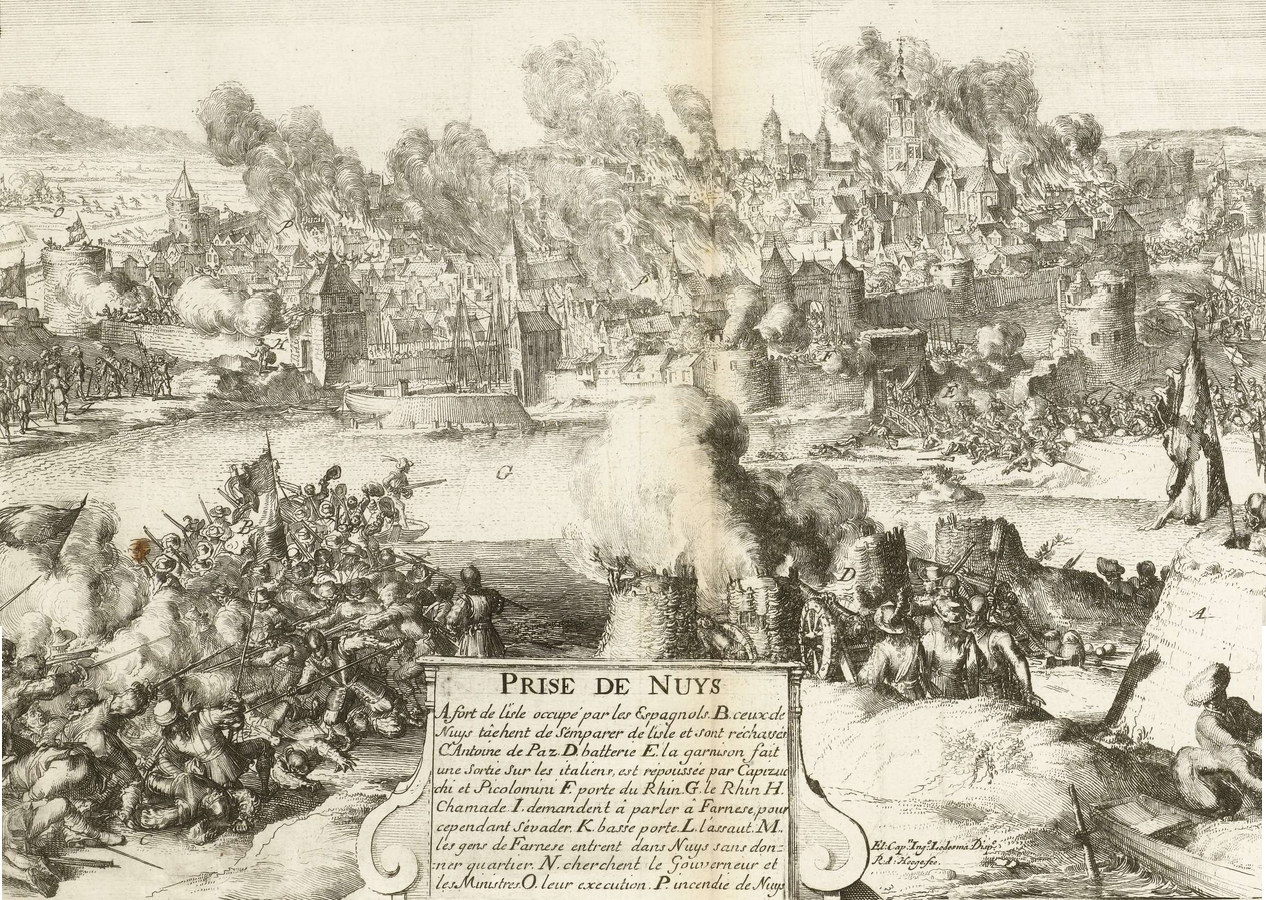
Destruction of Neuss
When Alexander Farnese, Duke of Parma, sent his emissary to demand the surrender of Neuss in the third week of July 1586, the townspeople jeered him as he walked back to the Spanish camp. They were not foolish people. They knew that a hundred and twelve years earlier their grandfathers had outlasted a year-long siege by Charles the Bold of Burgundy and won the right to mint their own coins and carry the imperial arms on their coat of arms. They had walls. They had the rivers. They had a garrison of sixteen hundred men. What they did not yet understand was that the man on the other side of the wall commanded forty-five cannons and ten thousand soldiers, and that none of the protocols of medieval warfare were going to apply to what happened next.
The Town Before
Neuss in the summer of 1586 was a fortified Rhineland city of roughly 4,500 people — bakers, weavers, fishmongers, brewers, parish priests, mothers, children, the elderly. It had been held since February by supporters of the Protestant Prince-Elector Gebhard Truchsess von Waldburg in the war that bears his name. Adolf, Count of Moers and Neuenahr, had refortified the walls, supplied the granaries, and stocked the magazines before taking most of his army north to defend Moers and Venlo. In his place he left a young commander named Friedrich Cloedt with sixteen hundred soldiers — most of them German and Dutch, some with experience, many of them recently recruited. The townspeople had every reason to believe their walls would hold. Their walls had held against worse. The trouble was that the laws of war had changed, and the man encircling them now had been sent by Philip II of Spain to make a point that the whole Rhineland would be required to understand.
Thirty Hours of Iron
Parma had ten thousand troops at Neuss — Karl von Mansfeld's two thousand soldiers, six thousand foot and the elite Spanish formations called Tercios, two thousand mounted Italian, Spanish, and German cavalry — plus forty-five cannons distributed on the heights and on a redoubt across the river. The next day was the feast of St. James, the patron saint of Spain, and the army stood down. Then the cannonade began. For thirty hours, iron cannonballs weighing between thirty and fifty pounds slammed into the walls of Neuss. Parma's artillery fired more than 2,700 rounds. Cloedt's garrison repelled assault after assault. The eighth attack failed. With the ninth, the outer wall breached. Italian troops poured in from one end of the city; Spanish troops poured in from the other. They met in the middle, in the marketplace. Inside one of the houses, Cloedt was being nursed by his wife and his sister — his leg nearly torn off, five other serious wounds. Parma's troops found him there.
The People in the Churches
Parma was reportedly inclined to give Cloedt the soldier's death of a sword. Ernst of Bavaria — the rival archbishop in whose name this army was nominally fighting — demanded he be executed. The dying man was hanged from a window of the house where his wife was nursing him, alongside several dozen of his officers. Then the soldiers turned on the rest of the garrison and slaughtered them, including the men who tried to surrender. Then they turned on everyone else. Women and children had taken refuge in the churches; at first they were left alone. Then a fire started somewhere in the city, and the wind took it, and they had to flee into the streets. Contemporary accounts describe what happened next — children, women, and old people, their clothes smoldering or already in flames, running between the burning houses, only to be cornered by the soldiers. If they escaped the Spanish, the Italians caught them. Parma wrote to Philip II in Madrid that more than four thousand bodies lay in the ditches and the moats. English observers confirmed his number. They added that only eight buildings still stood.
What Was Lost, What Was Learned
Roughly three thousand of the four thousand five hundred civilians who had lived in Neuss that July were dead. The entire garrison was killed. Parma had lost fewer than five hundred men of his own. The destruction of Neuss became, instantly, one of the most studied atrocities of the wars of religion — an English-language pamphlet circulated within months, and contemporary commentators on both sides used it as either a warning or a vindication, depending on their loyalties. Gebhard's supporters tried to console themselves that at least the city was now useless as a Catholic garrison. It was cold consolation. Parma had also won unhindered access to the Niederstift, the northern part of the Electorate, and from there a clean route to attack the rebellious Dutch provinces. Within two years, Gebhard would relinquish his claim to the Electorate and retire to Strassburg, his war essentially lost on the day Neuss burned. The town itself rebuilt — Neuss is still there today, a city of around 150,000 across the Rhine from Düsseldorf — but the destruction of 1586 marked a threshold the Rhineland had not previously crossed, and one the rest of Europe would cross repeatedly across the next sixty years.
From the Air
Neuss sits at 51.20°N, 6.69°E on the western bank of the Rhine, directly across the river from central Düsseldorf. From altitude, the broad sweep of the Rhine separates Neuss from Düsseldorf's distinctive Altstadt and the Rheinturm; the rebuilt medieval core of Neuss is clearly visible as a tighter, older street pattern within the modern city. The basilica of St. Quirin still anchors the old town. Düsseldorf International (EDDL/DUS) is 12 km northeast; Mönchengladbach lies 20 km west. The site of the 1586 destruction is the inner city around the present Markt and Münsterplatz.