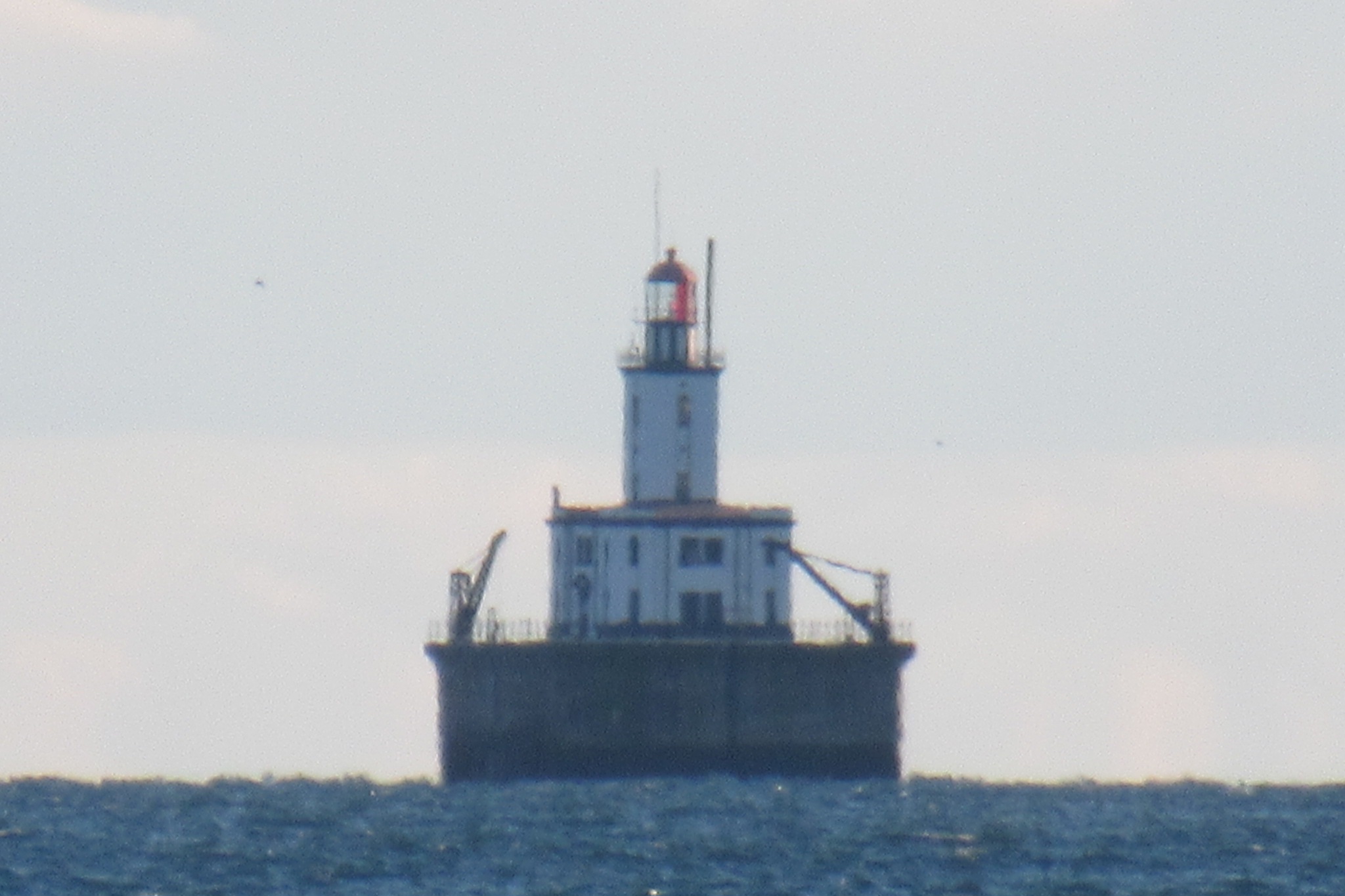
DeTour Reef Light
Five thousand vessels pass through the DeTour Passage every year. Freighters loaded with iron ore, grain, and limestone thread between Michigan's Upper Peninsula and Drummond Island, navigating the narrow channel that connects Lake Huron to the St. Marys River and, beyond it, Lake Superior. Since 1931, a concrete lighthouse with Art Deco lines has marked the southern entrance to this passage, its light sweeping the water in a rhythm of one-second flash and nine-second darkness. The DeTour Reef Light is the gateway to Lake Superior, and its story is one of engineering, endangered heritage, and a community that fought to keep the light alive.
Fourteen Reefs, Fourteen Lights
DeTour Reef Light belongs to a network of fourteen reef lights built around Michigan to help ships navigate the shoals and submerged hazards that lurk beneath the Great Lakes surface. Its concrete foundation shares a design lineage with the Martin Reef Light to the west and the Poe Reef Light near Cheboygan, all three constructed by the same crew around the same time. The station progressed through a succession of increasingly sophisticated optics. An 1857 fourth-order Fresnel lens gave way to a third-order in 1870, and in 1908 the light received a rare three-and-a-half-order Fresnel lens, one of only about a dozen used anywhere in the country. Manufactured by Barbier, Benard and Turenne of Paris, stamped with the number USLHE 317, this lens was reserved for locations that posed especially serious hazards to navigation. The station also carried a diaphone fog signal, its low moan warning ships away when the light could not penetrate fog or snow.
Shipwreck at the Gateway
The waters around DeTour Reef have always been treacherous. On April 30, 1909, the iron package freighter foundered near the lighthouse, adding another wreck to the collection scattered across the passage floor. The DeTour Passage Underwater Preserve now protects these remains, and divers explore the same waters that once terrified ship captains navigating without radar or GPS. The passage concentrates nearly all commercial Great Lakes traffic moving between Huron and Superior into a single corridor, making the reef light indispensable. Without it, the shipping lane that carries the raw materials of American industry would be far more dangerous. The light's one-second flash and nine-second eclipse, visible for miles across the water, has guided ore boats and grain haulers through this bottleneck for nearly a century.
Most Endangered
By the late 1990s, Michigan's historic lighthouses were deteriorating. The National Trust for Historic Preservation took notice, and in 1998 named Michigan's lighthouses to their annual list of America's Eleven Most Endangered Historic Places. DeTour Reef Light served as the prime example. It was the first time any lighthouse had appeared on the list. The designation brought national attention and gave impetus to the DeTour Reef Light Preservation Society, a group of local advocates who believed the lighthouse was worth saving. In 2000, Congress passed the National Historic Lighthouse Preservation Act, enabling the complete transfer of eligible light stations to private ownership. The DRLPS seized the opportunity, submitting an application to take over the lighthouse entirely.
The Community Lighthouse
By 2004, the DeTour Reef Light Preservation Society had completed a major restoration using private donations from the public, supplemented by federal, state, and private grants. The quality of the work spoke for itself. In 2005, the DRLPS was awarded full ownership of the DeTour Reef Light, one of approximately forty Michigan lighthouses transferred to private hands in recent years. The society opened the lighthouse to visitors through keeper programs and tours, letting the public experience what it means to live on a reef in the middle of a shipping lane. The lighthouse's former three-and-a-half-order Fresnel lens, taken out of service in 1978, is now displayed at the DeTour Passage Historical Museum in the village of DeTour. The original diaphone foghorn has been restored, fitted with new air compressors and tanks, and is periodically sounded from the tower, its deep voice carrying across the water just as it did decades ago.
Keeping the Light On
On March 21, 2022, the underwater power cable connecting the lighthouse to shore failed. The DRLPS was forced to cancel all keeper and tour programs for that season. Limited programs restarted in 2023 using a small temporary generator, but the cable failure underscored the fundamental challenge of maintaining a structure that sits on a reef in open water. Plans for a permanent power solution continue to develop. DeTour Reef Light is one of more than 150 major lights, past and present, in Michigan alone. The distinction between a light and a lighthouse matters: a lighthouse implies a keeper's quarters, a place where someone lived. The DeTour Reef Light has both, and the preservation society's mission is to ensure that distinction endures. The light remains an active, automated aid to navigation, its modern Vega VRB-25 optic flashing the same warning that Barbier and Turenne's handcrafted lens once projected across Lake Huron's northern waters.
From the Air
DeTour Reef Light sits at 45.949N, 83.903W in the DeTour Passage between Michigan's Upper Peninsula and Drummond Island, marking the northern end of Lake Huron. The concrete Art Deco tower stands in open water and is visible from altitude against the dark blue of the passage. Look for heavy freighter traffic in the shipping channel, especially ore boats heading to or from the Soo Locks. Nearest airports: Drummond Island Airport (KDRM) approximately 5nm northeast, Kinross/Chippewa County International Airport (KCIU) approximately 30nm northwest. Best viewed at 2,000-4,000 feet AGL. The Straits area funnels wind and can create sudden weather changes.