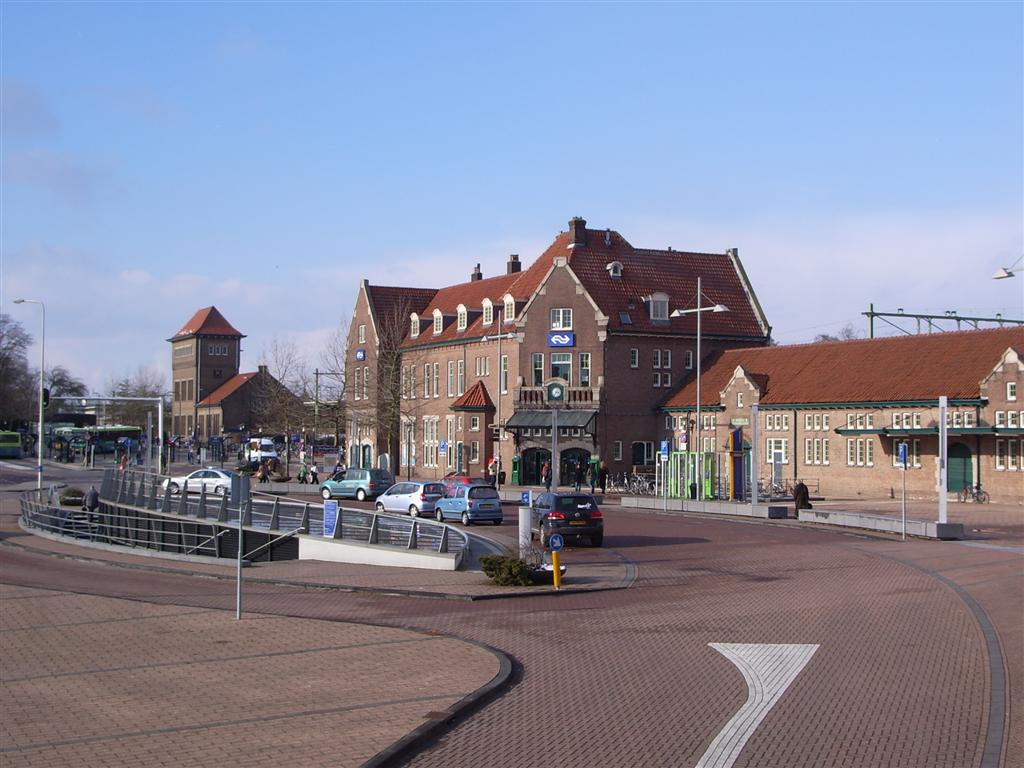
Deventer Railway Station
For roughly thirty years, two railway companies refused to share. The line from Arnhem to Zwolle belonged to one. The line from Apeldoorn to Almelo belonged to another. They ran through the same town - and rather than meet in a single station, they built two, on opposite sides of the tracks, with passengers walking the gap. Only in 1914, after the lines were lifted onto embankments to clear road traffic, did Deventer finally get the unified station that still stands today.
The State's Plan, the Companies' Quarrel
In 1860 the Dutch government decided to link the country's largest towns with a single national network, and the line from Arnhem through Zutphen, Deventer, Zwolle, and Heerenveen to Leeuwarden became Staatslijn A. Deventer's first station opened on August 5, 1865. Twenty-two years later, in 1887, a second line arrived - the railway from Apeldoorn, extended a year later to Almelo. Different owners meant different stations. The rivalry only resolved itself around 1910, when the OLDO, a small local line out to Raalte and Ommen, opened and the city took the opportunity to raise the tracks above street level. The current station building, completed in 1914, finally brought every line under one roof. The island platforms followed in 1920.
The Express to Warsaw
Once the line east through Almelo connected to the German Almelo-Salzbergen railway in 1892, Deventer became a node on the international map. Trains rolled through carrying through-coaches with painted destination boards that read like a Cold War atlas. The Holland-Scandinavie Express. The Nord-West Express. The Hoek-Warszawa Express. Passengers boarding at the Hook of Holland or Rotterdam could ride the same carriages to Berlin, Warsaw, Copenhagen, or Moscow. From 1991 the through services to Berlin grew, and in 1993 the last international train rolled out of the Hook of Holland and the era ended. A train to Berlin still passes through Deventer every two hours, and three nights a week the European Sleeper rumbles through on its way from Brussels and Amsterdam to Berlin and Prague.
The Platform That Wasn't There
By the 2000s, Deventer was choking on its own success. The station had just one island platform, and the city wanted to run four trains an hour to the west of the country. On June 15, 2008, a temporary third platform was laid down over the rarely-used track 1, buying time while planners worked out a permanent fix. Exactly six years later, on June 15, 2014, the permanent Platform 1 opened in its place, complete with a lift. The plaza outside was rebuilt too. In November 2015 an underground cycle park opened with room for 3,600 bikes - because 18,000 people pass through this station every day, and a great many of them arrive on two wheels. The next summer brought a new bus station. None of it would surprise the 1914 builders. The station has always been a place that keeps getting more useful.
A Monument in Daily Use
The 1914 building is a Rijksmonument, a nationally protected heritage site - one of those stations that the Dutch built when they still believed train travel deserved architecture. It survived the Allied bombing campaigns aimed at the nearby IJssel railway bridge, which struck the city repeatedly in late 1944 and early 1945. Today the concourse mixes the original masonry with OV-chipkaart turnstiles that arrived in 2015, a bookshop, a convenience store, and the smell of fresh stroopwafels. Step outside and you're a five-minute walk from the medieval Bergkwartier and the Brink market square. The same trains that connect Deventer to Berlin also feed daily commuters to jobs in Zwolle, Apeldoorn, and Enschede. The station does what it has always done: it moves the IJssel valley's people, only faster than before.
From the Air
The station sits at 52.26 degrees north, 6.16 degrees east, on the eastern edge of Deventer's old town. From above, look for the curving span of the IJssel railway bridge - the same bridge Allied bombers struggled to hit in 1944-45 - and trace the line west across the river. Nearest major airport is Schiphol (EHAM); Lelystad (EHLE) and Twente (EHTW) are closer regional fields. The rail line forms a clear east-west visual reference across the central Netherlands.