Devils Tower National Monument
The Lakota name says it better: Mato Tipila, Bear Lodge. According to their telling, seven young girls once fled from a giant bear onto a rock that rose beneath their feet, lifting them toward the sky while the bear's claws gouged deep furrows into the stone. The girls became the Pleiades, the rock became this tower, and those claw marks remain visible today as hundreds of hexagonal columns stretching over 500 feet into the Wyoming sky. When a U.S. cavalry party arrived in 1876, they mistranslated the name as "Bad God's Tower," and the error has stuck ever since.
First Among Monuments
Theodore Roosevelt made Devils Tower the nation's first national monument in 1906, setting a precedent that would eventually protect over 150 sites across America. The tower earned this distinction through sheer geological drama. Rising above the Belle Fourche River at the edge of the Bear Lodge Mountains, the monolith commands attention for miles in every direction. The surrounding Black Hills region rolls away in gentle waves of Ponderosa pine, making the vertical thrust of the tower all the more startling against the horizontal prairie.
Sixty-Five Million Years in the Making
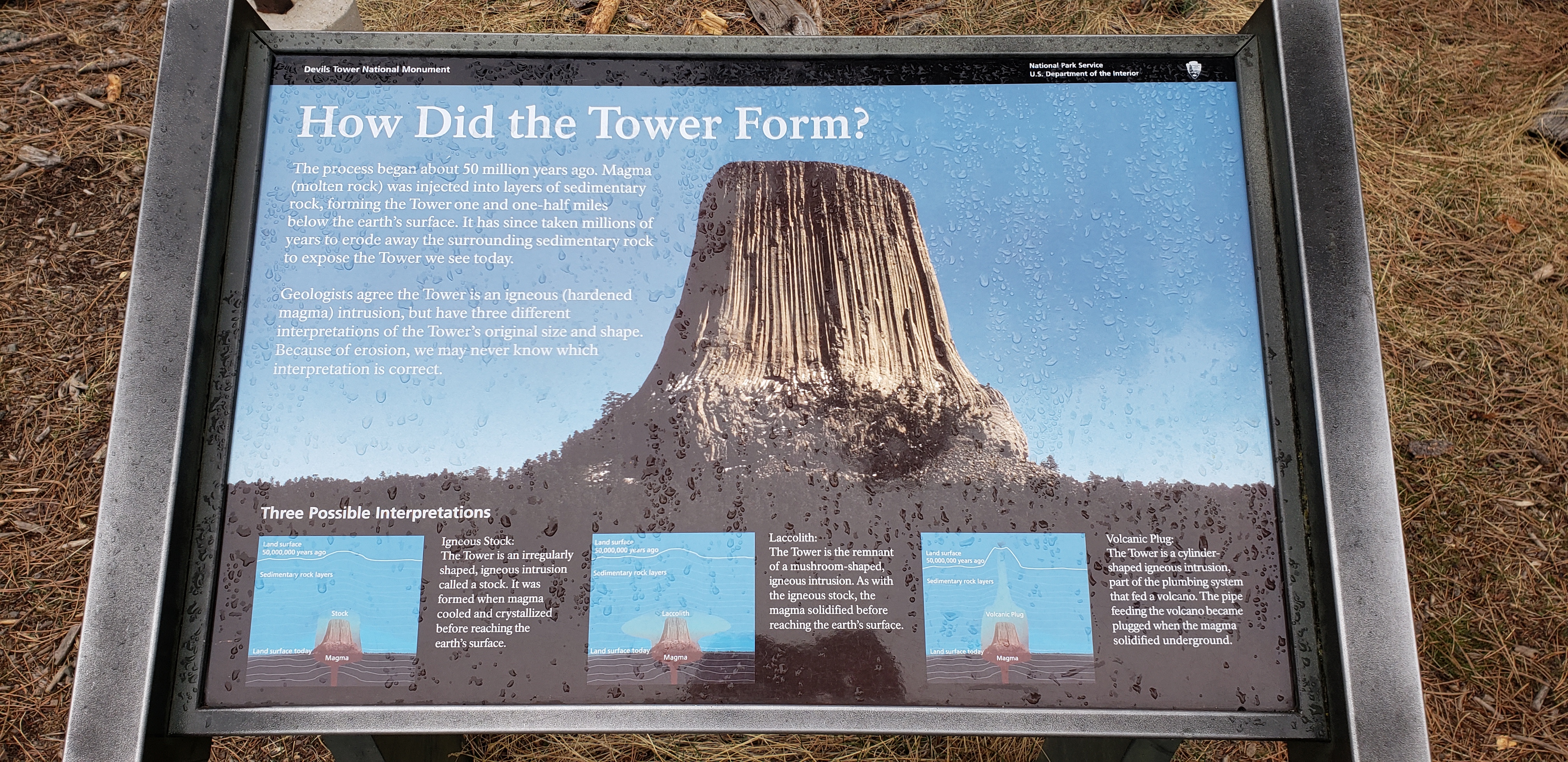
The tower is a laccolith, formed when molten magma pushed up through sedimentary rock about 65 million years ago. As the magma cooled, it contracted and cracked into the distinctive polygonal columns that characterize the tower today. These columns of phonolite lava resemble the columnar basalt at Ireland's Giant's Causeway and California's Devils Postpile. Over millions of years, erosion stripped away the softer sandstones and shales that once buried the intrusion, leaving the hardened core exposed. The tower continues to erode, shedding columns that pile as rubble at its base.
Sacred Ground
For the Lakota, Arapaho, Shoshone, Cheyenne, and Crow peoples, this place remains sacred. Tribal members make pilgrimages here to conduct ceremonies, from sweat lodges to sun dances. Prayer offerings appear along the trails as colorful cloths and bundles tied to trees, each representing a personal connection between an individual and this ancient stone. These offerings are as sacred as ceremonial objects in any religion and should never be disturbed. The Park Service asks visitors to observe a voluntary climbing closure each June out of respect for these traditions.
Close Encounters
Steven Spielberg's production designer Joe Alves was scouting locations across the American West in 1976 when he stumbled upon Devils Tower. The obscure park with its otherworldly monolith proved perfect for Close Encounters of the Third Kind, where the tower served as the alien-human rendezvous point. The 1977 film transformed the monument from a regional curiosity into an international icon. Today the tower sits roughly midway between Mount Rushmore and Yellowstone, making it a natural waypoint for travelers exploring the Northern Great Plains.
The Living Landscape
Prairie falcons nest on the tower's upper reaches, leading to seasonal closures of some climbing routes. Prairie dog colonies populate the meadows along the approach roads, though visitors are warned to keep their distance due to plague risk. The surrounding Ponderosa pine forest appears monotonous, a consequence of decades of fire suppression that allowed these trees to crowd out other species. The Park Service now conducts prescribed burns to restore the diverse ecosystem that once flourished here, bringing back the sunlight that smaller plants need to thrive.
From the Air
Located at 44.59N, 104.72W in Crook County, northeastern Wyoming. The tower rises 867 feet from its base and stands at 5,112 feet elevation. Best viewed from the northwest where the Belle Fourche River curves past the monument. Nearest airports: Gillette-Campbell County Airport (KGCC), 60 miles west; Rapid City Regional (KRAP), 100 miles east in South Dakota. Clear weather provides visibility from cruising altitude across the rolling prairie landscape.