Devipuram
A nuclear physicist walks away from a twenty-three-year career at the Tata Institute of Fundamental Research in Mumbai. He travels to a hillock near Visakhapatnam, meditates, and begins to dig. From the earth he unearths a Sri Chakra Maha Meru made of panchaloha -- a five-metal alloy -- at a spot where, he later learns, a massive fire ritual was performed more than two hundred and fifty years earlier. This is the founding story of Devipuram, a temple complex that its creator, Dr. N. Prahalada Sastry, built not from architectural blueprints but from meditative visions of the goddess Sahasrakshi, "she who has infinite eyes."
A Temple You Walk Into Like a Prayer
The Sahasrakshi Meru Temple is unlike any other Hindu temple in India. Measuring 108 feet square at its base and rising 54 feet high, the three-story structure is built in the shape of a Sri Meru Yantra -- the three-dimensional projection of the Sri Chakra, the sacred geometric diagram central to Srividya worship, an ancient and intricate form of Tantric Shakta devotion. To reach the innermost sanctum, devotees do not simply walk through a door. They circumambulate inward and upward, spiraling past more than one hundred life-sized stone murthis of shaktis and yoginis -- deities that Srividya cosmology says inhabit and energize the Sri Chakra. Each figure was sculpted to Sastry's specifications, physical manifestations of what he described as meditative visions. Two companion shrines, the Kamakhya Peetham and Sivalayam, stand on adjacent hills.
The Physicist and the Goddess
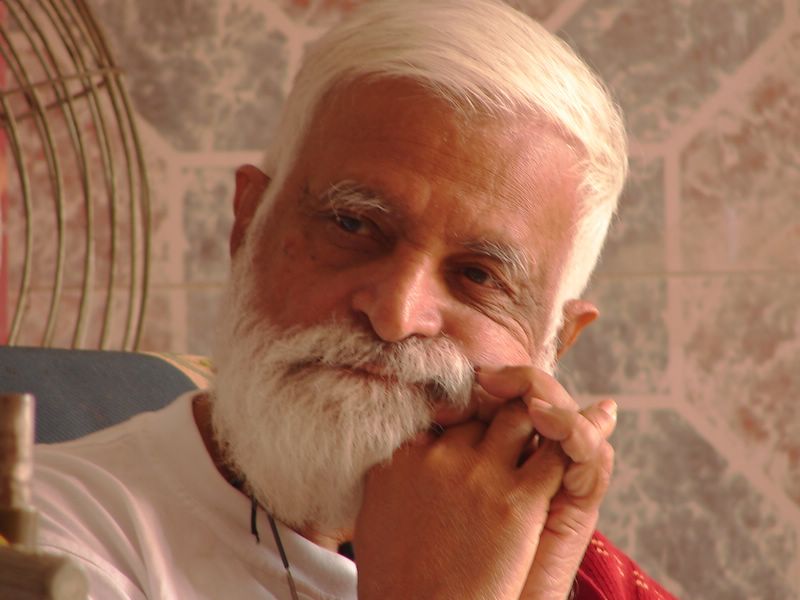
Sastry -- known to his followers as Sri Amritananda Natha Saraswati, or simply Guruji -- was born in 1934 and spent more than two decades in nuclear physics before turning to spiritual life. In 1983, during a Devi Yajna ceremony, members of the Putrevu family approached him with a request to build a temple for the Divine Mother, donating three acres of land near Visakhapatnam. Sastry purchased ten adjoining acres and began looking for a sign. He found it on a nearby hillock: a natural rock formation resembling the sacred yoni of the Kamakhya temple in Assam. Construction of the Sahasrakshi Meru Temple began in 1985. Nine years later, in 1994, the temple was completed and consecrated. It was re-consecrated for its twelfth anniversary in February 2007. Sastry died in 2015, having decreed that no human successor would lead Devipuram -- only the symbolic padukas of the goddess, administered by the Sri Vidya Trust.
Where Caste and Gender Fall Away
Devipuram breaks with convention in a way that draws both admiration and controversy. Any devotee, regardless of caste, creed, or gender, may perform puja to the Devi directly -- no priestly intermediary required. This open-access approach may echo the practices of the Kamakhya temple complex in Assam, but in the context of mainstream Hindu worship, it remains unusual. Many of the temple's murthis are depicted sky-clad -- unclothed -- a feature that has attracted attention over the years but reflects Tantric traditions of the divine feminine. The temple has become particularly significant for women. Through its community, women who have lost the social anchoring of India's traditional multi-generational household find new roles and purpose. A common saying among devotees captures the philosophy: "I am Devi, you are Devi, we are Devi."
Beyond the Sanctum
Devipuram has grown beyond a place of worship into something closer to a social enterprise. Sastry founded the Sri Vidya Trust, a nonprofit organization headquartered at the complex, which runs developmental programs in non-formal education, women's empowerment, and low-cost housing for the rural poor. A cooperative thrift society called Jagruti provides micro-financing to local villagers. Geodesic dome houses built with fire-retardant materials demonstrate affordable rural construction. Health and hygiene workshops, family planning programs, and literacy drives extend into the surrounding countryside. The trust also produces precision-made Meru yantras and educational materials for spiritual practitioners worldwide. In 2010, the Sri Villa guest house opened with rooms, a cafeteria, event halls, and family suites, positioning Devipuram as a pilgrimage destination that can accommodate the growing number of visitors drawn to its singular combination of sacred geometry, open worship, and social mission.
From the Air
Located at 17.77N, 83.08E on a hillock near Visakhapatnam in Andhra Pradesh. The temple complex is situated inland from the coast among low hills. Visakhapatnam Airport (ICAO: VOVZ) is approximately 20 km to the east-southeast. At low altitude, the distinctive three-story pyramidal form of the Sahasrakshi Meru Temple may be visible amid the surrounding vegetation and smaller shrine structures on adjacent hilltops. The area is rural with scattered villages and paddy fields.