The Tala site in Chhattisgarh is a collection of major Hindu temples and ruins from the early 6th century (c. 525 CE), making it one of the oldest known Hindu monuments in Chhattisgarh that have survived into the modern age. Before 1950, colonial era British and Indian archaeologists knew of scattered ruins and a large mound at Tala. The site was finally excavated and studied in the late 1970s through 1980s, thus unearthing the scale and significance of the Tala site.
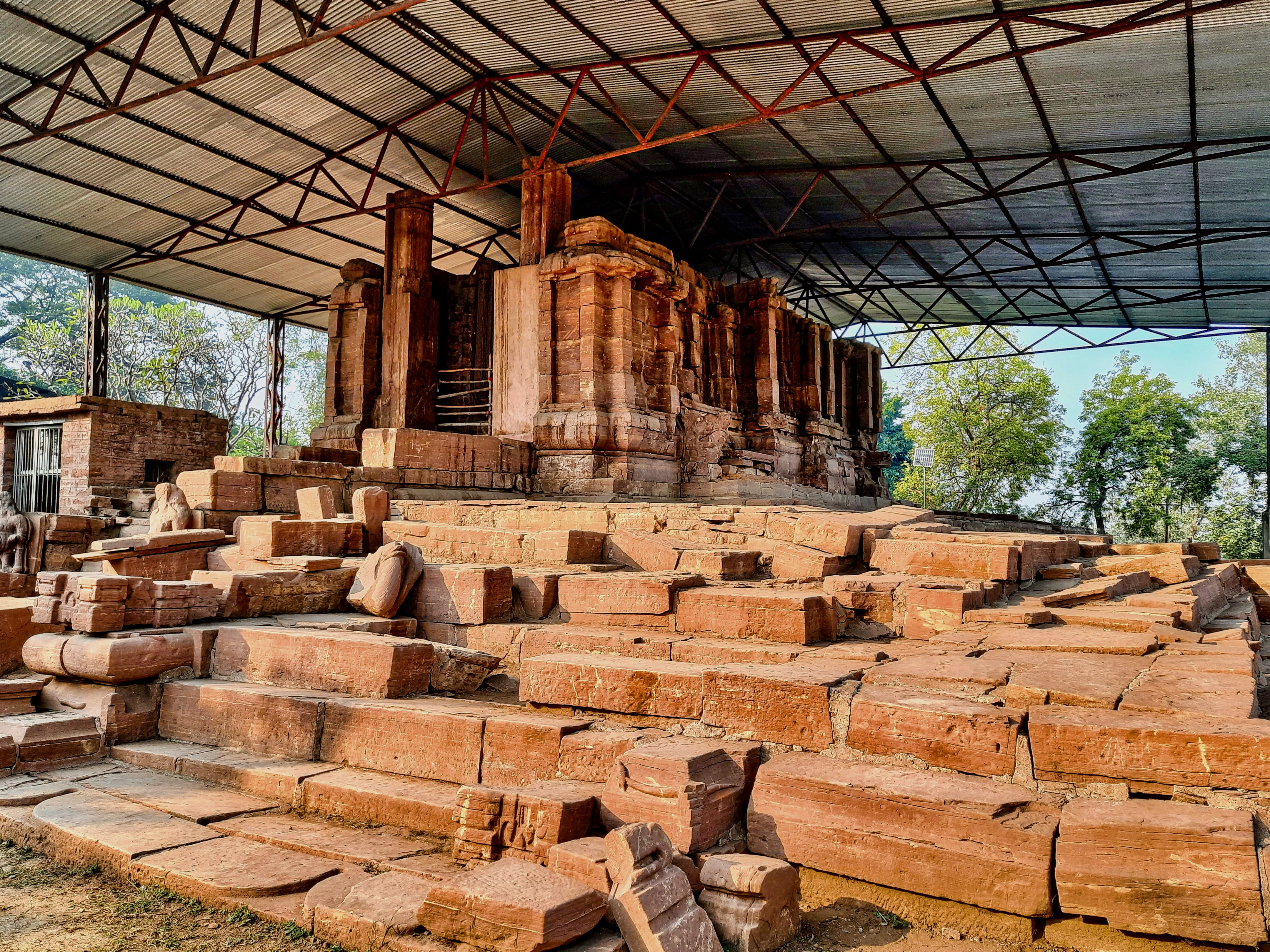
The Devrani Jethani temples site is located on the eastern banks of the Maniyari river, near a Hindu pilgrimage site and collection of modern era temples. The historic site consist of two temples made from sandstone. The larger Jethani temple is mostly in ruins. The smaller Devrani temple is more intact but also ruined. They are next to each other, and their modern era names mean "elder daughter-in-law" and "younger daughter-in-law" in many Indian languages, signifying that they are housed together, related and yet one is bit older and bigger. Both temples are under a shed (added in the 2010s) to prevent erosion from rain. A small museum at the site holds some of the better preserved 6th-century sculpture of Shaivism, Vaishnavism, Shaktism traditions, as well as Vedic deities.
The Jethani temple is quite large, spreads over 10000 square feet, with a platform and four stepped entrances. Huge damaged and fallen pillars, life size to larger than life size statues, naturally eroded structures, and some deliberately damaged Hindu artwork is visible. Of these, the bharavahakas (sculpted weight bearers below structural elements) are impressive as they facial expressions humorously show the dwarfs feeling the pressure of massive structure above them.
The better preserved Devrani temple is the oldest standing Hindu temple that can reliably dated to be from the ancient Kosala region mentioned in Indian epics. The dating is based on short inscriptions found here in a script style that existed prior to the 7th century. Further, the artwork here are of the quality found in some Gupta era sites in Madhya Pradesh and Vakataka era sites in eastern Maharashtra – both known to have flourished between the 3rd and 6th centuries. Thus, the Tala site has contributed a better understanding of art, Hindu iconography and creative innovation by about 550 CE in central and Deccan region of ancient India.
Tala enigmatic statue – a masterpiece of innovative creativity was unearthed in 1988. It is a stone statue about 5 tons in weight and larger than life (8 feet high), from a single rock, very likely produced at site with the temple. The exceptional aspect of the statue is that most of the man's visible body parts are other living beings. Snakes form his hair and a turban, a lizard forms his nose, lizard's hind legs form the brows, a frog his eyes, two fishes form his moustache, a crab shapes his chin and lip, two peacocks help form his ears, busts of two crocodiles shape his shoulder, a turtle his penis (in urdhvareta form, or ithyphallic), two lion cubs form his two knees, and so on. From fingers to toes, from a carefully interrelated fusion of living beings emerges the shape of a well built man. Further, many faces are carved on his chest and stomach. Since its discovery in 1988, scholars have offered many interpretations as to what this statue represents and signifies, particularly in light of the fact that it too is dated to early 6th century. Some suggest it to be a form of Shaiva and Vaishnava Hindu traditions, particularly Sadashiva, Matsya, Kurma, Narasimha and others avatars. An alternate theory is that the creature forms selected may be the vahanas of Hindu gods and goddesses, the artist thus implies and fuses the many gods and goddesses carried into one within the human form. There is no consensus yet. This Tala enigmatic statue stands in front of the Devrani temple and to the left of the steps that lead to its platform. This is where it was found.

The temple ruins, various artwork including the enigmatic statue attract reverential offerings and treated as a place for worship from the regional Hindus. It is also a tourist attraction, well connected with modern highways. The site is a declared national monument, under the protection and management of the ASI.
The Tala site in Chhattisgarh is a collection of major Hindu temples and ruins from the early 6th century (c. 525 CE), making it one of the oldest known Hindu monuments in Chhattisgarh that have survived into the modern age. Before 1950, colonial era British and Indian archaeologists knew of scattered ruins and a large mound at Tala. The site was finally excavated and studied in the late 1970s through 1980s, thus unearthing the scale and significance of the Tala site. The Devrani Jethani temples site is located on the eastern banks of the Maniyari river, near a Hindu pilgrimage site and collection of modern era temples. The historic site consist of two temples made from sandstone. The larger Jethani temple is mostly in ruins. The smaller Devrani temple is more intact but also ruined. They are next to each other, and their modern era names mean "elder daughter-in-law" and "younger daughter-in-law" in many Indian languages, signifying that they are housed together, related and yet one is bit older and bigger. Both temples are under a shed (added in the 2010s) to prevent erosion from rain. A small museum at the site holds some of the better preserved 6th-century sculpture of Shaivism, Vaishnavism, Shaktism traditions, as well as Vedic deities. The Jethani temple is quite large, spreads over 10000 square feet, with a platform and four stepped entrances. Huge damaged and fallen pillars, life size to larger than life size statues, naturally eroded structures, and some deliberately damaged Hindu artwork is visible. Of these, the bharavahakas (sculpted weight bearers below structural elements) are impressive as they facial expressions humorously show the dwarfs feeling the pressure of massive structure above them. The better preserved Devrani temple is the oldest standing Hindu temple that can reliably dated to be from the ancient Kosala region mentioned in Indian epics. The dating is based on short inscriptions found here in a script style that existed prior to the 7th century. Further, the artwork here are of the quality found in some Gupta era sites in Madhya Pradesh and Vakataka era sites in eastern Maharashtra – both known to have flourished between the 3rd and 6th centuries. Thus, the Tala site has contributed a better understanding of art, Hindu iconography and creative innovation by about 550 CE in central and Deccan region of ancient India. Tala enigmatic statue – a masterpiece of innovative creativity was unearthed in 1988. It is a stone statue about 5 tons in weight and larger than life (8 feet high), from a single rock, very likely produced at site with the temple. The exceptional aspect of the statue is that most of the man's visible body parts are other living beings. Snakes form his hair and a turban, a lizard forms his nose, lizard's hind legs form the brows, a frog his eyes, two fishes form his moustache, a crab shapes his chin and lip, two peacocks help form his ears, busts of two crocodiles shape his shoulder, a turtle his penis (in urdhvareta form, or ithyphallic), two lion cubs form his two knees, and so on. From fingers to toes, from a carefully interrelated fusion of living beings emerges the shape of a well built man. Further, many faces are carved on his chest and stomach. Since its discovery in 1988, scholars have offered many interpretations as to what this statue represents and signifies, particularly in light of the fact that it too is dated to early 6th century. Some suggest it to be a form of Shaiva and Vaishnava Hindu traditions, particularly Sadashiva, Matsya, Kurma, Narasimha and others avatars. An alternate theory is that the creature forms selected may be the vahanas of Hindu gods and goddesses, the artist thus implies and fuses the many gods and goddesses carried into one within the human form. There is no consensus yet. This Tala enigmatic statue stands in front of the Devrani temple and to the left of the steps that lead to its platform. This is where it was found. The temple ruins, various artwork including the enigmatic statue attract reverential offerings and treated as a place for worship from the regional Hindus. It is also a tourist attraction, well connected with modern highways. The site is a declared national monument, under the protection and management of the ASI.

Devrani Jethani Temple Complex

6th-century Hindu templesArchaeological sites in ChhattisgarhHindu temples in Chhattisgarh
4 min read

A lizard forms the nose. Frogs make the eyes. Peacocks serve as ears, a crab shapes the chin, and two fish curl into a moustache. Standing 2.7 meters tall and weighing five tonnes, the enigmatic statue unearthed in 1988 from beneath the Devrani temple at Tala, Chhattisgarh, is unlike anything else in Indian sculpture. Every part of its body is composed of animals or human faces -- crocodile-shaped makara shoulders, elephant-trunk legs, lion-head knees, a tortoise forming the phallus -- yet the whole reads as a single imposing figure, arms resting on a snake-belt waistband, staring straight ahead with those amphibian eyes. Scholars have spent decades arguing over what it represents. Most call it Rudra Shiva. Some say Pashupati, lord of animals. Others identify it as a yaksha or a gana, an attendant of Shiva. The statue keeps its own counsel.

The Younger and the Elder

The two temples at Tala are known locally as Devrani and Jethani -- the younger sister-in-law and the elder sister-in-law. The names reflect their relative sizes and conditions, not any documented family relationship. The Devrani temple, the smaller and better-preserved of the pair, retains its shrine, antechamber, and pavilion, all built from carefully cut ashlar stone, though its shikhara tower has been lost. The Jethani temple is the larger ruin, its plan readable only from the pillars and sculptural fragments scattered across the site. Art historian Donald Stadtner dates both temples to approximately 525-550 CE, during the reign of the Sharabhapuriya dynasty, making them among the oldest surviving Hindu monuments in Chhattisgarh. Indologist Hans Bakker argues that the Jethani came first -- its experimental, unconventional structure may have contributed to its eventual collapse.

A Bestiary in Stone

The Rudra Shiva statue demands close attention. Stand before it and the details compound. The jata turban is two intertwined snakes. The eyebrows are the hind legs of the lizard-nose. Seven human heads appear across the body: two mustached male faces form the chest, a large male head constitutes the abdomen, and each thigh carries a pair of female faces, one forward-looking with folded hands in anjali mudra, one turned to the side. The figure stands in samapada, feet together, its composure at odds with the carnival of creatures composing its form. When the Archaeological Survey of India excavated the statue from beneath the Devrani temple's doorway in 1988, it arrived without explanation. No inscription identifies it. Its position near the entrance suggests it may have served as a dvarapala, a door guardian -- which would make it the most extraordinary guardian figure in all of Indian temple architecture.

The Temple That Fell

The Jethani temple's ruins tell a story of ambition exceeding engineering. Brick buttresses line the base, and on the northern side, two large stone elephants were positioned to bear structural weight -- probably added in a desperate attempt to prevent the collapse that eventually came anyway. The temple had three entrances facing south, east, and west, with the main approach ascending a flight of stone steps from the south. Shaivite sculptures found among the rubble -- Kartikeya, Ardhanarishvara, Nandi, and Shiva himself -- confirm the temple's dedication. Three large stone amalakas, the ribbed disc-shaped elements that crown north Indian temple towers, lie among the debris. If these belonged to the superstructure, the Jethani temple followed a north Indian architectural tradition, while the Devrani temple next to it shows distinct south Indian influences. Two temples standing side by side, built in the same era, drawing from opposite ends of the subcontinent's architectural vocabulary.

Where North Meets South

This architectural duality is what makes the Tala complex significant beyond its famous statue. The Dakshina Kosala region -- literally "Southern Kosala" -- sat at a cultural crossroads in the 6th century, absorbing influences from the Gupta heartlands to the north and the Deccan kingdoms to the south. The Devrani temple's style carries echoes of Dravidian architecture, while the Jethani's amalakas and structural approach align with Nagara traditions. The sculptural program reinforces this fusion: makara crocodiles of southern temple tradition appear alongside gana figures more typical of northern Shaivite art. Fragments from the site now reside in the Bilaspur Museum, where they continue to invite scholarly debate about the artistic networks that connected central India's temple-building cultures fifteen centuries ago.

Still Guarding the Door

A protective shed now covers the Rudra Shiva statue where it was found, in situ beside the Devrani temple's eastern entrance. The Archaeological Survey of India manages the site, which sits near the Maniari River in Bilaspur district. The statue has become the unofficial emblem of Chhattisgarh's cultural heritage, reproduced on tourism materials and studied in art history courses worldwide. Yet it remains genuinely mysterious. The combination of animal forms, human faces, and ithyphallic energy does not map neatly onto any known iconographic program. Hans Bakker's suggestion that it represents a gana, one of Shiva's wild attendants, may come closest to capturing its spirit -- a figure from the divine retinue so charged with creative force that no single species could contain it.

From the Air

Located at 21.907N, 82.026E near the village of Tala in Bilaspur district, Chhattisgarh, along the Maniari River. The nearest airports are Bilasa Devi Kevat Airport at Bilaspur (VEBU), approximately 30 km to the northeast, and Swami Vivekananda Airport at Raipur (VERP), approximately 85 km to the south. From the air, the site appears as a clearing with temple ruins near the river. Best viewed at 2,000-4,000 feet AGL in clear weather to distinguish the two temple platforms and the protective shed over the Rudra Shiva statue.