Dewa Sanzan
Somewhere on the slopes of Mount Yudono, behind a gate that forbids cameras and loose tongues, pilgrims encounter something so sacred that describing it to outsiders is prohibited. This vow of silence has held for centuries. The secret of Yudonosan Shrine is one piece of a larger spiritual puzzle spread across three mountains in Yamagata Prefecture -- the Dewa Sanzan, or Three Mountains of Dewa -- where Shinto, Buddhism, and the mountain ascetic tradition of Shugendo have intertwined since the year 593. The sound that announces this place is not a temple bell but a conch shell, blown by yamabushi practitioners in white robes as they climb through cedar forests older than most nations.
A Prince's Refuge Becomes Japan's Oldest Mountain Shrine
The story of Dewa Sanzan begins with a fugitive prince. In 593, Prince Hachiko -- the first-born son of Emperor Sushun, the 32nd emperor of Japan -- fled to the remote province of Dewa after his father was assassinated by the powerful Soga clan. Rather than seek revenge, Hachiko devoted himself to spiritual practice in the mountains. Through grueling ascetic exercises, he came to worship Haguro Gongen, the deity of Mount Haguro, then extended his devotion to Mount Gassan and Mount Yudono. He enshrined all three deities at the temple on Mount Haguro's summit, establishing what would become the oldest center of mountain worship in Japan. Over the centuries, pilgrims trekked thousands of miles to reach these shrines during the summer months, including En no Gyoja, the founder of Shugendo asceticism, and Kukai, who established the Shingon Buddhist sect.
2,446 Steps Through Ancient Cedar
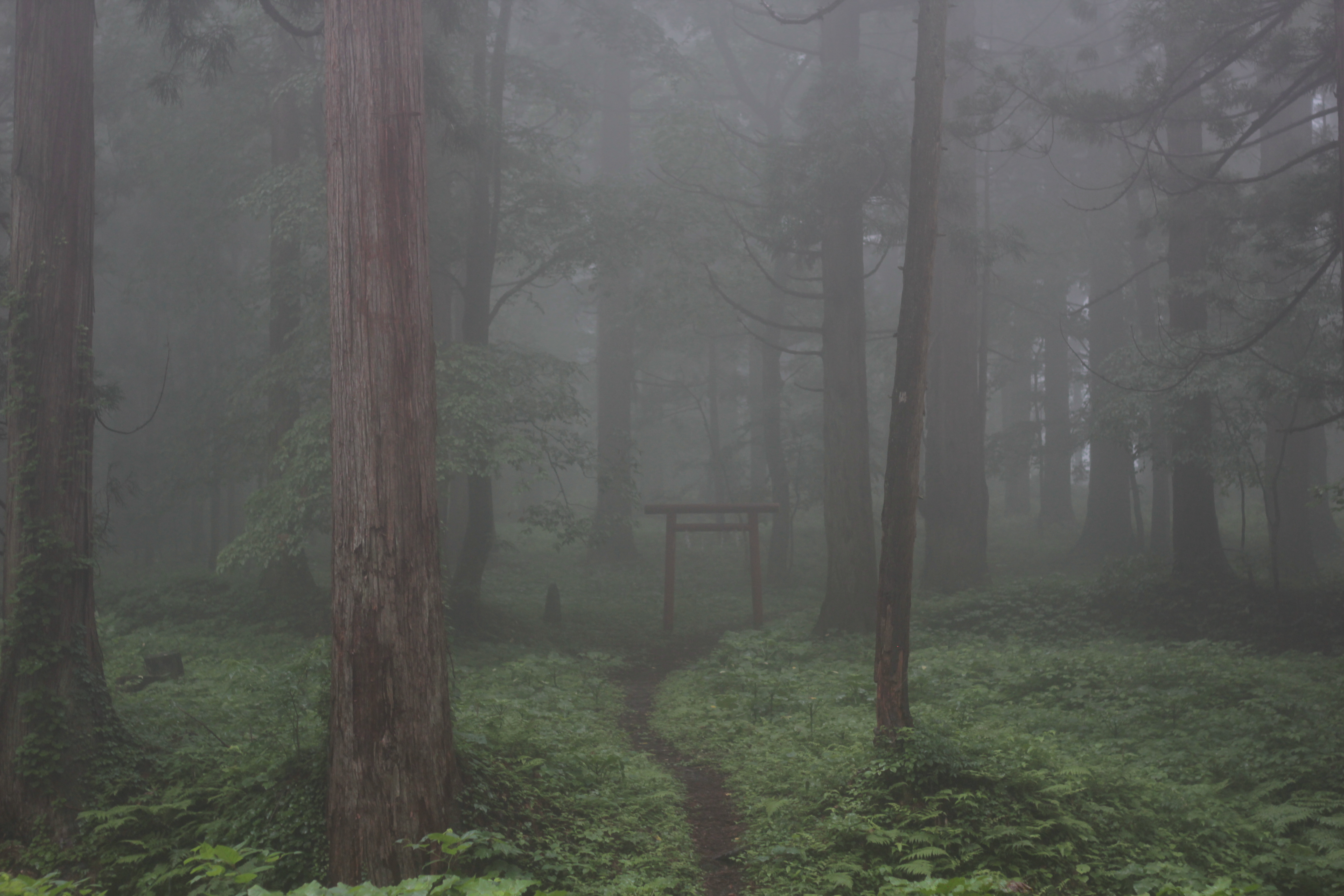
Mount Haguro stands at only 414 meters, the smallest of the three peaks, yet it delivers the most iconic approach. From the base, a stone-paved trail winds through dense forest to reach the Goju-no-to, a five-story wooden pagoda built roughly 600 years ago and designated a National Treasure of Japan. Beyond it, 2,446 stone steps begin their relentless climb through towering Japanese cedar. The ascent takes about an hour at a steady pace, with a teahouse at the halfway point where climbers can catch their breath and collect a certificate for making it this far on foot. The great haiku poet Matsuo Basho paused here during his famous Narrow Road to the Deep North journey to compose verse. At the top, the trail simply flattens out. Past a torii gate, the Sanzan Gosaiden appears -- the main shrine that venerates the spirits of all three mountains in one hall. Mount Haguro is the only peak accessible year-round, making it the gateway for pilgrims who cannot reach the snow-buried summits of Gassan and Yudono.
Into the Mist on Gassan
Mount Gassan rises to 1,984 meters, the tallest of the three, and its upper slopes belong to a different world. Buses deliver hikers to the Eighth Station at around 1,400 meters, where a two-and-a-half-hour climb through rolling highland plains -- often shrouded in thick mist -- leads to the summit. Rare alpine plants and marsh grasses carpet the terrain, and the weather shifts fast: high-speed wind gusts, slippery rock, and plunging temperatures near the top can turn a clear morning dangerous by noon. At the peak sits the spare, simple Gassan Shrine, where a resident Shinto priest performs a purification ritual for each arriving pilgrim. The mountain is typically accessible only from late spring through early fall, with heavy snowfall sealing the trails for the rest of the year. Gassan's peak is the second-highest point in the Shonai region, and the views on a clear day stretch across a landscape that has drawn worshippers for fourteen centuries.
The Mountain That Keeps Its Secret
The trail from Gassan's summit descends toward Mount Yudono on a path that grows increasingly steep, in places requiring steel ladders bolted into rock. After about an hour and twenty minutes of careful descent, pilgrims reach Yudonosan Shrine, considered the holiest of the three. Mount Yudono is regarded as the spiritual heart of Dewa Sanzan -- many yamabushi believe their pilgrimage is incomplete until they stand here. The shrine possesses a goshintai, a sacred object believed to be directly connected to a deity, and the entire precinct is treated as hallowed ground. Photography and video are strictly prohibited, and pilgrims are honor-bound not to describe what they witness. This tradition of sacred secrecy persists today, unbroken. Nearby, the temples of Dainichibou and Churenji in the village of Oami offer their own remarkable encounters with Shugendo history for those with time between infrequent buses.
Living Tradition in White Robes
The Meiji Restoration of 1868 nearly destroyed Shugendo when the government separated Shinto and Buddhism and made Shinto the state religion. Many Shugendo priests left religious life entirely. But after World War II, the tradition was permitted to resume as a minor religious group, and today it thrives again on these mountains. Each summer, yamabushi in white robes -- laymen practitioners who undergo the same ascetic disciplines their predecessors endured for centuries -- make their way across all three peaks. The pilgrimage town of Haguro-machi at the mountain's base hosts over 30 shukubo, traditional temple lodgings where pilgrims sleep on tatami mats, eat vegetarian monk's cuisine, and rise early for morning prayers. The cycle of opening and closing the mountain shrines each season is still marked with festivals, and the blast of a conch shell still echoes through cedar forests that have witnessed this ritual longer than almost any other place in Japan.
From the Air
Located at 38.70N, 140.00E in Yamagata Prefecture, northern Honshu. The three peaks cluster together: Mount Haguro (414m) is the lowest and most accessible, Mount Gassan (1,984m) is the tallest, and Mount Yudono sits between them. From the air, the mountains form a distinctive group in the southern Dewa Mountains. Nearest airports: Shonai Airport (RJSY) approximately 15nm west, Yamagata Airport (RJSC) approximately 45nm southeast. The mountains are often shrouded in mist and cloud, particularly Gassan's upper slopes. Best visibility in autumn months. The Sea of Japan coastline is visible to the west, and the Shonai Plain spreads between the mountains and the coast.