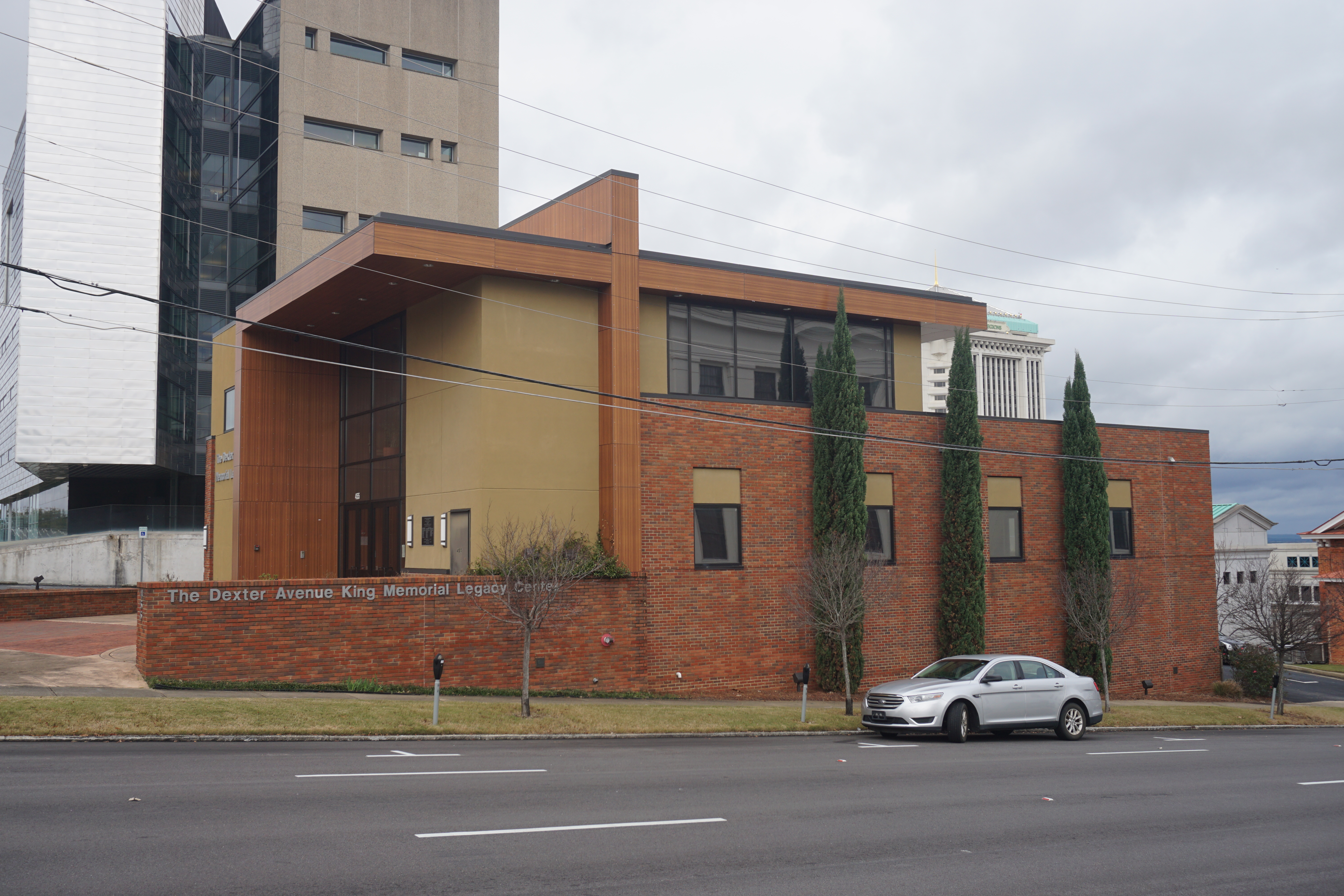
Dexter Avenue Baptist Church: The Basement Where a Boycott Was Born
The distance from the front steps of the Alabama State Capitol to the doors of Dexter Avenue Baptist Church is roughly one city block. That short stretch of sidewalk is one of the most loaded pieces of ground in America. Jefferson Davis took the Confederate oath at one end; at the other, a 26-year-old pastor named Martin Luther King Jr. organized a bus boycott that changed the nation. The church sits there still, red brick and Gothic arches, defiantly close to the seat of power it spent a century challenging.
Built by the Formerly Enslaved
The congregation came together in 1877, organized by freedmen and free people of color who named it the Second Colored Baptist Church. Their founding pastor was Charles Octavius Boothe. Two years later, in 1879, the church trustees paid $270 for a lot at the corner of Dexter Avenue and Decatur Street, where they first raised a small wood-frame building. Construction of the current brick structure began in 1883 and took six years to complete. By 1887 the church was already serving the wider Black community: on October 3 of that year, it hosted the first student registration for Alabama State University, a historically Black institution. The building that freedmen raised from nothing became an anchor for a people building institutions of their own.
The Preacher Before King
Before Martin Luther King Jr. arrived, there was Vernon Johns. Pastor of Dexter Avenue from 1947 to 1952, Johns was brilliant, volatile, and fearless. He preached sermons with titles designed to provoke -- 'Segregation after Death' and 'When the Rapist Is White' -- and once walked off a Montgomery city bus in protest of its segregated seating, demanding his fare back. Johns pushed his middle-class congregation to confront Jim Crow directly, and that friction eventually led to his departure. But the ground he broke mattered. King himself described Johns as 'a brilliant preacher with a creative mind' and 'a fearless man who never allowed an injustice to come to his attention without speaking out against it.' When King accepted the pastorate in 1954, he inherited a church that had already been primed for resistance.
381 Days of Walking
On December 1, 1955, Rosa Parks refused to surrender her bus seat. Four days later, the Montgomery bus boycott began. King, newly installed as Dexter Avenue's pastor, organized much of the effort from his basement office in the church. He was 26 years old. The boycott was a logistical feat: roughly 40,000 Black residents of Montgomery found alternative transportation -- carpools, taxis, and their own feet -- for 381 days. The response was violent. King's parsonage was bombed on January 30, 1956, with his wife Coretta and their seven-week-old daughter Yolanda inside; both survived. In November 1956, the Supreme Court ruled bus segregation unconstitutional. The boycott that started in a church basement had won.
Landmark and Legacy
In 1974 the church was designated a National Historic Landmark for its role in the civil rights movement. Four years later it was renamed the Dexter Avenue King Memorial Baptist Church in honor of its most famous pastor. In 2008, the United States government submitted the church to UNESCO as part of a prospective World Heritage Site nomination -- placing a congregation founded by formerly enslaved people alongside the pyramids and cathedrals of the world. The church remains an active congregation. Visitors who step inside find the basement office where King worked, the pulpit where Johns thundered, and the sanctuary where ordinary people decided they would no longer ride the bus until they could ride it as equals.
From the Air
Located at 32.377N, 86.303W in downtown Montgomery, Alabama, directly adjacent to the Alabama State Capitol dome on Goat Hill. The red-brick church is visible along Dexter Avenue, the boulevard connecting the Capitol to the commercial district. Nearest airport: Montgomery Regional Airport (KMGM), approximately 7 nm southwest. Best viewed at 2,000-3,000 feet AGL. The Capitol dome, Alabama River bend, and Alabama State University campus are nearby visual references.
Sources
- Dexter Avenue Baptist Church - Wikipedia
- Dexter Avenue King Memorial Baptist Church History
- EJI Calendar - King Home Bombed January 30, 1956
- King Institute - Vernon Johns
- Wikipedia - Montgomery bus boycott
- UNESCO Tentative List - Civil Rights Movement Sites
- Dexter Avenue King Memorial Baptist Church - Former Pastors