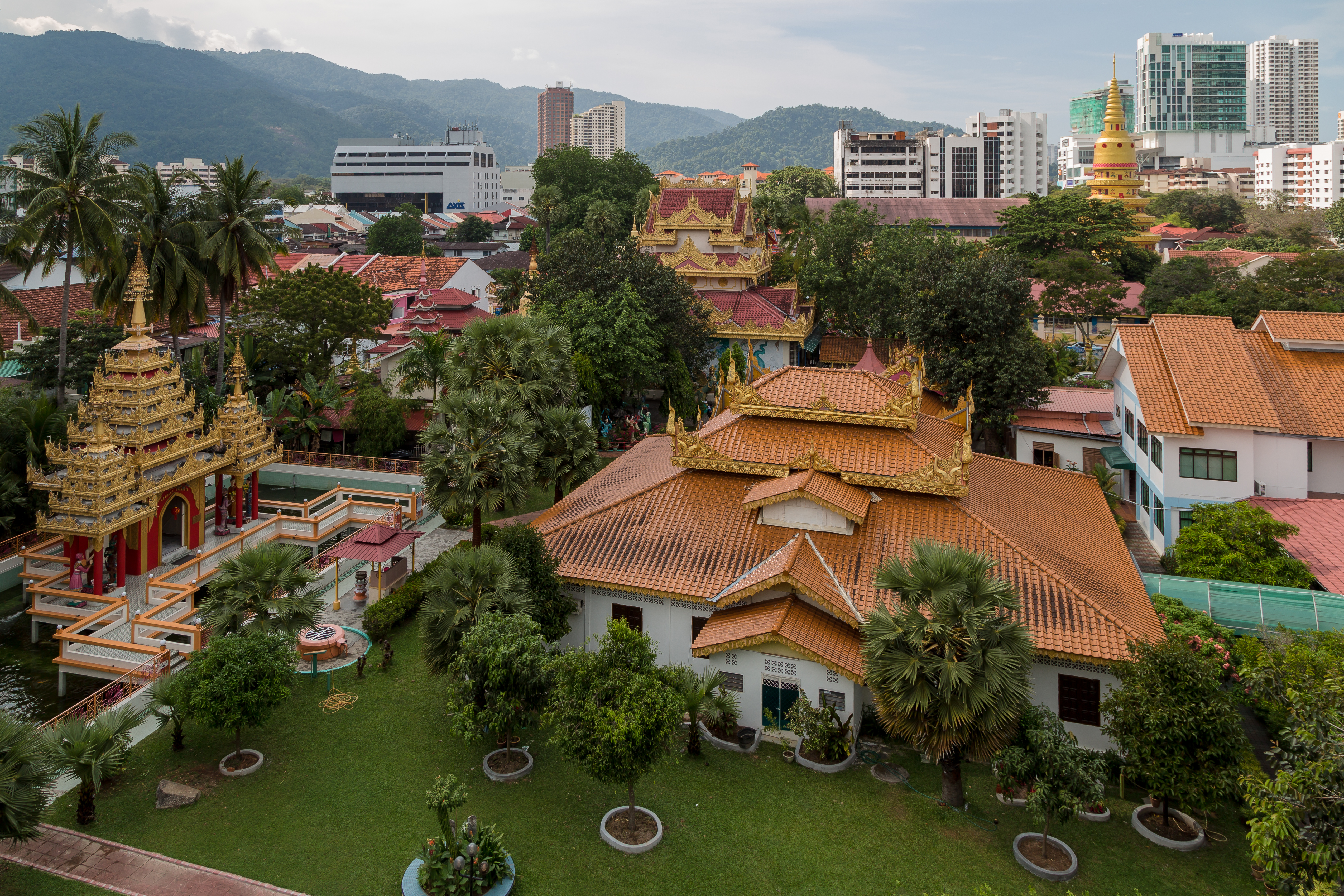
Dhammikarama Burmese Temple
On Lorong Burma in George Town, two religious traditions face each other across the road. On one side stands Wat Chayamangkalaram, a Thai Buddhist temple famous for its enormous reclining Buddha. On the other, Dhammikarama Burmese Temple -- the only Burmese temple in the entire state of Penang -- offers something quieter, more layered, and deeply rooted in a diaspora community that settled here more than two centuries ago. Established around 1803 as a kyaung, or monastery, Dhammikarama is both a working religious retreat and a transplanted piece of Myanmar in the heart of Malaysia.
Guardians at the Gate
Visitors entering Dhammikarama encounter its mythological inhabitants before they encounter its monks. Stone chinthe -- the lion-like guardian figures found at the entrance of Burmese temples -- flank the approach. Inside the compound, statues of elephants, fish, and the winged garuda are scattered among gardens and walkways, representing what the temple calls the three realms of land, air, and sea. The Panca Rupa, winged chimeras known as the Guardian Protectors of the World, stand watch near the temple buildings. These are not decorative afterthoughts. In Burmese Buddhist tradition, the physical landscape of a temple mirrors the cosmological structure of the universe, and every creature placed within the grounds serves a symbolic purpose -- marking thresholds between the mundane world outside and the sacred space within.
Gold, Lacquer, and Imported Hands
The shrine hall, last renovated in 1995, houses a standing Buddha with a gold-gilded backdrop of intricate carvings. The ceiling above is covered in fine lacquerwork stained a deep brown, a technique that requires patient skill and materials specific to the Burmese craft tradition. Alongside the main figure stand two companion statues, one of them depicting Arahant Khema, a female disciple of the Buddha revered for her wisdom. What distinguishes Dhammikarama from temples that merely reference Burmese style is its commitment to authenticity. Artisans were brought from Myanmar specifically to construct the temple's pagoda and decorative elements, ensuring that every arch, spire, and carved panel reflects genuine Burmese architectural practice rather than a local interpretation of it. The result is a building that could sit comfortably in Mandalay or Bagan.
A Living Monastery
Dhammikarama is not a museum or a tourist attraction that happens to look like a temple. It functions as a working Theravada Buddhist monastery, with monks' quarters, a preceptees' lodge for those undertaking temporary ordination or intensive meditation retreats, and a library. The daily rhythms of monastic life -- morning alms, chanting, meditation, study -- continue here as they have since the early nineteenth century. For visiting Buddhists, the temple offers a place of genuine practice rather than spectacle. The grounds are maintained with careful gardening that blends tropical foliage with the temple's architectural formality, creating an atmosphere that feels both cultivated and contemplative.
Festival Crossroads
Throughout the year, Dhammikarama serves as a gathering point for George Town's Burmese community and for Buddhists of all backgrounds. The temple is a focal point for the annual Water Festival and Thingyan, the Burmese New Year celebration held in April, when joyful crowds drench each other to wash away the old year's misfortunes. The Mid-Autumn Festival also draws visitors to the temple grounds. During Vassa -- the Buddhist Lent, a three-month rainy season retreat when monks remain within their monastery -- the temple takes on a more introspective character, its rhythms slowing as residents commit to intensive study and meditation. These cycles of celebration and withdrawal give Dhammikarama a texture that shifts with the seasons, making it a place that rewards repeated visits rather than a single stop on a heritage trail.
Burma Across the Water
Penang's Burmese community arrived centuries ago, part of the broader migration that followed trade routes across the Bay of Bengal and the Strait of Malacca. Lorong Burma itself -- Burma Lane -- takes its name from these settlers, whose presence shaped an entire neighborhood. Dhammikarama is the physical anchor of that community's identity: a place where language, ritual, architectural knowledge, and religious tradition were preserved far from their country of origin. Sitting directly across from its Thai Buddhist neighbor, the temple is also a quiet testament to the religious diversity that defines George Town -- a city where mosques, Chinese clan temples, Hindu shrines, Christian churches, and Buddhist monasteries stand within walking distance of one another, each maintaining its own traditions while sharing the same equatorial streets.
From the Air
Located at 5.43N, 100.31E in the Pulau Tikus neighborhood of George Town, on the northwest coast of Penang Island. The temple is on Lorong Burma (Burma Lane), directly opposite Wat Chayamangkalaram. Penang International Airport (WMKP) lies approximately 16 km to the south. From altitude, the temple's pagoda and gilded architectural elements may be visible within George Town's dense urban fabric. The Penang Strait runs along the island's east side, with Butterworth and Sultan Abdul Halim Airport (WMKB) on the mainland.