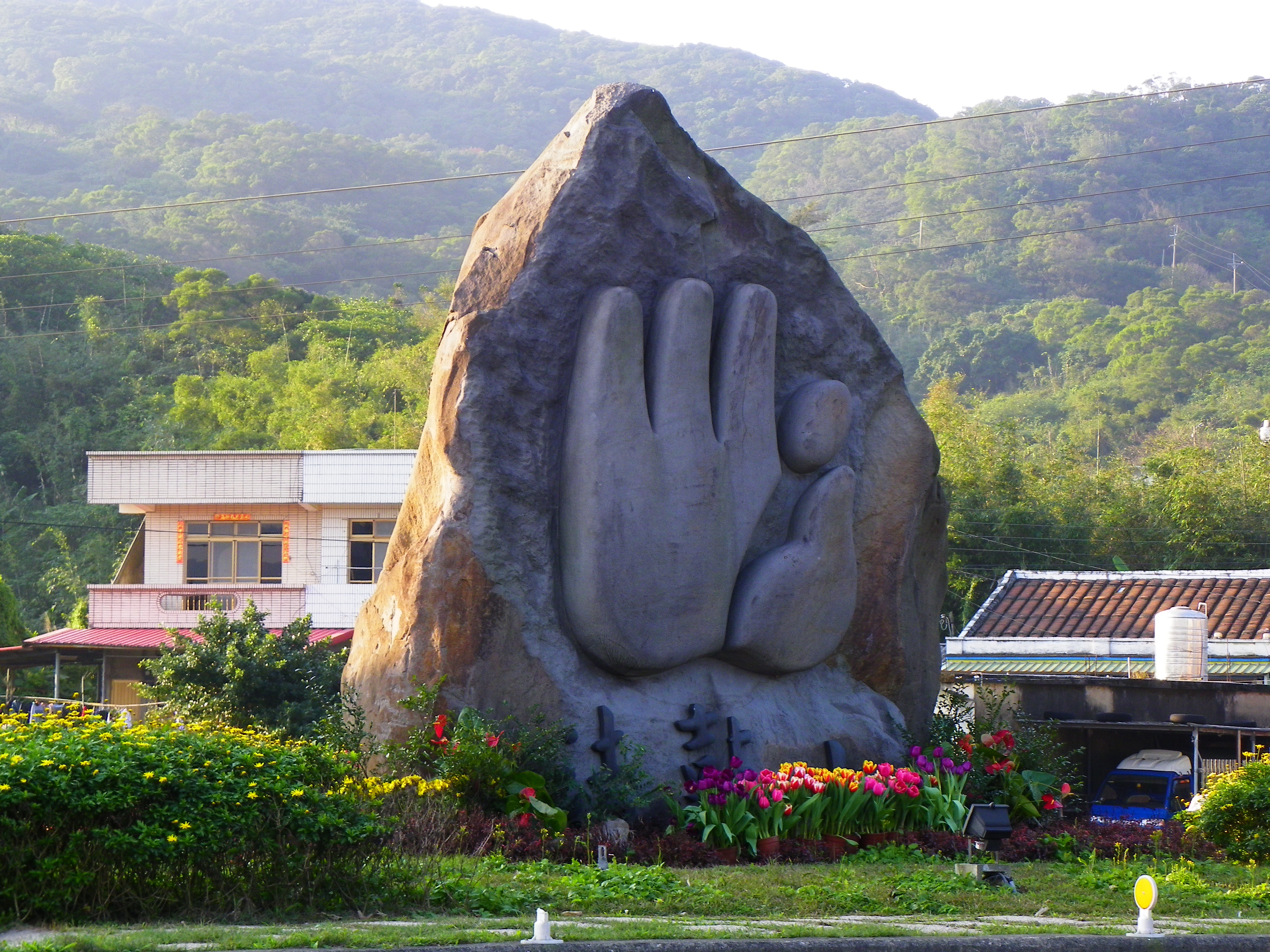
Dharma Drum Mountain
The architect wanted to flatten the hilltop. Master Sheng-yen said no. When the Chan Buddhist monk purchased a plot of hilly land in Jinshan, New Taipei City, in 1989 to build a new monastery, he insisted the buildings follow the natural contour of the terrain rather than the other way around. The architectural design took seven years. The result is a monastery where the ground floor of one building sits at the third level of another, where walking paths wind through bamboo forests and along splashing streams, and where the largest lotus bell in the world rings out from a hillside that looks much as it did before construction began.
Farming Chan
Dharma Drum Mountain's roots reach back further than its hilltop campus suggests. The organization grew from two institutions founded by Dongchu, a prominent Chan monk who was himself a disciple of the modernist Grand Master Taixu. In 1956, Dongchu established the Chung-Hwa Institute of Buddhist Culture, primarily a publishing venture that produced journals including Humanity Magazine. In 1975, he founded Nung Chan Monastery -- "Farming Chan" -- a name evoking the Chan tradition of combining meditation with manual labor. Dongchu died in 1977, and the following year his principal disciple and Dharma heir, Sheng-yen, became abbot of both institutions. Under Sheng-yen's leadership, the number of devotees and students quickly overwhelmed the existing buildings, prompting the search for a larger site.
One of the Four Great Mountains
In Taiwan, Sheng-yen was regarded as one of the "Four Heavenly Kings" of Buddhism, and Dharma Drum Mountain is counted among the island's "Four Great Mountains" -- the four major Buddhist organizations alongside Tzu Chi, Fo Guang Shan, and Chung Tai Shan. With an estimated 400,000 members as of 2005, the organization's influence extends well beyond its Jinshan campus. Its focus is educational rather than purely charitable: while Dharma Drum Mountain funds humanitarian projects, including relief efforts after the 2004 Indian Ocean earthquake and the 2006 Yogyakarta earthquake, its primary mission is teaching Buddhism to the public. The Dharma Drum Buddhist College offers graduate and post-graduate programs in Buddhist Studies and Buddhist informatics, while the Dharma Drum Sangha University trains monks from Taiwan and around the world.
Buildings That Breathe
The first phase of construction broke ground in 1993 and was completed and inaugurated in 2001. Sheng-yen personally oversaw the details, and his environmentalist convictions shaped every decision. Because the buildings mirror the hills, a visitor walking from the entrance through Building II -- past the bus terminal, visitor center, Guanyin Hall with its tranquility pond and waterfall, and a vegetarian dining hall -- finds themselves ascending through the landscape rather than traversing a flat campus. Building I rises from the hillside with its Founding History Memorial Hall, an auxiliary hall displaying artworks, a multipurpose exhibition room, and at the summit, the Grand Buddha Hall. The complex includes a Chan Hall for meditation practice, the Buddhist College and Sangha University, a library, and separate quarters for monks and nuns.
Four Kinds of Environmentalism
Dharma Drum Mountain's philosophy extends beyond architecture. Sheng-yen articulated four kinds of environmentalism -- spiritual, natural, living, and social -- framing Buddhist concepts in modern terms. Protecting the spiritual environment means practicing Chan meditation and the "Fivefold Spiritual Renaissance Campaign." Protecting the natural environment means recognizing, cherishing, nurturing, and sowing blessings. The social dimension includes what Sheng-yen called the "Six Ethics of the Mind" and distinctive communal practices: Buddhist-style joint weddings, joint birthday celebrations for the elderly, and joint natural funerals. In 2006, Sheng-yen's student Venerable Guo Dong succeeded him as abbot. Sheng-yen died in 2009 at the age of 78, leaving behind an organization whose physical form -- a monastery that bends to the shape of its mountain -- embodies the philosophy its founder spent a lifetime teaching.
From the Air
Located at 25.24N, 121.62E in Jinshan District, New Taipei City, on the northern coast of Taiwan. The monastery complex is visible from the air as a series of buildings integrated into a forested hillside near the coast. The coastline of the East China Sea is nearby to the north. Yehliu Geopark is a prominent coastal landmark to the west. Taipei Songshan Airport (RCSS) is approximately 25 km to the south-southwest. Taiwan Taoyuan International Airport (RCTP) is about 45 km to the southwest. Best viewed at 3,000-5,000 feet to appreciate how the buildings follow the contour of the terrain.