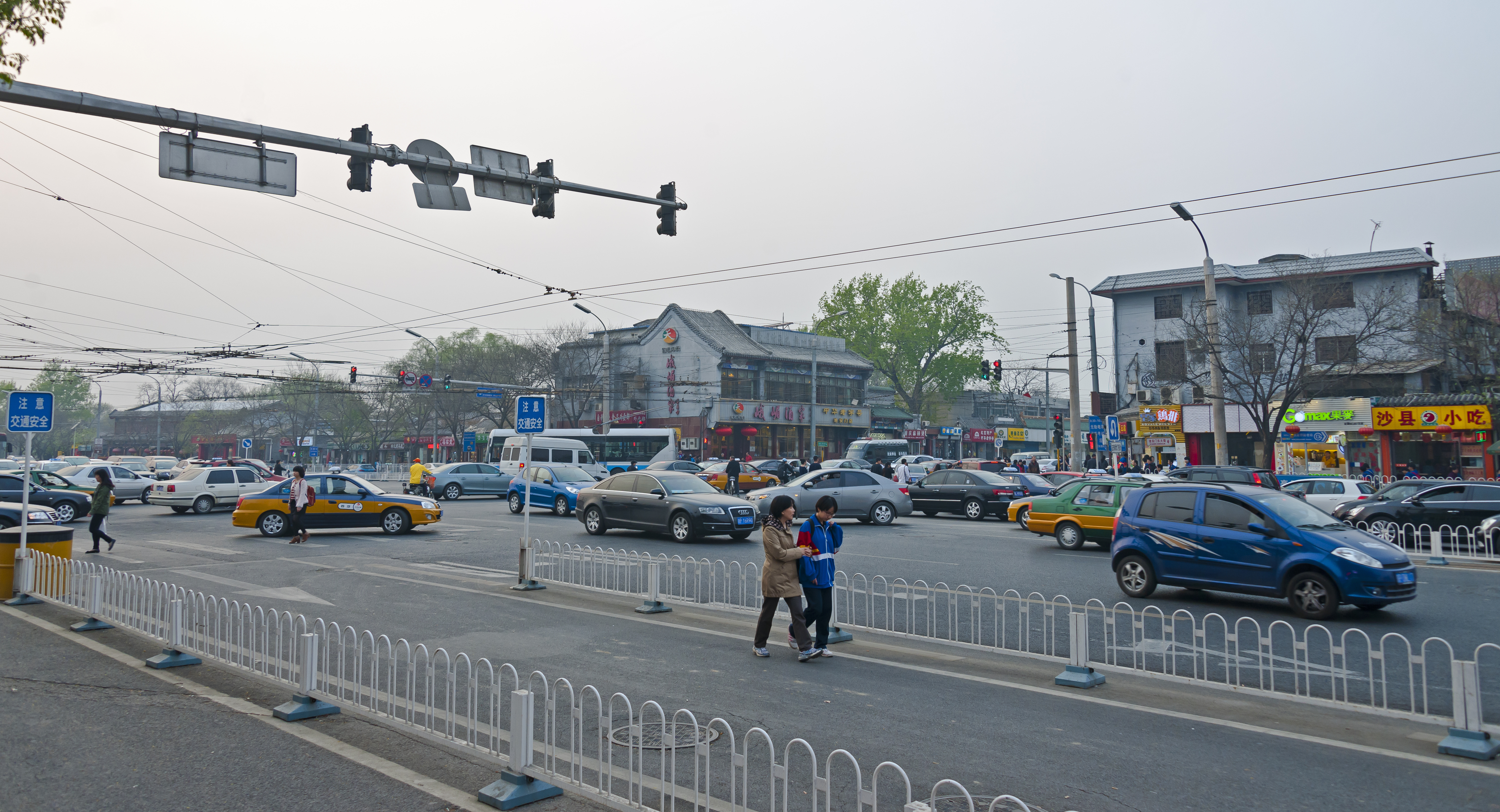
Di'anmen
Beijingers called it the back gate. Di'anmen sat at the northern end of the Imperial City's central axis, the quieter counterpart to the famous Tiananmen at the south. Where Tiananmen faced the public square and the world beyond, Di'anmen looked toward the Drum Tower and the residential neighborhoods that stretched north. Built in 1420 during the Yongle Emperor's construction of the Imperial City, the gate stood for over five hundred years before being demolished in late 1954 to improve road traffic. Its bricks and timber were carted away and used to build the north gate of the Temple of Heaven.
Five Centuries of Renaming
The gate was originally called Bei'anmen -- Northern Gate of Peace -- when it was constructed during the eighteenth year of the Ming dynasty. In 1651, the eighth year of the Shunzhi Emperor's reign during the Qing dynasty, the name was changed to Di'anmen, meaning Gate of Earthly Peace. It was rebuilt the following year. The structure was a palace-gate-style brick and wood building with seven wide bays, three central passages, and two duty rooms flanking each side. This layout was identical to Xi'anmen, the western gate of the Imperial City, reflecting the careful symmetry that governed every aspect of the capital's design. The gate sat between Jingshan Park to the south and the Drum Tower to the north, marking the precise point where the Forbidden City's influence ended and the ordinary city began.
Demolished for Traffic
The erosion of Di'anmen began during the Republic of China. In 1913 and 1923, the imperial walls flanking the gate on its east and west sides were demolished to facilitate transportation. But the gate itself survived until the early years of the People's Republic. From late 1954 to February 1955, both Di'anmen and the adjacent Yanchi Towers were torn down. The stated reason was straightforward: improving road traffic. The materials salvaged from the demolition were used to construct the north gate of the Temple of Heaven, a recycling of imperial architecture that gave Di'anmen's stones and timbers a second life in a different sacred context. The decision was part of a broader pattern in which Beijing's ancient infrastructure was sacrificed to the demands of modern circulation.
A Restoration That Took Decades
The absence of Di'anmen left a gap not just in the streetscape but in the historical logic of Beijing's central axis, the north-south line that connects the city's most important monuments. In 2005, literary historians proposed restoring Di'anmen and the Yanchi Towers. In 2011, the Beijing Municipal Administration of Cultural Heritage launched the Central Axis Cultural Relics Protection Project, which planned the restoration, though no construction started. Beijing launched a separate Restoration Project of Landmark Historic Buildings in Famous Cities in 2012, again including Di'anmen. Finally, on May 16, 2013, construction began on the Yanchi Tower restoration, and by August 2014 the main project was completed. The Yanchi Towers -- whose name means Goose Wing Towers, a reference to their position flanking the gate like a bird's outstretched wings -- originally stood on the east and west sides of Di'anmen Inner Street, framing the approach to the gate that is no longer there.
From the Air
Located at 39.93N, 116.40E on Beijing's central axis, between Jingshan Park and the Drum Tower. The gate itself was demolished in 1954; the restored Yanchi Towers mark its former location. Nearest airport is Beijing Capital International Airport (ZBAA), approximately 27 km northeast.