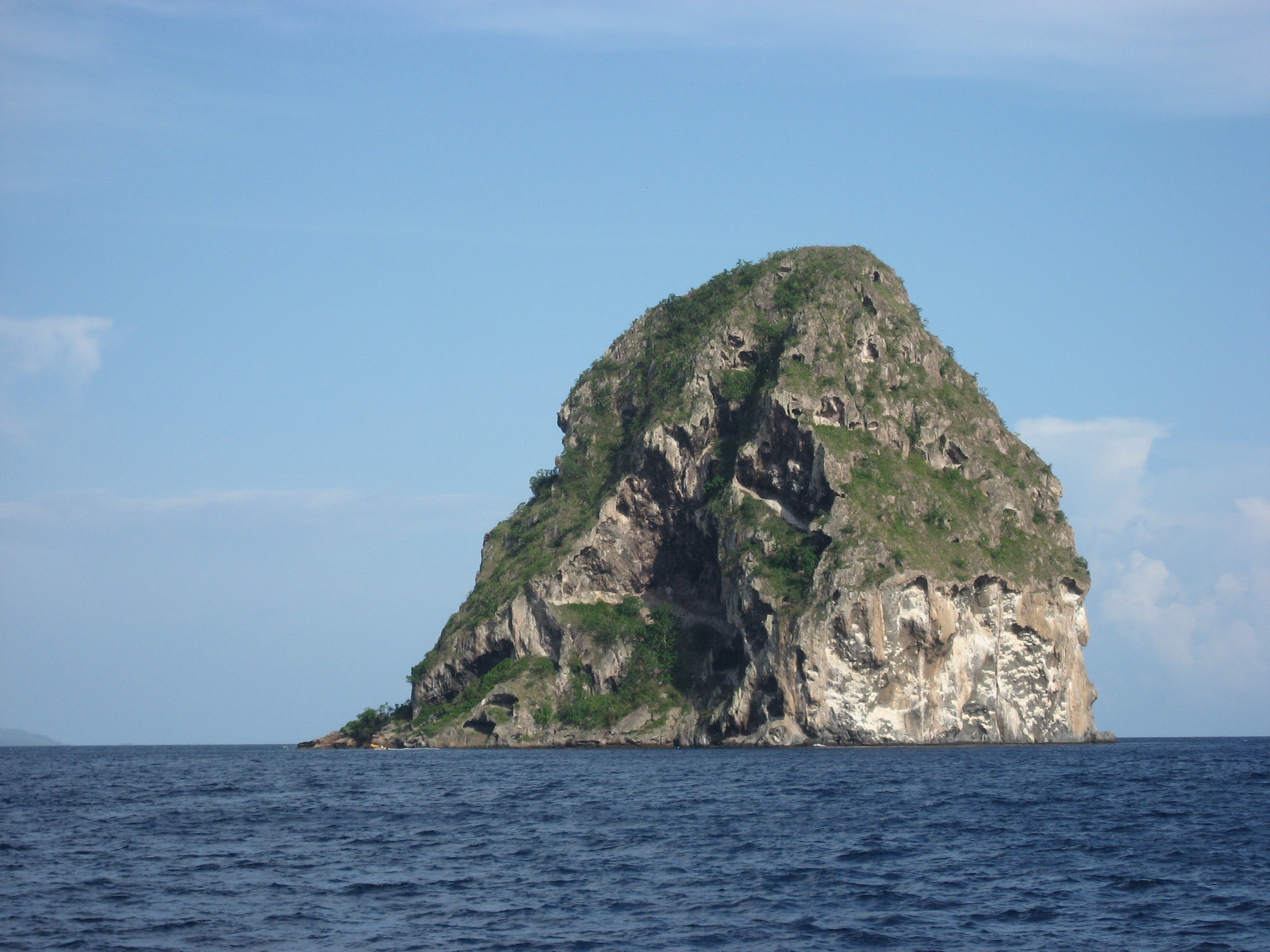
Diamond Rock
Somewhere in the Royal Navy's records, a rock is still listed as a ship. Diamond Rock -- Le Rocher du Diamant -- stands 175 meters above the Caribbean Sea off Martinique's southern coast, a basalt spire so steep and isolated that in 1804 the British decided the only sensible thing to do with it was commission it as HMS Diamond Rock and garrison it with cannons. That chapter lasted seventeen months. The rock's geological history stretches back a million years, and the life clinging to its slopes today -- rare snakes, nesting seabirds, underwater coral gardens -- suggests it will outlast every navy that ever claimed it.
Born from Fire
Diamond Rock is a volcanic plug, the solidified throat of a volcano whose softer outer cone eroded away over hundreds of thousands of years, leaving only this core of dense basalt standing in the sea. The volcanic activity that produced it shaped the entire Lesser Antilles arc roughly a million years ago. In May 1902, when Mount Pelee -- forty kilometers to the north -- erupted and destroyed Saint-Pierre, a Norwegian steamship captain named Hansen reported what he believed was a volcanic eruption from a hole in the rock itself. He did not investigate further, perhaps wisely. Whether the rock vented volcanic gas that day or Hansen misinterpreted what he saw in the chaos of Pelee's eruption, the incident underscored that Diamond Rock sits in geologically restless territory. Like the other 47 islets that circle Martinique, the rock has its own microclimate -- sunnier and drier than the main island, with a long seasonal dry period that has covered its upper slopes in scrub and cacti.
The Warship That Never Sailed
In 1804, Commodore Samuel Hood recognized the rock's strategic value: it commanded the sea lane between Martinique's coast and the open Caribbean, and anyone holding it could menace French shipping entering or leaving Fort-de-France. Hood assigned Lieutenant James Maurice to haul cannons up the cliffs and establish a garrison. For seventeen months, about 120 sailors and marines lived in tents and caves on the rock, operating it as a stationary warship. The French tried and failed to dislodge them until Vice-Admiral Villeneuve's fleet overwhelmed the garrison in June 1805. Maurice's men were taken prisoner, split between the French ships Pluton and the ex-British Berwick, and repatriated to Barbados. A court-martial exonerated Maurice for the loss of his "ship" and commended his defense. When Martinique was returned to France in 1815, Diamond Rock was included in the transfer. The Royal Navy, however, still considers it nominally in commission. British warships passing the rock are said to render honors -- a tradition that has outlived the empire that created it.
Last Refuge of the Couresse
Diamond Rock's very inhospitality has made it a sanctuary. Uninhabited and difficult to reach, it has sheltered species that vanished from Martinique itself. The couresse grass snake, Liophis cursor (now reclassified as Erythrolamprus cursor), was once found across the main island. It was last reliably seen on mainland Martinique in the 1960s and is now considered extinct on the main island. Nature surveys have suggested that Diamond Rock may be the species' final refuge -- a population surviving on an isolated spire because the pressures that eliminated it everywhere else never reached this far. BirdLife International has designated the rock an Important Bird Area for its breeding colonies of brown boobies, brown noddies, and bridled terns. The birds nest on ledges that were once cannon emplacements, in a landscape that has quietly reverted from military outpost to wildlife preserve without any human decision to make it so.
Below the Waterline
The rock continues underwater. The Diamond Rock cavern is a deep triangular cave that has become one of Martinique's most sought-after dive sites. Inside, sea fans and corals grow in profusion, fed by the nutrient-rich currents that sweep around the rock's base. Those same currents make the dive hazardous -- strong and unpredictable, they require experience and careful planning. Divers have reported finding one of the garrison's cannons on the seafloor, toppled from the summit by the French after they captured the rock in 1805. It rests among the coral now, encrusted and half-buried, a piece of Napoleonic-era ordnance slowly becoming part of the reef. The rock that was once a volcano, then a fortress, then a warship, has become something harder to define -- a place where geology, military history, and marine biology overlap in a single vertical column of basalt rising from the Caribbean floor.
From the Air
Located at 14.44N, 61.04W, Diamond Rock is a 175-meter (574-foot) volcanic spire rising sharply from the sea approximately 1.8 km off Martinique's southwestern coast, near the commune of Le Diamant. It is unmistakable from the air: a dark, steep-sided pinnacle surrounded by deep blue water, with the long crescent of Grande Anse du Diamant beach visible on the mainland shore. On clear days, Mount Pelee is visible 40 km to the north. The rock casts a visible shadow on the water in morning light. Nearest airport: Aime Cesaire International Airport (TFFF/FDF) in Le Lamentin, approximately 30km northeast. The approach along Martinique's southern coast provides dramatic views of the rock against the open Caribbean.