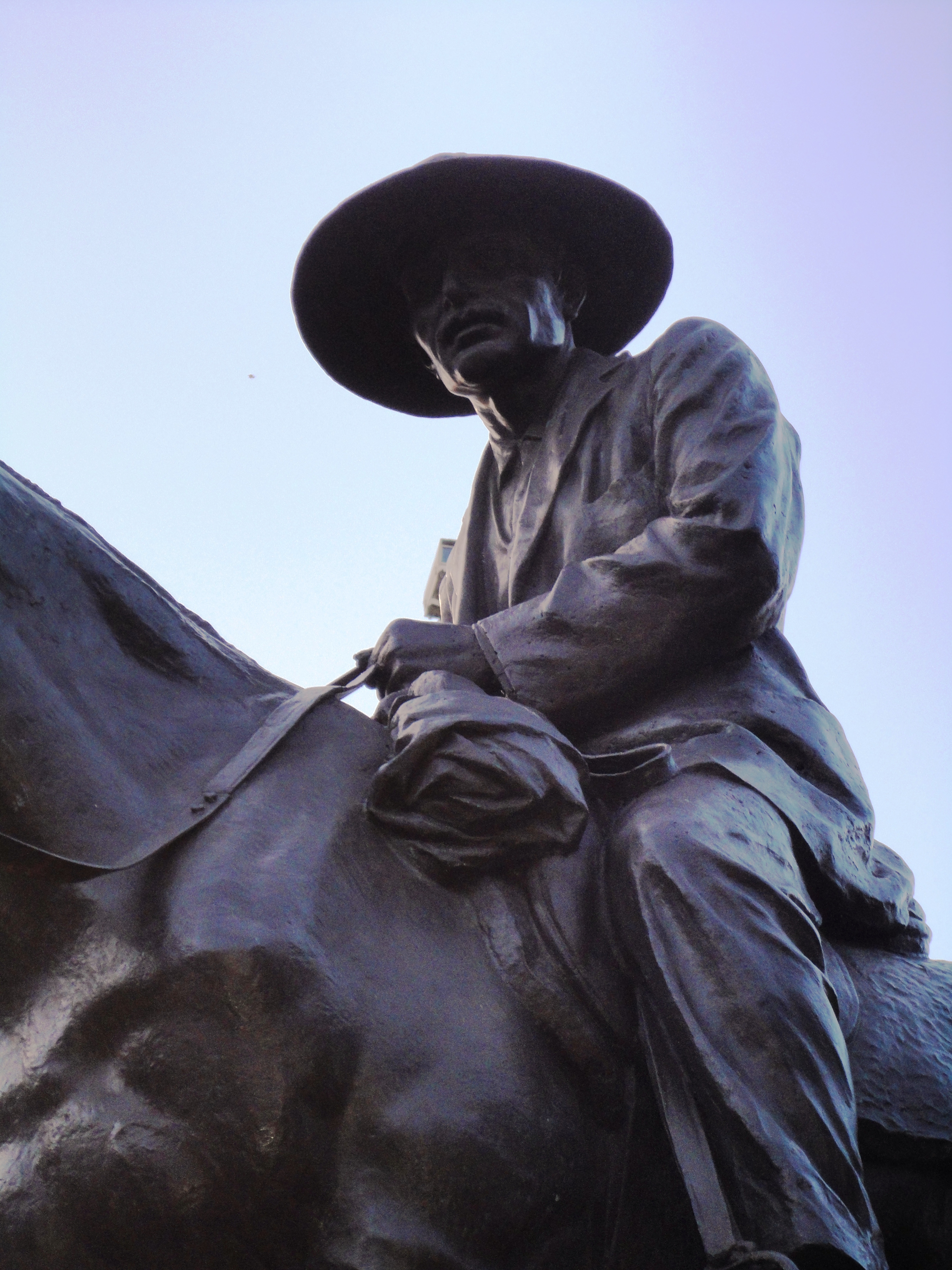
Dick King
Two riders left Port Natal in the dark, heading south along the coast. One was Richard Philip King, an English trader. The other was Ndongeni, his Zulu servant. Behind them, the British garrison was surrounded, running out of food, and days from surrender. Ahead lay 960 kilometers of wilderness, 120 river crossings, and ten days in the saddle -- assuming everything went right. It was May 1842, and the fate of British control over what would become KwaZulu-Natal rested on whether these two men could reach Grahamstown before the garrison fell. One of them rode a horse named Somerset. The other had no saddle at all.
From Gloucestershire to the Frontier
Dick King was born on 26 November 1811 in Dursley, a small market town in the English county of Gloucestershire. His family emigrated to the Albany district of the Cape Colony as part of the 1820 Settlers -- a British government scheme that shipped roughly 4,000 emigrants to the Eastern Cape frontier partly to create a buffer between the colony and the Xhosa people. By 1828, when Dick was about fifteen, the family had resettled to the frontier region of Port Natal, the small British trading station that would eventually become Durban. King's early employment was with the clergy, and in the company of Reverend Francis Owen he met Zulu chief Dingane and became acquainted with Captain Allen Gardiner. It was an education in the volatile politics of a region where Zulu sovereignty, Boer ambition, and British commercial interest were about to collide.
The Killing Season
King first proved himself in a crisis born from exactly that collision. In February 1838, after Zulu king Dingane murdered the Voortrekker leader Piet Retief and his entire delegation at his royal kraal, word reached Port Natal through the American missionary George Champion. The settlers sent Dick King to warn the Voortrekker camps inland. He departed immediately on foot, accompanied by a group of local men, walking day and night for four days. They arrived too late to save the van Rensburg camp, which had already been attacked. Reaching the vicinity of present-day Estcourt on 17 February, they found the next camp under assault. King participated in its defense, but could not prevent the death of his eighteen-year-old son George, who was further inland at the Blaauwkrans River. Across the region, approximately 600 Boers died in Dingane's coordinated attacks. King survived, carrying with him the knowledge that in this country, distance was both enemy and potential salvation.
The Ride That Changed Everything
Four years later, King would put that knowledge to use. In May 1842, Boer-British tensions had escalated into open fighting at Port Natal. Captain Charlton Smith's British garrison was besieged, outnumbered, and running low on supplies. Someone needed to reach Grahamstown -- 960 kilometers to the southwest -- to summon reinforcements from the Cape Colony. King volunteered, and Ndongeni rode with him. The journey was extraordinary by any measure: ten days through largely trackless country, fording 120 rivers, sleeping little, constantly at risk from both the terrain and hostile forces. Ndongeni, who rode without saddle or bridle, was forced to turn back roughly halfway through -- his body could no longer endure the punishment of bareback riding over such distances. King pressed on alone aboard Somerset, reaching Grahamstown in ten days, covering a distance that normally took seventeen. The story has often been told as one man's heroic ride. It was two men's ride, and Ndongeni's contribution -- undertaken with fewer resources and greater physical hardship -- deserves equal recognition.
Relief and Recognition
King returned to Port Natal a month later aboard the Conch, one of the British vessels carrying the relief force. The ship arrived at the bay on 24 June 1842, and the reinforcements saved Smith's garrison from what would have been imminent surrender or starvation. Both riders were rewarded with farms for their service. Ndongeni received land at the Mzimkulu River. King received an estate at Isipingo, south of Durban, where he managed a sugar mill until his death on 10 November 1871. The disparity in their rewards reflected the racial hierarchies of the colony they had helped preserve, but at least Ndongeni's contribution was formally acknowledged -- a rarity in colonial-era southern Africa. In 1911, Ethel Campbell interviewed the elderly Ndongeni, learning details of the epic journey that the official accounts had left out or compressed. His testimony remains one of the few firsthand African perspectives on an event that reshaped the region.
Bronze Horse, Incomplete Story
A statue of Dick King on horseback was unveiled on the north shore of Durban Bay on 14 August 1915. It shows King astride Somerset, riding south. Ndongeni is absent from the bronze. Several of Durban's most prominent landmarks carry King's name: Kings Park Rugby Stadium, Kingsmead Cricket Ground, and Kingsway High School among them. Ndongeni has no stadium. The statue and the naming tell a familiar story about whose contributions colonial societies chose to remember and whose they chose to flatten into footnotes. Yet the facts themselves resist that flattening. King could not have made the ride without Ndongeni. The garrison might have fallen without both of them. And the British hold on Natal -- for better or worse -- might have ended four years after it began. The ride of 1842 was a partnership forged under extreme duress, and telling only half of it has always meant telling it wrong.
From the Air
Port Natal (Durban) lies at approximately 29.86S, 31.03E on the Indian Ocean coast. The Dick King statue stands on the north shore of Durban Bay. King's route south to Grahamstown (now Makhanda) at 33.31S, 26.52E followed the coast and inland valleys for 960 km. King Shaka International Airport (FALE) at 29.61S, 31.12E serves Durban. Isipingo, where King settled, is visible just south of Durban along the coast. The route south passes through the rolling hills of the KwaZulu-Natal south coast, crossing numerous rivers that are visible as dark vegetation lines from cruising altitude.