Diepkloof Rock Shelter
Someone picked up a fragment of ostrich eggshell and, using a sharp point, scratched a pattern into its surface. Parallel lines. Cross-hatching. Geometric forms repeated with enough consistency to suggest intention, convention, shared meaning. That act -- seemingly small, almost casual -- happened roughly 60,000 years ago in a rock shelter perched 100 meters above the Verlorenvlei River in what is now South Africa's Western Cape. It is among the earliest evidence anywhere on Earth that human beings used symbols to communicate.
The Shelter on the Butte
Diepkloof Rock Shelter sits in quartzitic sandstone on a butte overlooking the Verlorenvlei River, about 17 kilometers from the Atlantic shoreline and 150 kilometers north of Cape Town. The semi-arid landscape around it today gives little hint of the world its ancient inhabitants knew -- coastlines shifted dramatically during the ice ages, and the shelter's distance from the sea has varied by tens of kilometers over the millennia. What has remained constant is the shelter itself: a protected overhang facing east, catching the morning sun, offering refuge from wind and rain. Since 1999, archaeologists from the University of Cape Town and the University of Bordeaux have been collaborating on excavations here, uncovering one of the most complete and continuous Middle Stone Age sequences in southern Africa.
Messages on Eggshell
Some 270 fragments of ostrich eggshell have been recovered from the shelter, covered with engraved geometric patterns. The fragments are small -- typically 20 to 30 millimeters -- but researchers have fitted some together into larger pieces of roughly 80 by 40 millimeters, estimating that fragments from about 25 separate containers are represented. Ostrich eggshells were commonly used as water containers across southern Africa, and eggshell fragments appear throughout the shelter's occupation layers. But the engraved pieces cluster specifically within the Howiesons Poort period, distributed across 18 stratigraphic layers. The tradition of engraving appears to have persisted for several thousand years -- not a single act of creativity but a sustained cultural practice, passed from one generation to the next by people whose ancestors are the ancestors of all living humans.
Deep Time, Living Heritage
The significance of Diepkloof extends beyond its age. These engravings represent abstract, non-representational art -- patterns that carry meaning independent of what they depict. They suggest that the cognitive capacity for symbolic thought, for encoding and transmitting information through marks on a surface, was fully developed in our species at least 60,000 years ago. The shelter sits alongside other South African sites -- Blombos Cave, Pinnacle Point, Klasies River Caves, Sibudu Cave, and Border Cave -- that collectively demonstrate that the roots of human symbolic behavior lie deep in the African Middle Stone Age. In 2015, the South African government proposed adding Diepkloof and several of these partner sites to the UNESCO World Heritage List as a serial nomination. Three of the sites, including Diepkloof, gained World Heritage status in 2024 as part of the Pleistocene Occupation Sites of South Africa.
Reading the Layers
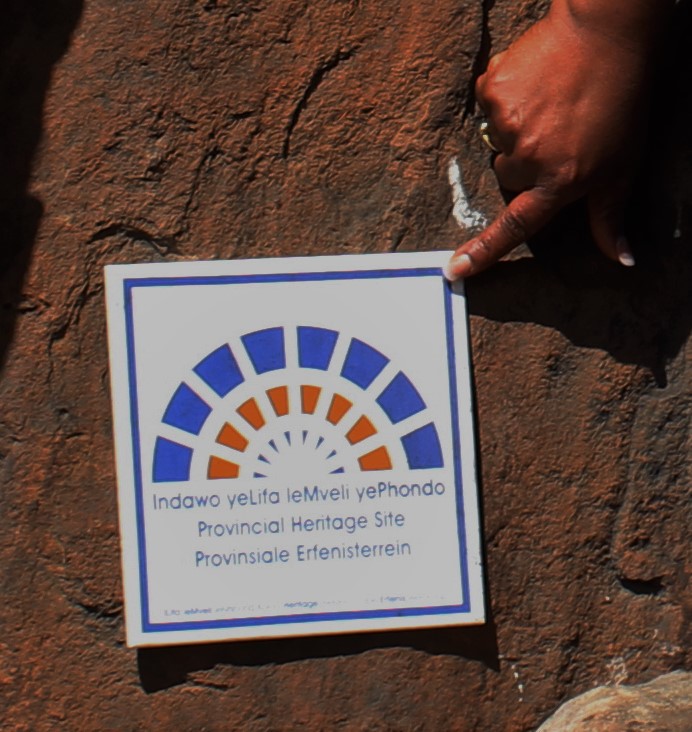
The shelter's stratigraphic record is exceptionally deep and continuous, with occupation layers spanning tens of thousands of years. Researchers have given individual layers names -- Frank, Darryl -- that have become reference points in the broader study of the Middle Stone Age. The engraved eggshells are concentrated in specific layers, suggesting that the practice of decoration emerged, flourished, and eventually ceased within a defined cultural period. This kind of temporal resolution is rare in archaeology of this age. The site holds Grade II heritage status under South African law, providing legal protection for a place whose importance belongs not just to South Africa but to every human being alive. The patterns scratched into those eggshells 60,000 years ago are, in the most literal sense, part of all our heritage -- evidence of the moment our species began to make marks that meant something.
From the Air
Diepkloof Rock Shelter is at 32.39S, 18.45E, perched on a sandstone butte approximately 100m above the Verlorenvlei River on the Atlantic coast of the Western Cape. The shelter faces east, overlooking the river valley. From the air, look for the Verlorenvlei estuary and river system running toward Elands Bay on the coast about 17km to the west. The terrain is semi-arid with sparse vegetation. Nearest airports: Cape Town International (FACT, ~150km S). This is a UNESCO World Heritage Site (2024) -- the archaeological area is protected. The butte formation is distinctive from altitude against the surrounding lowlands.