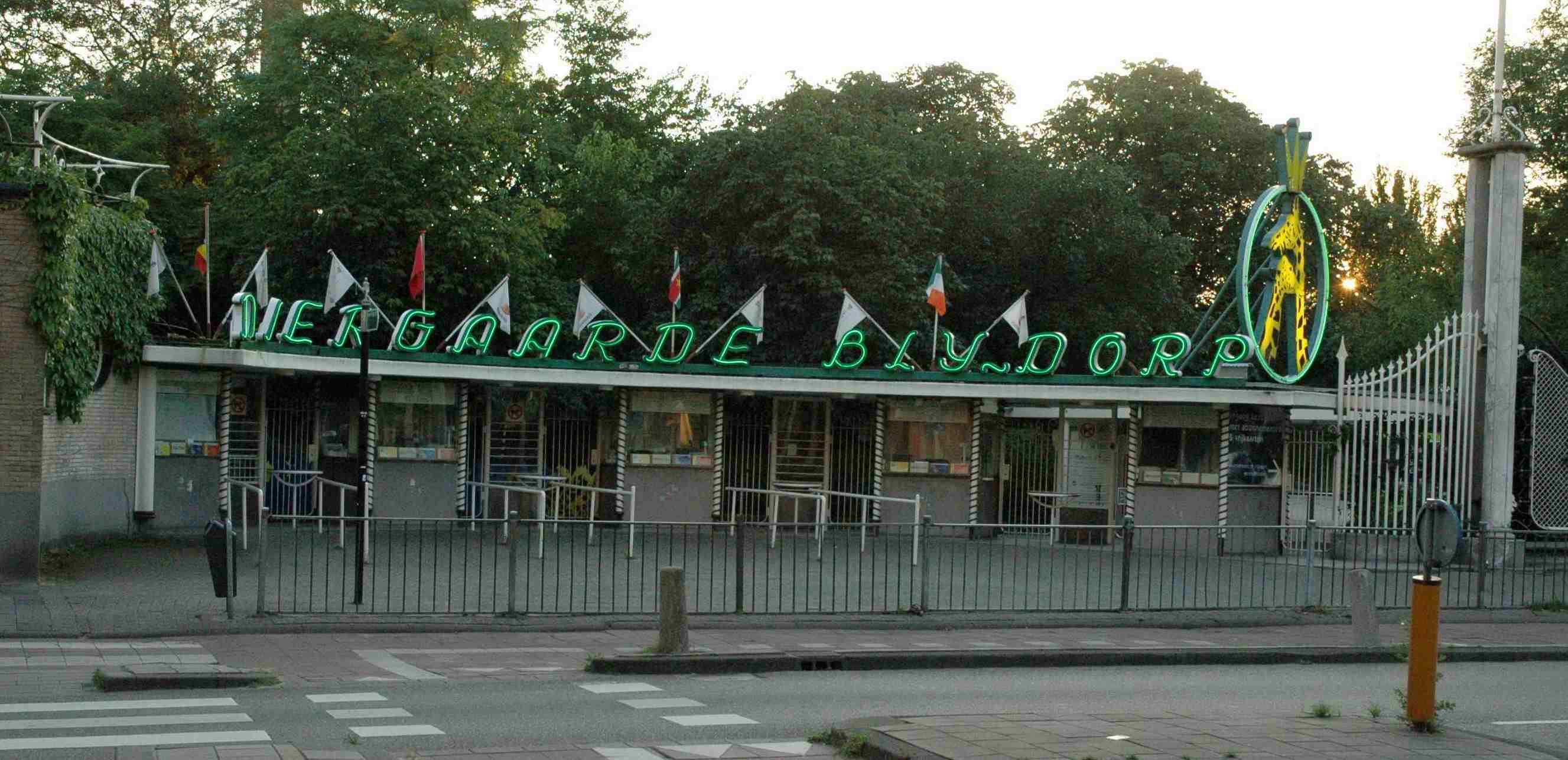
Diergaarde Blijdorp
Three years before the Luftwaffe flattened the center of Rotterdam, the city's zoo decided to move. The old grounds near the Kruiskade had run out of room, and the foundation that ran the place struck a complicated land deal with the municipality: trade some of the old site, lease a third of a new 13-hectare parcel out in the Blijdorp district for one guilder, build something modern. The architect was Sybold van Ravesteyn, the same man who would later design Rotterdam's central railway station, and his sweeping curved pavilions opened to the public on December 7, 1940. By then, the center of Rotterdam was rubble. The May 14 bombing had missed Blijdorp entirely. Diergaarde Blijdorp had survived the war by moving out of its way.
Pheasants to 562 Species
It began in 1855 as a garden for pheasants and waterfowl near the Kruiskade in central Rotterdam - the kind of genteel Victorian collection that gentlemen of means assembled for the edification of the public. It was popular enough that on May 18, 1857, the proprietors formally opened it as the Rotterdamsche Diergaarde, with the animal trainer Henri Martin as first director. From those pheasant pens, Blijdorp has grown into a 34-hectare park holding 562 species across half a dozen zoogeographic regions - Asian swamps, African savanna, Mongolian steppe, the Amur watershed - laid out so visitors can walk continent to continent in an afternoon. In 2007 the zoo turned 150 and was declared a rijksmonument, a national heritage site, protecting van Ravesteyn's curves for the next century.
Bokito
On May 18, 2007, the silverback gorilla Bokito vaulted the moat surrounding his enclosure and went into the visitor area. He attacked a woman who had been visiting him on average four times a week for years, who had developed what she believed was a special bond - smiling at him through the glass, holding eye contact, touching the barrier between them. The attack was severe; she survived. The Dutch press, in the aftermath, talked at length about the dangers of misreading what an animal is doing when it looks back at you. A primate's bared teeth are not a smile. Sustained eye contact is a threat. The gorilla had not loved her back. The story passed into Dutch idiom: 'a Bokito look' is now shorthand for an unsettling, fixed stare, and 'Bokitoproof' for anything robust enough to survive one.
Oceanium and Red Pandas
In 2001 the zoo nearly doubled in size when it opened the Oceanium, an aquarium and Americas-themed expansion on the western side - puffin colonies on a recreated Bass Rock, sharks and tarpons sliding through Atlantic tanks, penguins from the Falklands, Galapagos tortoises lumbering in their own enclosure. Behind the public-facing exhibits is the quieter work: Blijdorp participates in about 70 breeding programs and studbooks, and coordinates several of the most important ones internationally - the global program for red pandas runs out of Rotterdam, and the European programs for Asian elephants, Komodo dragons, red-crowned and Siberian cranes, Visayan warty pigs, and Egyptian tortoises are all managed here. A zoo's value, in the era of vanishing wild populations, is increasingly measured by how many species it can keep in the genetic ledger.
The Giraffe and the Dying Man
In March 2014, a former Blijdorp cleaner named Mario - terminally ill with a brain tumor - asked, as a last wish, to be wheeled back to the zoo where he had worked. Staff arranged it. They brought him on his hospital bed to the giraffe enclosure he used to clean, and one of the giraffes leaned its long neck down through an open hatch and licked his face, then nuzzled him for a long time. Someone filmed it. The video went viral within days - tens of millions of views, a small global moment of an animal apparently recognizing a sick human and offering whatever comfort a giraffe can offer. Whether the animal recognized him or was simply curious, nobody can say for sure. But Mario, who died not long after, said it was the gift he had wanted.
Politics of Keeping
Running a zoo in the twenty-first century means defending it constantly. In October 2010, the city of Rotterdam announced that yearly subsidies to Blijdorp would drop from about 4.5 million euros to roughly 0.8 million by 2015, and the zoo's supporters - Vriendenvan Blijdorp - put up a public protest that it could not survive the cut. It did survive, partly by drawing 1.5 million visitors a year, partly by deepening its conservation work. In 2019 a new natuurbehoudscentrum (conservation center) opened with a cargo of Lesser Antillean iguanas flown in from Sint Maarten by then-prime minister Mark Rutte himself. The zoo that moved house to dodge a bombing has spent the eighty-five years since proving that surviving was the easy part.
From the Air
Diergaarde Blijdorp sits at 51.93°N, 4.45°E in the Blijdorp district of northwestern Rotterdam, just inside the A20 ring road. The closest airport is Rotterdam The Hague (EHRD), about 5 km north; Schiphol (EHAM) is roughly 60 km north-northeast. From the air the zoo reads as an irregular green patch wedged between motorway and dense residential blocks, with the elongated Oceanium structure recognizable on its western side. The Maas river curves to the south, and central Rotterdam's downtown towers are about 3 km southeast. Best viewing altitude 2,000-4,000 feet; the zoo is small enough that you want to be low to make out the curved pavilions of the van Ravesteyn layout. Heavy controlled airspace - check EHRD CTR boundaries.