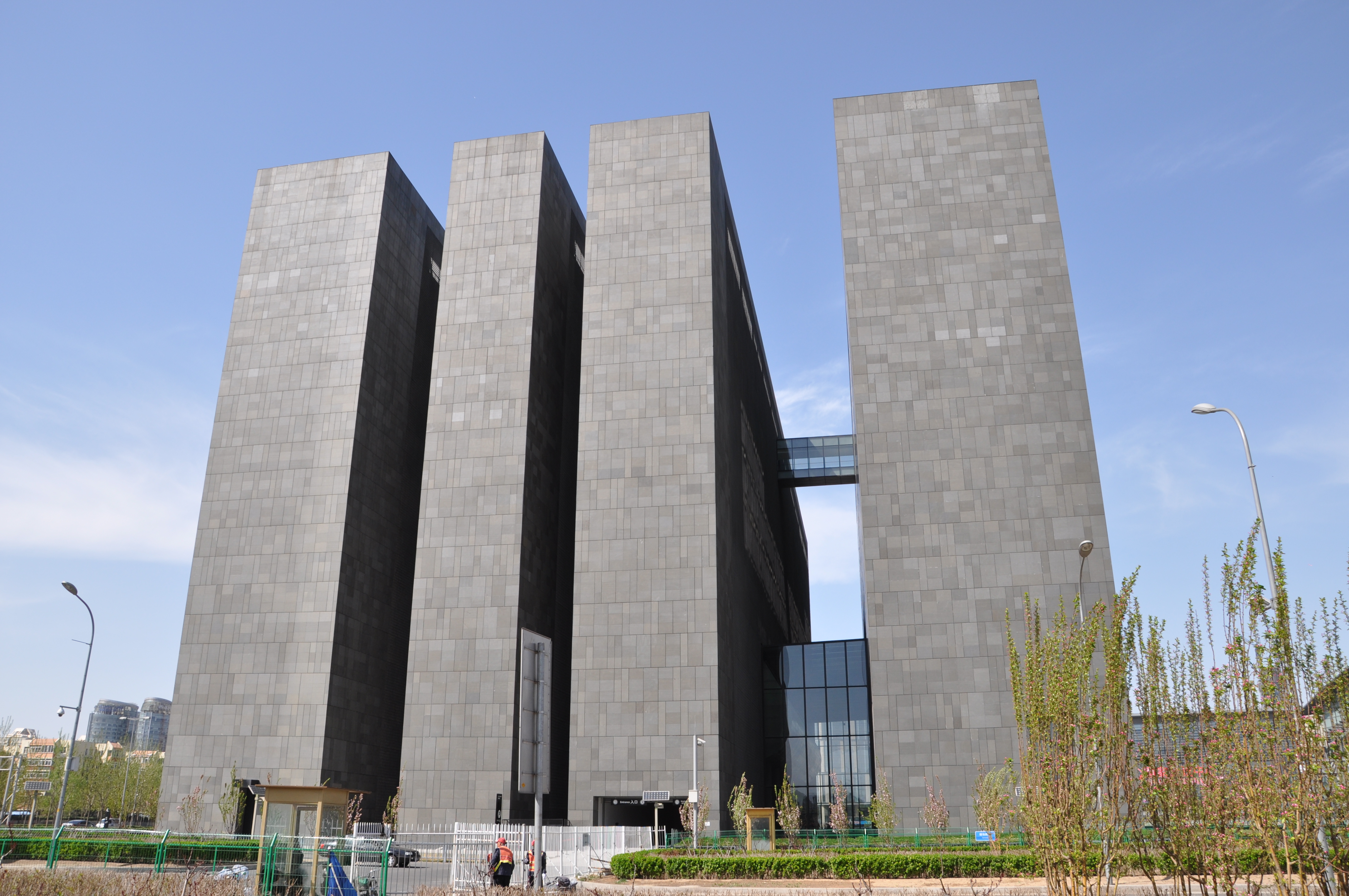
Digital Beijing Building
One architecture critic called it an excellent impression of an Orwellian Ministry of Truth. Another said it was delightful. A third wrote that it steered dangerously close to kitsch -- and succeeded anyway. The Digital Beijing Building, a 57-meter block on Olympic Green in Beijing's Chaoyang District, has provoked reactions as angular as its own silhouette since its completion in late 2007. Designed by Chinese architect Pei Zhu, it was built to serve as the main data center for the 2008 Summer Olympics, and it was the only major facility on Olympic Green that was not an event venue -- and the only one designed by a Chinese architect.
Circuit Board, Barcode, Building
Pei Zhu was interested in the connections between traditional Chinese design and digital technology, and the building he produced makes those connections physical. Viewed from either side, the structure resembles a circuit board, with irregularly spaced vertical grooves of varying width running down the windowless west face, taking diagonal turns at different points before straightening out again. Viewed from either end, it looks like a barcode. The design was selected from among eight competitors in a 2004 contest, when Zhu was in the process of leaving the Chinese firm Urbanus to establish his own studio. Four upright slabs, separated by glass atria, compose the structure. The east elevation features a smooth glass curtain wall made of low-energy glass with low thermal conductivity, while the west face is entirely windowless. An LED lighting system uses sixty percent less energy than conventional alternatives. There are 98,000 square meters of interior space.
The Nerve Center of the Games
During the 2008 Summer Olympics, Digital Beijing served as the main data center, processing the information that kept the games running. A backup facility was built at an undisclosed location. The building sits on the northwest corner of the intersection of Beichen West and Anxiang North roads, roughly ten kilometers north of the Forbidden City along the capital's central axis. Its neighbors are among the most celebrated buildings of the Olympic era: the Beijing National Aquatics Center, known as the Water Cube, sits to the southeast, and the Bird's Nest -- the Beijing National Stadium -- rises beyond it. The Beijing National Indoor Stadium, where gymnastics events were held, stands to the east. Since the games, Digital Beijing has served its planned second life as a museum devoted to computing in the Olympics and as exhibition space for digital technology companies.
Praise, Contempt, and Grudging Respect
The Guardian's Jonathan Glancey was first to weigh in, writing in February 2008 that the stadium and its attendant buildings had set a heady precedent, contrasting them favorably with designs for the 2012 London Olympics. He likened the four upright slabs to upright 1960s IBM computers and praised Zhu's creative use of unexpected materials. Months later, Tom Dyckhoff of The Times toured Olympic Green under military guard and called Digital Beijing cheesy, comparing it to an Orwellian Ministry of Truth, though he allowed it was slightly less spirit-crushing inside. His was the only prominent negative review. At the 2008 World Architecture Festival, the building was shortlisted in its category. Paul Goldberger, the former New York Times critic, wrote that while Digital Beijing steered dangerously close to a kitschy conceit, the finished building had a dignity that was surprising -- an austerity that is the opposite of kitsch. Harvard professor Peter Rowe later noted that the building's monumental form might seem at odds with the dispersed nature of digital media, but suggested that contradiction was part of the point.
From the Air
Located at 39.99N, 116.38E on Olympic Green in Beijing's Chaoyang District. The block-shaped building is visible near the Bird's Nest and Water Cube. Nearest airport is Beijing Capital International Airport (ZBAA), approximately 22 km northeast.