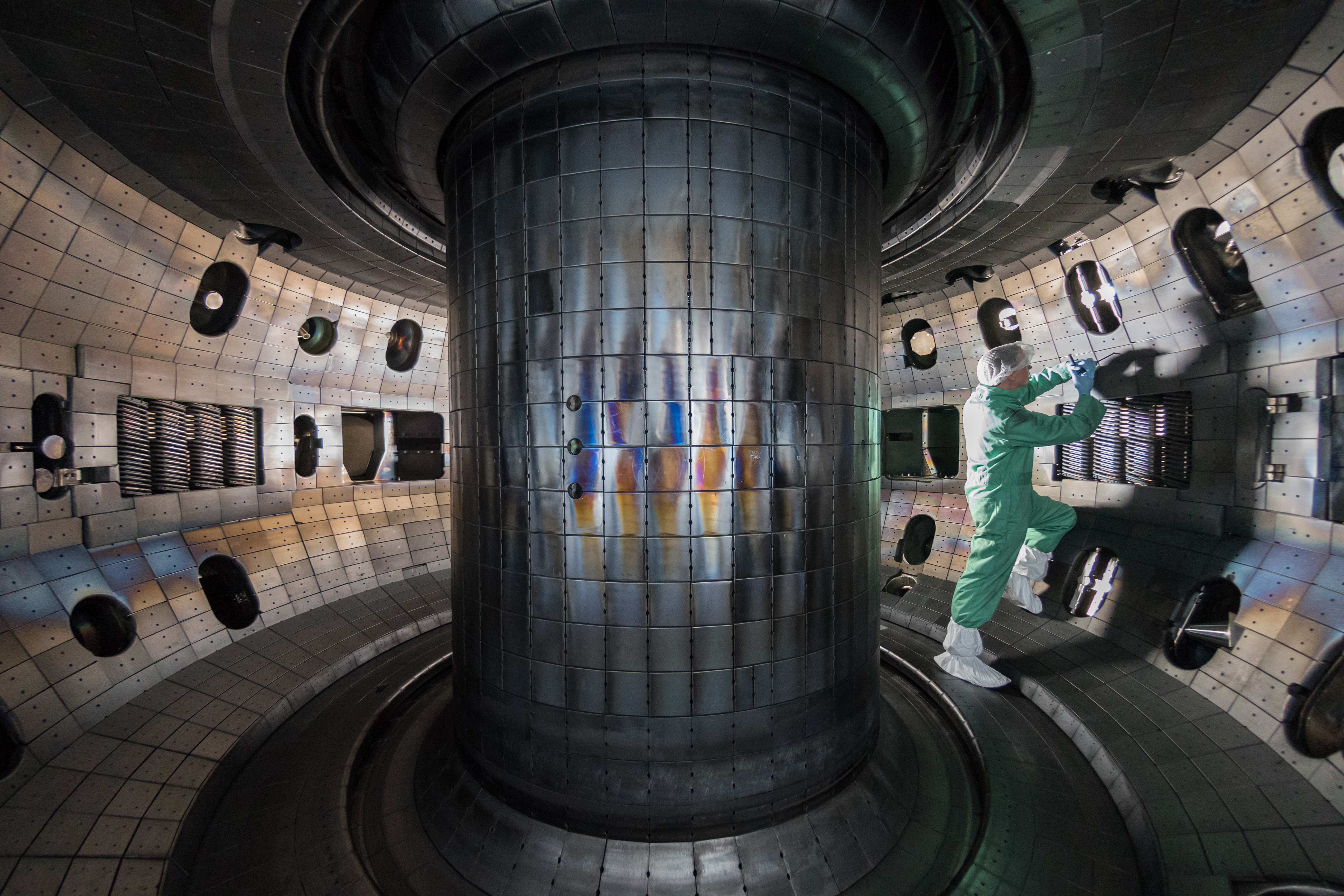
DIII-D
The plasma inside DIII-D reaches temperatures above 150 million degrees Celsius — roughly ten times the temperature at the core of the sun. The machine that contains it is a tokamak, a donut-shaped magnetic chamber that uses powerful superconducting magnets to keep the plasma from touching the walls. It is located on the campus of General Atomics in a San Diego suburb, it is operated for the United States Department of Energy, and it is one of the most productive fusion research devices in the world.
The Shape of the Machine
DIII-D is a tokamak, a Russian acronym for 'toroidal chamber with magnetic coils' — a device type invented in the Soviet Union in the 1950s and since developed by research programs around the world. What distinguishes DIII-D from earlier tokamaks is its plasma cross-section: rather than a circular cross-section, DIII-D uses a D-shaped cross-section, which allows the plasma to be shaped and controlled in ways that improve its confinement. The D in DIII-D refers to this shape. The machine has a major radius of roughly 1.67 meters and a minor radius of about 0.67 meters. It is not a large device by industrial standards, but the physics happening inside it — plasma at extreme temperatures, confined by magnetic fields measured in tesla — makes its scale somewhat beside the point.
What Fusion Research Requires
Nuclear fusion, the process that powers the sun, combines light atomic nuclei to release energy. Achieving fusion in a controlled way requires heating plasma — ionized gas — to temperatures where atomic nuclei have enough energy to collide and fuse despite their mutual electromagnetic repulsion. Containing plasma at those temperatures requires magnetic fields strong enough to prevent any contact between the plasma and the material walls of the chamber; contact would cool the plasma instantly and damage the walls. DIII-D uses a combination of magnetic field configurations to shape and control the plasma, and researchers use the device to study what combinations of conditions — temperature, density, plasma shape, magnetic field geometry — produce the best confinement. The knowledge generated at DIII-D feeds directly into the design of larger machines, including ITER, the international fusion experiment under construction in France.
General Atomics and the DOE
DIII-D is owned and operated by General Atomics under a contract with the United States Department of Energy. General Atomics, headquartered in San Diego, is a defense and technology company with a long history in nuclear research — it was founded in 1955 as a division of General Dynamics specifically to pursue civilian nuclear technology. The company has operated tokamak research devices on its San Diego campus for decades; DIII-D is the most recent and most capable. The machine is a national user facility, meaning that researchers from universities and national laboratories across the country and internationally can apply for experimental time. The staff physicists and engineers who operate it work alongside visiting scientists pursuing their own research programs. It is a collaborative scientific instrument operating in an industrial setting.
Toward a Power Plant
The goal of fusion research, after seven decades of effort, remains the same: a fusion power plant that produces more energy than it consumes and can operate continuously. DIII-D contributes to this goal by advancing the scientific understanding of plasma physics in configurations that might be scalable to a power plant. Experiments at DIII-D have demonstrated plasma conditions that, scaled up, could produce net energy gain. The machine has operated continuously since the late 1980s, generating research that has been published in thousands of papers and incorporated into the designs of larger machines. Whether a commercial fusion power plant ever operates, and whether its design will trace back in part to experiments conducted in this building on a mesa north of La Jolla, remains an open question. The plasma is being made, the measurements are being taken, and the work continues.
From the Air
Located at 32.894°N, 117.235°W on the General Atomics campus in Torrey Pines, north of La Jolla. The General Atomics complex is a large industrial/research campus visible from the air as a cluster of low-profile buildings on the Torrey Pines mesa. The campus sits between the UCSD campus to the west and the Carmel Valley residential area to the east. San Diego International Airport (KSAN) lies approximately 11 miles to the south-southeast.