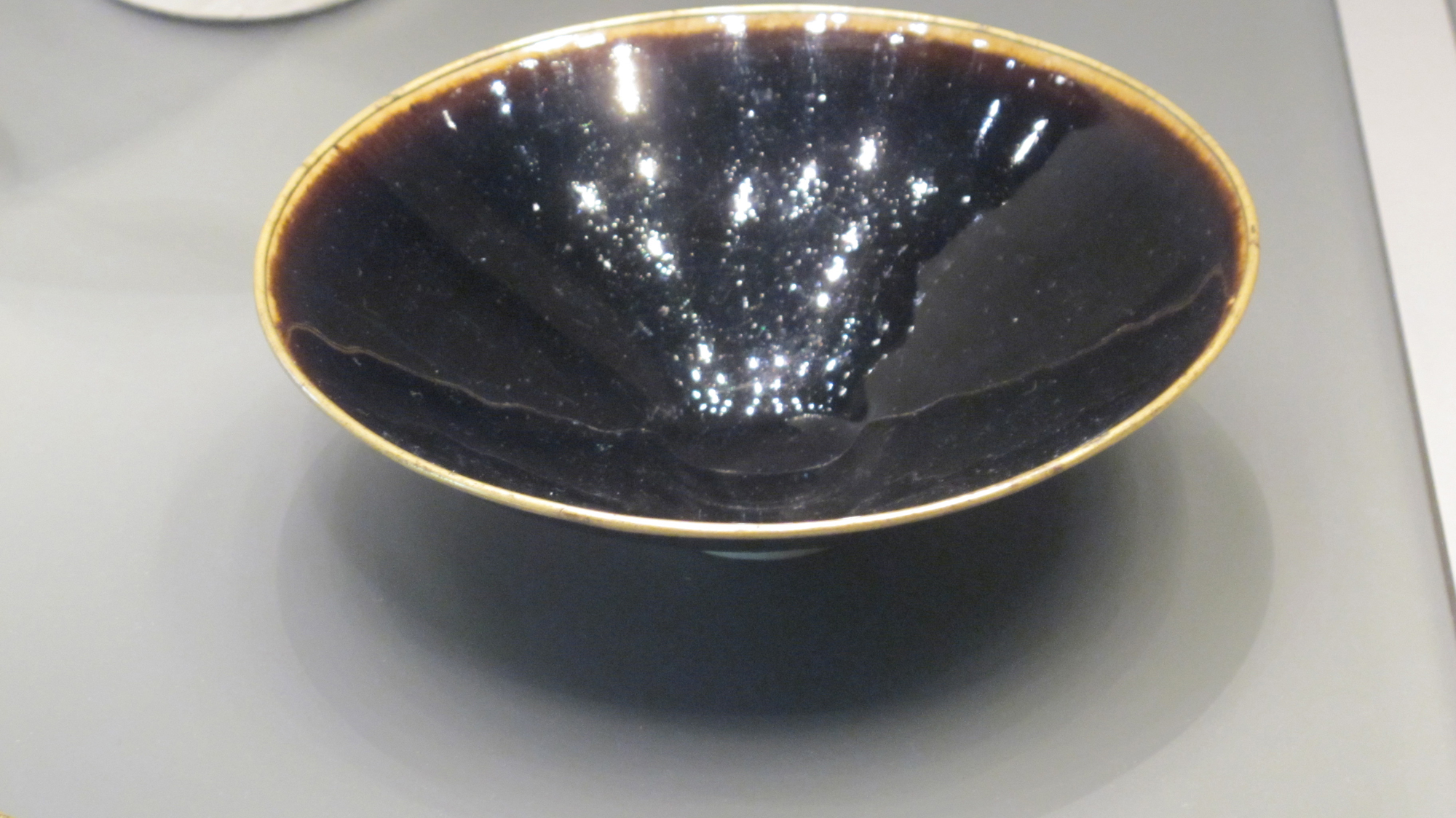
Ding Ware
Hold a piece of Ding ware to the light and you see through a thousand years. The glaze is nearly transparent, carrying a faint ivory tint that Northern Song connoisseurs considered the hallmark of quality. Run your finger along the rim and you might find it rough -- unglazed, because bowls were fired upside down in the kilns at Jiancicun, in Quyang County, Hebei Province. Many pieces wore thin bands of silver or a brassy alloy to cover that roughness, though a court chronicle noted that these imperfections, along with occasional 'teardrops' of running glaze, eventually made Ding ware less than fine enough for the emperor himself. The potters, it seems, were victims of their own technique.
Six Centuries at the Kiln
The Ding kilns operated in almost continuous production from the early 8th century to the mid-14th century, spanning the Tang, Song, Jin, and Yuan dynasties. They began by imitating Xing ware, the earlier standard for white ceramics in northern China, but by the Song dynasty the student had surpassed the teacher. The key technical shift came in the 10th century, when potters switched from wood firing to coal. Wood produced a reducing atmosphere that gave early pieces a bluish tint; coal firing created the warm ivory tone that became Ding ware's signature. The clay itself was unusual -- chemical analysis shows many pieces were made entirely from kaolinitic clay without the petuntse (porcelain stone) that typically defines true porcelain. The result was a body that some Western scholars classify as stoneware, though Chinese tradition has always called it porcelain.
Lotus, Peony, and the Shift to Moulds
Early Ding decoration was carved by hand into leather-hard clay -- scrolling lotus and peony, the occasional duck or fish, all rendered with what one scholar described as 'remarkable fluency and an apparently unfailing sense of compositional balance.' In the late 11th century, potters began using moulds, which allowed greater complexity: scenes with children, landscapes, more elaborate animal motifs. The moulds pressed decoration into the inside of bowls, freeing the exterior for continued hand-carving. This innovation also transformed production efficiency. Ding potters developed stepped saggars -- kiln furniture that allowed several bowls, each slightly smaller than the last, to be fired in the same container. The combination of moulded decoration and stacked firing meant the kilns could produce high-quality ceramics at a scale that supplied everyone from wealthy merchants and scholar-literati to the imperial court itself.
When the Court Fled South
The Northern Song dynasty's catastrophic defeat in the Jin-Song wars of the 1120s changed the geography of Chinese ceramics forever. As the remaining Song court fled south to establish itself in Hangzhou, potters may have migrated with them -- carrying Ding techniques to Jingdezhen, the southern kiln complex that would eventually dominate world porcelain production. Jingdezhen's early white ware is actually called 'Southern Ding' in recognition of this lineage. The Qingbai ware that followed shows Ding influence in its decoration, though the southern glaze took on a different, slightly blue-green character. Back in Hebei, Ding production continued under the Jin dynasty, whose court taste favoured more intricate plant-scroll designs than the Song aesthetic had allowed. These complex monochrome scrolling patterns, rendered in very shallow relief, became the visual vocabulary from which blue and white pottery -- perhaps the most globally influential ceramic tradition -- would eventually emerge.
Among the Five Famous Kilns
Chinese ceramic tradition groups Ding ware among the Five Famous Kilns, alongside Ru, Jun, Guan, and Ge wares. Of these, Ding was the largest producer and the most widely distributed. It was also the only one defined primarily by its white body rather than a distinctive coloured glaze, though 'secondary' wares in black, red, brown, gold, and green were also produced -- known more through historical literature than surviving examples. Song court taste ran to the extremes of simplicity: plain wares whose only decoration was an exquisite monochrome glaze in a colour almost impossible to achieve consistently. The legendary Ru ware was produced for only 40 years, with surviving pieces numbering in the two figures. Against such rarefied competition, Ding ware represented something different -- beauty at scale, craftsmanship democratized enough to reach beyond the palace without sacrificing the qualities that made it worth reaching for.
From the Air
The historic Ding ware kilns were centered at Jiancicun in Quyang County, Hebei Province, at approximately 38.81°N, 114.69°E. The kiln sites lie in the foothills where the Taihang Mountains meet the North China Plain, near the modern towns of Quyang and Dingzhou. Nearest major airport is Shijiazhuang Zhengding International Airport (ICAO: ZBSJ), approximately 90 km to the south. The terrain visible from altitude transitions from mountain valleys to flat agricultural plains -- the same geography that provided both the clay and the coal that fuelled 600 years of production.