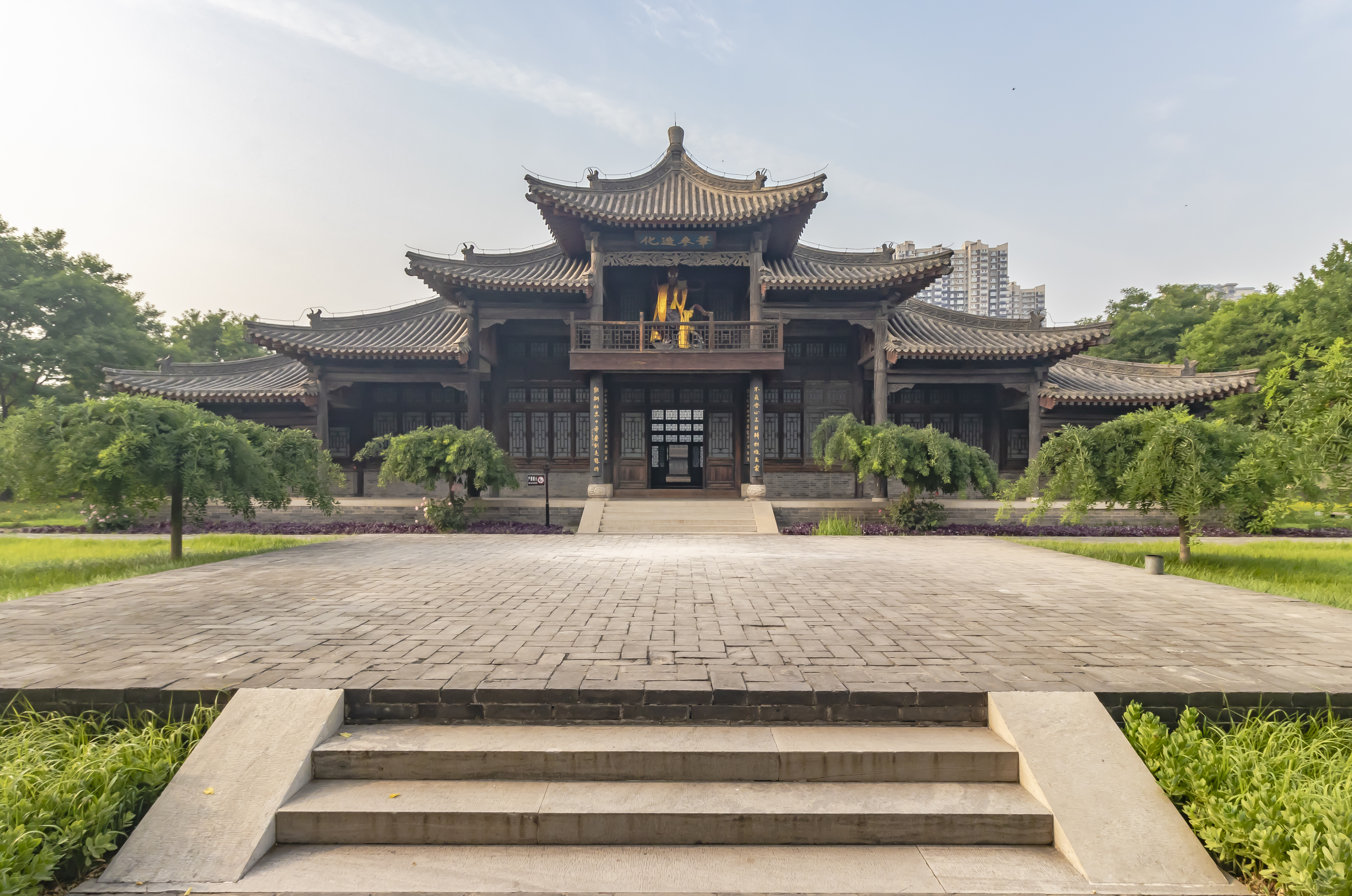
Dingzhou Examinational Hall
Imagine more than a hundred young men, each sealed in his own narrow cell, bent over a writing desk for days on end. Outside, ancient scholar trees -- said to have been planted by the Qianlong Emperor himself -- cast shade over a compound designed for a single purpose: to determine who was worthy of governing. The Dingzhou Examination Hall in Hebei Province is the most complete surviving imperial examination site in northern China, a place where the machinery of China's meritocratic bureaucracy is still legible in stone, brick, and the silent geometry of examination cells.
The Architecture of Ambition
Built in 1738 during the third year of the Qianlong reign, the examination hall was established by Prefect Wang Danian as a venue for the Tongshi examinations -- the first rung of the imperial examination ladder. The compound covers 22,150 square meters, with 1,547 square meters of floor space. Its current form dates largely from 1834, when Prefect Wang Zhonghuai oversaw a major expansion. The complex is organized along a ceremonial axis, beginning with a screen wall 22.5 meters long and 6.1 meters high that served double duty: decorative barrier and public bulletin board where examination results were posted. Beyond it, the Kuige Examination Cells form the heart of the compound -- seven bays wide and nine bays deep, large enough to hold over a hundred candidates simultaneously.
Where the Short Side Faces You
The Kuige pavilion at the southern end of the examination building contains an architectural oddity rare in traditional Chinese construction: the short side of the building serves as the entrance facade. This unusual orientation creates an elegant, narrow front that opens into the deeper examination space behind. The roof above is a half-pyramid structure that once housed a statue of Kuixing, the star deity associated with literary success. Candidates would have passed beneath Kuixing's gaze on their way to their cells, a last celestial endorsement before the grueling test. At the northern end of the compound, the Lansheng Tower -- a two-story structure -- served as offices and living quarters for the examiners who graded the papers and determined futures.
Meritocracy in Practice
China's imperial examination system operated for roughly 1,300 years, from the Sui dynasty through 1905. At its best, it offered a path from rural poverty to government office based on demonstrated knowledge of Confucian classics, literary composition, and policy analysis. The Dingzhou hall served the Tongshi level, where candidates earned the basic qualification needed to advance through successively more demanding tests -- prefectural, provincial, and finally the metropolitan examination in Beijing. During restoration work in 2019, workers discovered a stele from 1838 that detailed the hall's construction history, adding documentary evidence to what the architecture already showed: that maintaining these examination compounds was a matter of state concern. The hall was listed as a Major National Historical and Cultural Site in 2001, recognition that its value extends beyond architecture to the idea it embodied -- that talent, properly tested, should govern.
From the Air
The Dingzhou Examinational Hall is located at 38.51°N, 115.00°E in Dingzhou City, Hebei Province, on the flat North China Plain. The compound is situated in the northern district of Dingzhou's historic center, near the Liaodi Pagoda. Nearest major airport is Shijiazhuang Zhengding International Airport (ICAO: ZBSJ), approximately 80 km to the southwest. Best viewed at 2,000-3,000 feet AGL to see the compound layout.