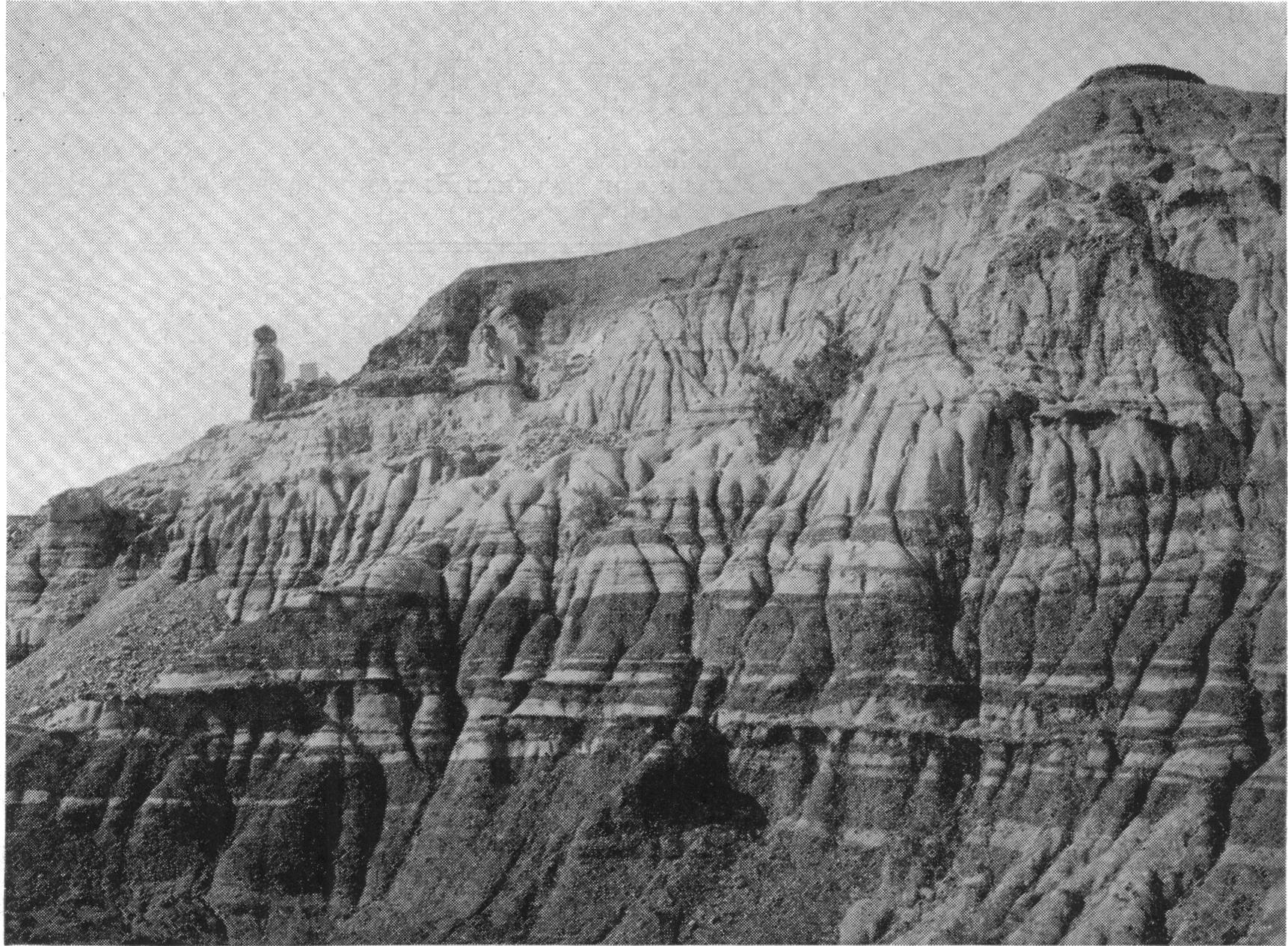
Dinosaur Park Formation
The bones here sometimes still have skin attached. Paleontologists working the eroded badlands flanking the Red Deer River in southern Alberta have uncovered dinosaur skeletons so well preserved that soft tissues remain visible after 75 million years. The Dinosaur Park Formation, a layer of sediment deposited between 76.5 and 74.4 million years ago during the Late Cretaceous, has yielded such dense concentrations of articulated skeletons that UNESCO designated the area a World Heritage Site. This was once a coastal plain at the edge of an inland sea that covered much of North America, and the warm, wet conditions created perfect preservation in the mud and sand that became stone.
A Graveyard of Giants
The numbers stagger: dozens of dinosaur species have been recovered from the formation, from massive ceratopsians like Centrosaurus and the newly identified Vagaceratops irvinensis to duck-billed hadrosaurs like Lambeosaurus magnicristatus. Paleontologists Darren Tanke and M.K. Brett-Surman discovered that hadrosaurs nested in both the ancient uplands and lowlands here, leaving behind eggshells and the bones of hatchlings. Armored ankylosaurs left fragmentary remains of their bony plates and thick skulls. The predators came too: tyrannosaurs including specimens recently identified as Daspletosaurus horneri, their teeth scattered among the bones of their prey. Above them all soared Cryodrakon, an azhdarchid pterosaur known from specimens both small and impressively large.
The Living World
Dinosaurs dominated the landscape, but they shared it with a remarkable diversity of life. Crocodilians like Albertochampsa and Leidyosuchus lurked in the waterways alongside champsosaurs, aquatic reptiles that superficially resembled crocodiles. Turtles of at least ten species left their shells in the sediment. Helodermatid and varanid lizards hunted smaller prey. In the rivers swam carpet sharks, rays, guitarfish, and gars, while ancient pike and salmonids moved through freshwater channels. The plant world included towering sequoias and cypresses, ginkgoes, and flowering plants like sycamores and early grapes. Pollen and spore fossils reveal at least 88 species of flowering plants alone, plus dozens of ferns, mosses, and club mosses.
The Vanishing Fauna
Something happened near the top of the formation. The familiar dinosaurs of the lower layers begin to disappear, replaced by rarer species: an unnamed pachyrhinosaur, the newly described Vagaceratops, the crested hadrosaur Lambeosaurus magnicristatus. Paleontologists believe a third distinct fauna may have replaced the earlier two as conditions changed, perhaps as the Bearpaw Sea transgressed onto the land from the east. The marine Bearpaw Formation lies directly above the Dinosaur Park sediments, recording the advance of that shallow sea. The transition captures a snapshot of ecosystems in flux, dinosaur populations shifting as their world transformed around them in the final millions of years before the mass extinction.
Badlands Revealed
The Red Deer River carved through these ancient sediments, exposing the bone-rich layers in dramatic badlands topography. The eroded hoodoos and coulees of Dinosaur Provincial Park create an otherworldly landscape where new fossils emerge each year as wind and water strip away the protective rock. Since the early 1900s, paleontologists have worked these exposures, shipping complete skeletons to museums worldwide. The park's visitor center displays casts and original specimens, while the Royal Tyrrell Museum in nearby Drumheller houses one of the world's finest collections of Dinosaur Park Formation fossils, including many of the type specimens that define entire species.
From the Air
The Dinosaur Park Formation is exposed at 49.20N, 110.40W in the badlands of Dinosaur Provincial Park, Alberta. The Red Deer River carves through the landscape, creating dramatic eroded terrain visible from altitude. Nearest major airport is Calgary International (CYYC), approximately 150 km west. Medicine Hat Airport (CYXH) is closer at roughly 100 km east. Best viewed at 2,000-4,000 feet AGL to appreciate the badlands topography. The distinctive striped layers of sediment are visible in the canyon walls.