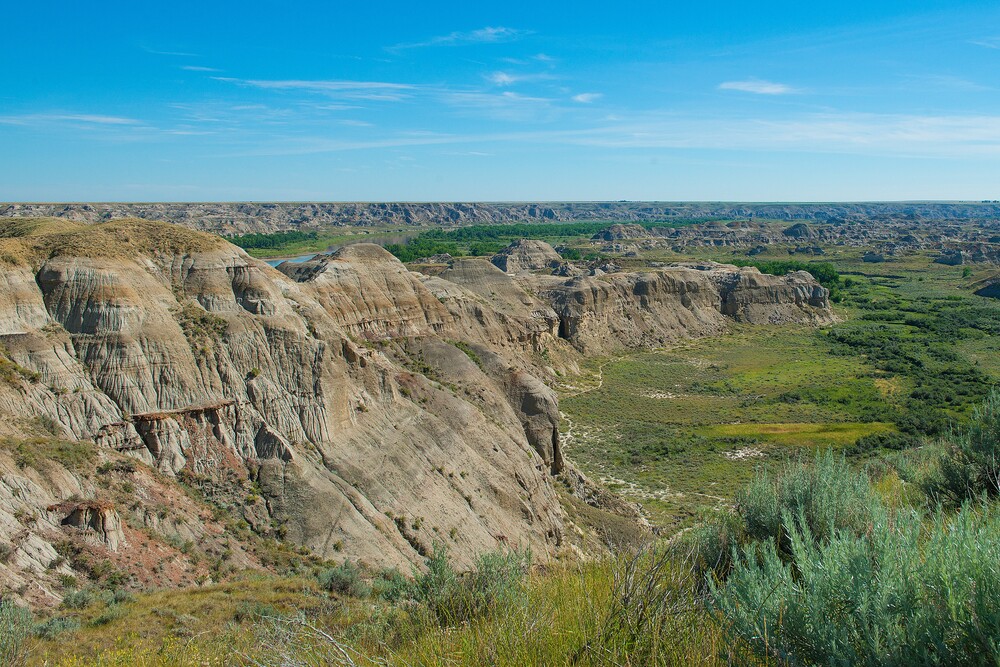
Dinosaur Provincial Park
Dinosaur Provincial Park contains the world's richest concentration of Late Cretaceous dinosaur fossils. Over 500 dinosaur skeletons have been excavated here and shipped to museums around the world. Forty distinct species have been identified - more than at any other site on Earth. The badlands along the Red Deer River in southern Alberta expose 75-million-year-old sediments from a time when this region was a warm, swampy coastal plain on the edge of an inland sea. Dinosaurs lived, died, and were buried here in extraordinary numbers. When erosion began exposing their bones in the late 1800s, the area became a paleontological bonanza. Collecting expeditions from Europe and North America competed for specimens in what became known as the 'Great Canadian Dinosaur Rush.' Today the park is a UNESCO World Heritage Site where fossils still emerge from the eroding badlands.
The Environment
Seventy-five million years ago, this region was unrecognizable. A warm, humid coastal plain bordered the Western Interior Seaway, an inland sea that split North America. Rivers deposited sediments that would become the Dinosaur Park Formation. The climate was subtropical; the vegetation was lush. Dinosaurs thrived: hadrosaurs (duck-billed dinosaurs), ceratopsians (horned dinosaurs), tyrannosaurs, and smaller species. When they died, many were buried quickly by sediment, preserving their bones. The fossil record captures an entire ecosystem, including plants, fish, turtles, crocodilians, and mammals.
The Rush
The 'Great Canadian Dinosaur Rush' ran from 1910 to 1917, as collecting expeditions from American and Canadian museums competed for specimens. Barnum Brown of the American Museum of Natural History worked from a floating camp on the Red Deer River. The Sternberg family collected for the Geological Survey of Canada. The expeditions removed hundreds of specimens, now displayed in museums worldwide. New York, Ottawa, London, and Toronto all have dinosaurs from Dinosaur Provincial Park. The rush ended when World War I diverted resources; by then, the site's global significance was established.
The Species
More than 40 dinosaur species have been identified from the park - an extraordinary diversity. Hadrosaurs like Corythosaurus, Lambeosaurus, and Parasaurolophus (with their distinctive crests) are common. Ceratopsians include Centrosaurus and Styracosaurus. Predators like Gorgosaurus hunted here. Smaller dinosaurs, including ornithomimids (ostrich-mimics) and dromaeosaurs (raptor-like hunters), round out the ecosystem. The diversity suggests a healthy, complex environment supporting multiple species and ecological niches. Many species are known primarily or exclusively from this site.
The Protection
Dinosaur Provincial Park became a UNESCO World Heritage Site in 1979, recognizing both its paleontological importance and the beauty of its badlands landscape. Collecting is now strictly controlled; removing fossils is illegal without permit. Researchers continue to make discoveries - new species are still being described. The park interprets the fossils in context: guided hikes explore the badlands, and the visitor center explains the science. The challenge is preservation: the same erosion that exposes fossils also destroys them. What's visible today won't exist in a few decades.
Visiting Dinosaur Provincial Park
Dinosaur Provincial Park is located in southeastern Alberta, about 180 km east of Calgary near the town of Brooks. The visitor center provides orientation and exhibits. Public areas offer self-guided hiking through the badlands. Protected areas - with the best fossil exposures - are accessible only through guided programs; book well in advance. Options include bus tours, interpretive hikes, and excavation experiences. Camping is available in the park. The badlands are spectacular at sunrise and sunset. Summer is hot; bring water and sun protection. Calgary International Airport (YYC) is the nearest major airport. The town of Brooks has services. Allow at least half a day; fossil enthusiasts need more.
From the Air
Located at 50.77°N, 111.52°W along the Red Deer River in southeastern Alberta, Canada. From altitude, the park is visible as a dramatic badlands landscape carved into the surrounding prairie - a serpentine ribbon of eroded terrain following the river valley. The transition from flat agricultural land to deeply eroded badlands is abrupt and striking. The Red Deer River winds through the park. The isolation of the badlands within the prairie is evident; this is an island of ancient landscape in a sea of modern agriculture.