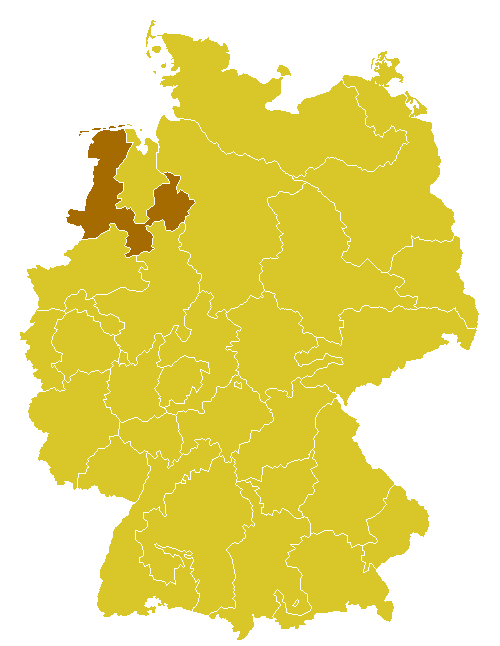
Diocese of Osnabrück
In 1764, a baby 196 days old became Prince-Bishop of Osnabrück. He was Prince Frederick, second son of King George III of Britain, and he had been entitled to the office before he could lift his own head. He held the title until 1803. He never set foot in his diocese. He was Lutheran. This was not absurdity but treaty: under the Peace of Westphalia signed in Osnabrück itself in 1648, the bishop's chair alternated between a Catholic prelate and a Protestant prince - so the diocese, founded by Charlemagne to Christianise the pagan Saxons, spent most of its later history being run, on paper, by men who would not have shared its sacraments.
Charlemagne's First See
The Diocese of Osnabrück was erected in 772, making it the oldest diocese Charlemagne founded as he hammered Saxony into Christendom by sword and pulpit. The first bishop, Saint Wilho, served from 785 to 804. His successor Meginhard - sometimes spelled Meingoz - was the one who actually built the institution out of nothing, organising parishes across a forested borderland where pagan groves had stood within living memory. For its first thousand years the diocese answered to the Archbishop of Cologne as suffragan. The bishopric grew temporally as well as spiritually, becoming a Hochstift, a prince-bishopric where the bishop ruled as both pastor and prince, levying taxes and raising soldiers across territory that would one day form the western half of Lower Saxony. The cathedral chapter, the convents, the Catholic schools - all of it grew under that double crown.
The Parish-by-Parish Reformation
When Luther's revolt rolled north in the sixteenth century, Osnabrück refused to choose. Instead of converting wholesale or holding the line as a Catholic stronghold, each parish made its own peace with the new theology. Some kept the mass and rejected Rome's authority; some kept Rome and edited the liturgy; some went fully Lutheran. The Peace of Westphalia, negotiated in Osnabrück's own town hall from 1643 to 1648, froze the patchwork in place: every parish would remain as it had been in 1624. Then it added a stranger clause. The prince-bishop's chair would alternate between Catholic and Lutheran holders, drawn for the Protestant rotations from the Brunswick-Lüneburg dukes - the family that would become the House of Hanover and inherit Britain. While a Lutheran prince held the temporal office, the Archbishop of Cologne quietly oversaw Catholic worship across the same territory. Two churches, one address, by treaty.
The Infant Bishop and the End of Princes
The most extreme product of that arrangement was Frederick, Duke of York and Albany, made prince-bishop in 1764 at the age of 197 days because he was the younger son of George III and the Hanoverians had the next Protestant turn. The boy grew up in England, became a soldier, gave his name to the nursery rhyme about marching ten thousand men up a hill and back down again, and held the Osnabrück title until 1803. In 1803, Napoleon's German Mediatisation swept the entire arrangement away. The prince-bishopric was dissolved and absorbed into Hanover. The convents were secularised, the cathedral chapter dissolved, the see left vacant. The territory was traded around the room - Prussia in 1806, the Kingdom of Westphalia in 1807, Napoleonic France in 1810, back to Hanover in 1814 - while Klemens von Gruben quietly looked after the surviving Catholic parishes as Vicar Apostolic, a man with no diocese but the people in it.
Restoration and the Long Reach North
Pope Leo XII brought the diocese back to life on 26 March 1824 with the bull Impensa Romanorum Pontificum, restoring Osnabrück as a see directly answerable to Rome. For thirty years it shared a bishop with Hildesheim. Then in 1857, with the consent of King George V of Hanover, Pope Pius IX appointed Paul Melchers as the first independent bishop in over half a century. From there the diocese kept expanding. In 1930, after the Prussian Concordat, the Northern Missions were folded in - Hamburg, Bremen, Schleswig-Holstein, Mecklenburg, Schaumburg-Lippe - putting Osnabrück's bishop in charge of Catholics across a vast Protestant north. That arrangement held until 1995, when the northern reaches were spun off into the new Archdiocese of Hamburg, and Osnabrück, the oldest see north of the Rhine, became its suffragan. Dominicus Meier was installed as bishop in May 2024.
Twelve Hundred Years in One Cathedral City
Walk into the Romanesque cathedral of St Peter's in the old town and the layers are visible in the stonework: foundations from the eighth century, naves from the twelfth, baroque additions wedged into Gothic windows. The Triumphkreuz, the great triumphal cross above the choir, has watched bishops come and go since around 1230. The diocesan archive holds documents back to the 800s, in handwriting that predates the language they were trying to evangelise. For a city of just 170,000 people, Osnabrück carries an unusual weight of religious history: the cathedral chapter, the seminary, the diocesan museum, and the modern bishop's office sit within a few minutes' walk of the town hall where the Catholic and Protestant envoys of the Thirty Years' War once worked out who would oversee whose souls.
From the Air
The cathedral and diocesan offices cluster at 52.28°N, 8.04°E in Osnabrück's old town. EDDG (Münster/Osnabrück International) lies 30 km north for direct access; EDDV (Hanover) and EDDP (Paderborn-Lippstadt) work as alternates. At 8,000-10,000 feet on the approach from the southwest, the cathedral's twin towers stand out against the half-timbered Altstadt and the medieval city wall remnants.