Diocese of Rotterdam
By the standards of the Catholic Church, where dioceses can trace their lineage to Roman antiquity, Rotterdam is brand new. The diocese was erected on July 16, 1955, splitting off from the much older Diocese of Haarlem along with a sibling diocese carved out the same day - the Diocese of Groningen, on the opposite end of the country. The pope who signed it into being, Pius XII, was responding to a Dutch Catholic population that had grown and shifted south during the twentieth century and needed governance closer to home. Three decades later, in May 1985, John Paul II would walk through Rotterdam himself, the first reigning pope ever to set foot in the new diocese.
A Minority Church in a Secular Land
The numbers tell a particular story. As of 2014, the diocese served about 531,600 Catholics in a population of 3.66 million - roughly 14.5 percent of the people in its 3,403 square kilometers of South Holland province. The rest are mostly Protestants, atheists, and the religiously unaffiliated, in a country where weekly Mass attendance has been in long decline. The diocese has 358 priests, 110 of them diocesan and 248 from religious orders, plus 34 deacons and 452 lay religious - brothers and sisters running schools, hospitals, charities. Only 6 seminarians were in training that year. Catholic Holland has always been a minority church, suspicious of itself and suspect to its neighbors, and Rotterdam diocese inherits that long Dutch experience of Catholicism as the second tradition rather than the first.
The Cathedral and the Basilica
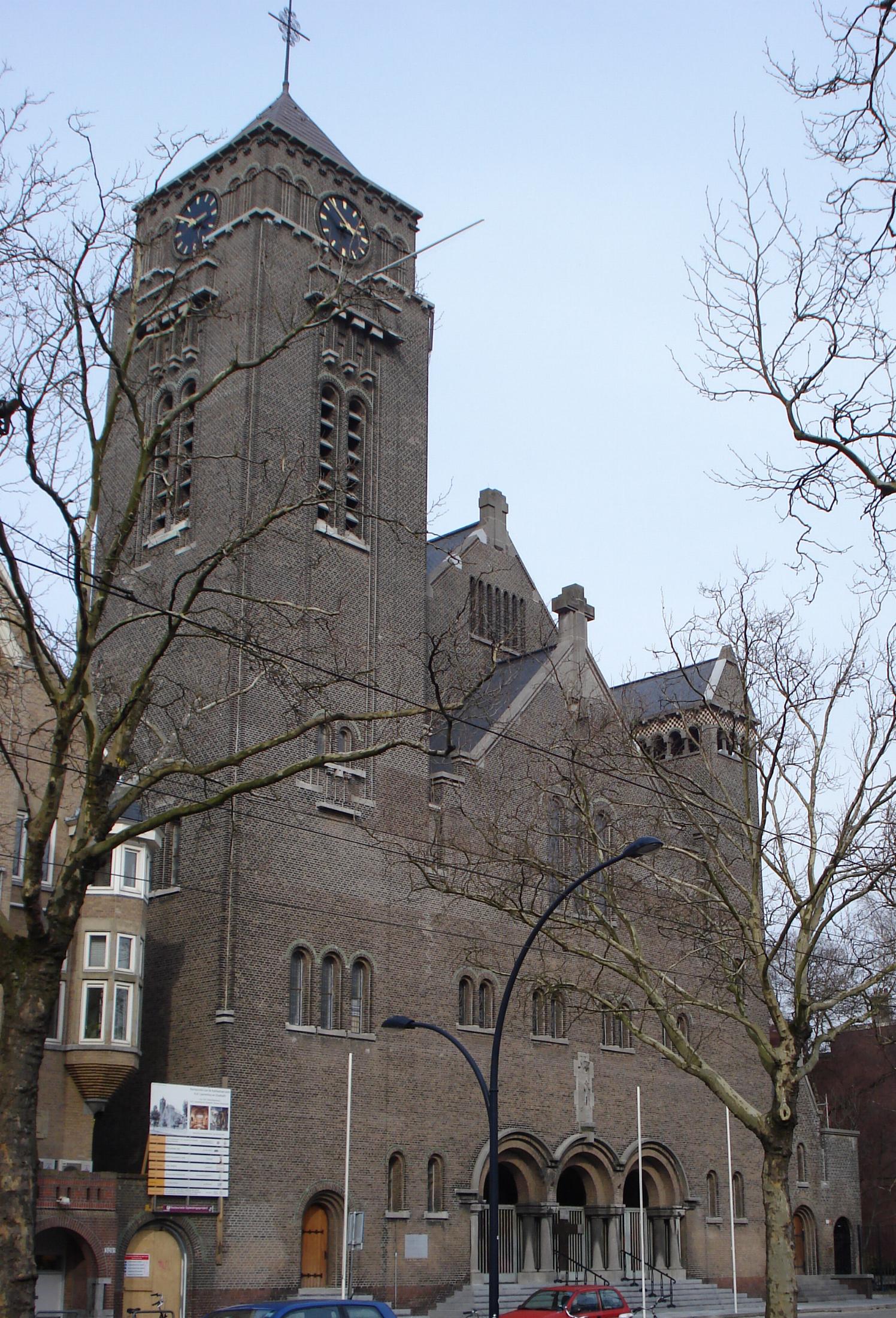
The diocese's cathedral is the Kathedrale Kerk van de HH Laurentius en Elisabeth in Rotterdam - dedicated to Saints Lawrence and Elisabeth, the early Christian deacon martyred in third-century Rome and the medieval Hungarian princess who fed the poor. The cathedral church is the bishop's seat, the formal cathedra from which the diocese takes its name. The only minor basilica - a higher honorary rank granted by the Vatican - sits a few kilometers west in Schiedam: the Basiliek van de H. Liduina en Onze Lieve Vrouw van de Rozenkrans. It is dedicated to Saint Liduina, a fourteenth-century mystic from Schiedam who suffered for thirty-eight years from a chronic illness contracted after a skating accident, and to Our Lady of the Rosary. Both buildings have survived the destruction Rotterdam endured in 1940.
Bishops of a Small See
Only five men have ever been Bishop of Rotterdam. The first, Martien Jansen, was installed in March 1956 and served until 1970. His successor, Adrianus Johannes Simonis, lasted thirteen years before being promoted to Archbishop of Utrecht in 1983 and later being created a cardinal-priest at the Church of San Clemente in Rome - the most prominent Dutch Catholic of his generation. Ronald Bär, a Benedictine, took the chair from 1983 to 1993, serving simultaneously as the last military vicar and first military ordinary of the Netherlands armed forces. Adrianus van Luyn, a Salesian, served from 1993 to 2011 and was elected president of the Council of European Bishops' Conferences along the way. The current bishop, Hans van den Hende, was installed in May 2011 and has served since 2016 as president of the Dutch Bishops' Conference.
The Geography of Parish Life
On paper the diocese contains 75 parishes; on the ground the structure is denser and more complicated, organized into two vicariates - Rotterdam itself, and The Hague - each subdivided into clusters and federations. Some parishes serve a single Rotterdam neighborhood; others stretch across half a dozen villages in the Westland, the greenhouse country between Delft and the sea. There are parishes named for medieval Dutch martyrs - the Holy Martyrs of Gorcum, executed by Calvinists in 1572 - and parishes named for the universal saints of any Catholic almanac: Augustine, Anthony, Joseph, Willibrord the missionary who first preached the faith here in the eighth century. Every parish is shrinking, merging, consolidating; the diocese's actual parish footprint in 2026 looks very different from what was drawn in 1956. The work of keeping a church alive in secular Europe is mostly the work of redrawing maps.
A Suffragan See
Rotterdam is what the Church calls a suffragan diocese - meaning it sits beneath a metropolitan archbishopric, in this case the ancient Archdiocese of Utrecht, which dates to Willibrord's mission in 695. The arrangement places Rotterdam in the ecclesiastical province of Utrecht alongside Haarlem-Amsterdam, Breda, 's-Hertogenbosch, Roermond, and Groningen-Leeuwarden, a tidy six-suffragan province covering the whole country. When Catholic Holland needs to speak with one voice - to government, to the press, to Rome - it does so through the Bishops' Conference, where Hans van den Hende currently sits as president. The youngest diocese in the country thus speaks, for now, for the oldest church in it.
From the Air
The diocesan see sits at approximately 51.93°N, 4.48°E in central Rotterdam, with the cathedral of Saints Lawrence and Elisabeth on Mathenesserlaan in the heart of the city. The territory of the diocese covers South Holland province south of a line roughly through Leiden, extending east to the Lek river and south to the islands of Voorne-Putten and Hoeksche Waard. Closest major airport is Rotterdam The Hague (EHRD), about 4 km north of the cathedral; Schiphol (EHAM) is roughly 55 km north-northeast. From cruising altitude the cathedral itself is hard to pick out among Rotterdam's postwar skyline, but the diocese's geography becomes visible in the long line of village church spires marking older Catholic strongholds in the Westland and along the Maas. Plan for EHRD controlled airspace; viewing altitude 3,000-6,000 feet.