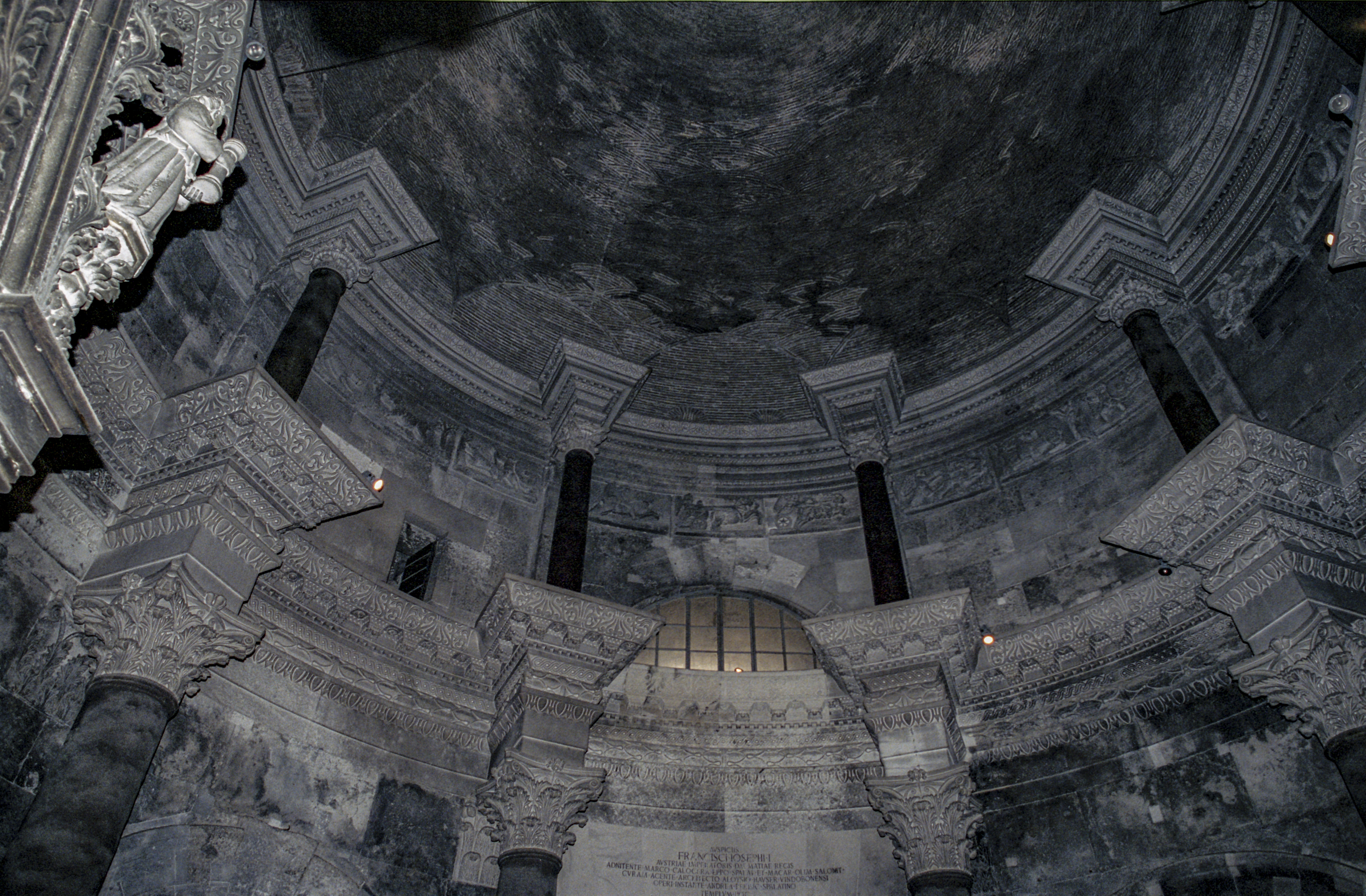
Diocletian's Palace
When delegates begged Diocletian to return to power and resolve the civil wars tearing Rome apart, the old emperor reportedly told them that if they could see the cabbages he had grown with his own hands, they would understand why he refused. It is one of history's more eccentric retirement speeches, and it was delivered from a palace built to match the scale of its owner's ambitions. Constructed around 295 CE on a peninsula six kilometers from the city of Salona -- then the capital of Roman Dalmatia, with a population of 60,000 -- Diocletian's Palace was half imperial residence and half military fortress, modeled on the Roman forts that lined the empire's borders. Today it forms roughly half the old town of Split, Croatia, a UNESCO World Heritage Site since 1979 where 3,000 people live, work, and dine inside walls that a Roman emperor built for solitude.
An Emperor Steps Down
Diocletian became the first Roman emperor to voluntarily give up power on May 1, 305 CE. This was not a gesture of humility but a calculated political act. He had devised the Tetrarchy -- a system in which four co-emperors shared rule over different quadrants of the empire -- and his abdication was supposed to demonstrate that the system could outlast any individual. It did not. Within years, his successors turned on each other. Constantine rose. Maxentius usurped. Diocletian watched from his palace gardens as the system he had designed collapsed under the weight of the ambitions he had tried to distribute. Statues and portraits of his former co-emperor Maximian were torn down within the palace itself. Diocletian died on December 3, 312 CE, deep in despair and illness, possibly by his own hand. The palace that was meant to be a monument to ordered succession became instead a monument to how quickly order unravels.
Limestone, Brick, and Greek Hands
Construction began around 295 CE, though the palace was likely still unfinished when Diocletian moved in a decade later. The workforce was drawn from across the empire. Engraved Greek names -- Zotikos and Filotas among them -- and numerous Greek inscriptions indicate that many builders came from the eastern provinces, brought by an emperor who was himself born nearby in Spalatum. Local labor contributed too, and the materials came from close at hand: white limestone quarried from the island of Brac and from Seget near Trogir, tufa extracted from riverbeds, and bricks fired in workshops at Spalatum and surrounding towns. The complex measured roughly 215 by 180 meters, covering over 30,000 square meters. Its design borrowed from the Roman military fort tradition of the 3rd century -- rectangular, walled, gated on four sides -- but adapted it to serve the dual purpose of defense and domestic comfort. Half the interior was given over to the emperor's private quarters; the other half housed his military garrison.
From Palace to City
After Diocletian's death, the palace served various administrative purposes, but the transformation that defines it came centuries later. When Slavic raiders destroyed nearby Salona in the 7th century, refugees fled to the abandoned palace and made it their home. Imperial chambers became apartments. The mausoleum where Diocletian was entombed became the Cathedral of Saint Domnius -- an irony not lost on anyone who remembers that Diocletian was one of Christianity's most vigorous persecutors. The Peristyle, once the emperor's ceremonial reception courtyard, became the town square. Streets followed the original Roman grid. Walls that had kept out barbarian armies now sheltered a growing medieval city. This organic transformation is what makes the palace unique among Roman monuments. It was never abandoned, never preserved as a ruin, never fenced off for study. Instead, it was continuously inhabited and adapted, each century adding its own layer without fully erasing what came before.
The Four Gates
Four gates pierced the palace walls, each facing a cardinal direction. The Golden Gate on the north led toward Salona. The Silver Gate opened east. The Iron Gate faced west, and the Bronze Gate looked south toward the sea. Today, walking through these gates is the experience that most clearly conveys the scale of the original construction. The walls still stand to impressive height, and passing through them delivers you from modern Split into the compressed density of the palace interior, where narrow lanes thread between structures spanning seventeen centuries of construction. The Bronze Gate leads directly into the palace's substructure -- vaulted basement halls that mirror the layout of the imperial apartments above. These basements survived largely intact because they were filled with centuries of accumulated refuse, which, paradoxically, preserved them. Cleared in the 20th century, they now host markets and exhibitions, their barrel-vaulted ceilings offering the closest thing to an unaltered Roman interior that the palace preserves.
Living Inside History
What distinguishes Diocletian's Palace from every other Roman monument in Europe is that it never stopped being used. This is not a site where ropes keep visitors at a respectful distance from fragile walls. Restaurants fill vaulted Roman basements. Laundry hangs from windows set into imperial stonework. Shops line underground passages where soldiers once patrolled. Cafes occupy the Peristyle, and evening concerts echo off the same columns that once framed Diocletian's entrance. Some archaeologists might wish for a more protective approach, but Split chose habitation over preservation, and the result is a place where Roman architecture is not studied at arm's length but lived in, daily and without ceremony. Three thousand residents call the palace home. They share it with tourists, students, and stray cats, all of them moving through spaces a Roman emperor designed for one man's retirement -- a retirement that proved as impermanent as the political system its architect created.
From the Air
Diocletian's Palace (43.508N, 16.438E) sits on Split's waterfront in Croatia. Split Airport (LDSP/SPU) is 24km west, with runway 05/23 measuring 2,550m. From the air, the palace's rectangular footprint is visible as the dense historic core along the harbor. The southern wall faces the Adriatic, and the distinctive rectangular layout -- roughly 215m x 180m -- is discernible from low altitude. The Marjan peninsula extends west of the city. Islands of Brac and Hvar are visible offshore to the south. Weather is Mediterranean: hot, dry summers and mild winters with occasional Bora winds.