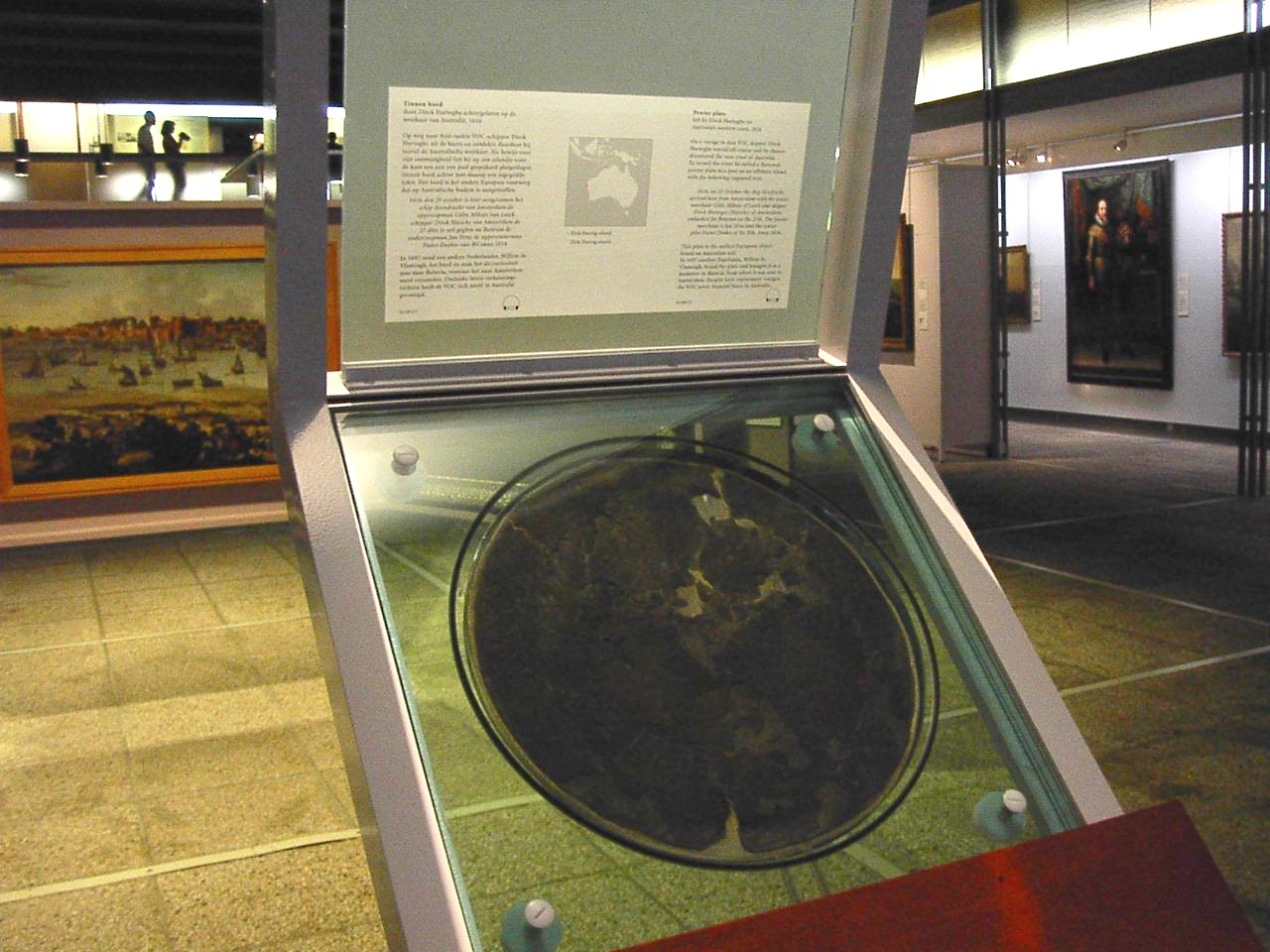
Dirk Hartog Island
A pewter dinner plate, nailed to a wooden post and wedged into a cliff-top fissure -- that was what Dutch captain Dirk Hartog left behind on 25 October 1616, after becoming the first confirmed European to set foot on the Western Australian coast. The plate recorded the date, the ship Eendracht, and the names of the senior crew. Four centuries later, the island that bears his name is the site of one of the most ambitious ecological restoration projects in Australia: an attempt to wind the clock back to the very day Hartog stepped ashore.
A Parade of Plates
Known as Wirruwana to its traditional custodians, the Malgana people, Dirk Hartog Island stretches 80 km along the Gascoyne coast, covering 620 square kilometers of scrub-covered sand dunes within the Shark Bay World Heritage Area. Hartog's pewter plate survived 81 years of wind and salt before Dutch captain Willem de Vlamingh found it in 1697, its post nearly rotted away. De Vlamingh replaced it with his own plate -- copying Hartog's inscription and adding the details of his own voyage -- and sent the original home to Amsterdam, where it sits in the Rijksmuseum today. In 1772, French navigator Louis Aleno de Saint-Alouarn buried bottles containing an annexation document and a coin, claiming the land for Louis XV. One bottle was unearthed in 1998, its lead cap still intact, though the annexation document was never found.
The Plate's Odyssey
De Vlamingh's replacement plate had its own eventful journey. In 1801, Emmanuel Hamelin's expedition found it half-buried in sand and re-erected it. Seventeen years later, Louis de Freycinet -- who had served under Hamelin -- sent men ashore to take the plate to France. It arrived in Paris, was presented to the Academie Francaise, and then vanished. For over a century it sat unrecognized on the bottom shelf of a small room, mixed in with old copper engraving plates. It was rediscovered in 1940 and, in recognition of Australian sacrifices in the defense of France during two world wars, returned to Australia in 1947. Today it is displayed at the Western Australian Maritime Museum in Fremantle. The northern tip where all this inscription happened is aptly named Cape Inscription, and its lighthouse still marks the spot.
From Sheep Station to National Park
By the late 19th century, the island's history had shifted from maritime exploration to pastoralism. Francis Louis von Bibra took a lease in 1869, grazing sheep and trading guano. The Withnell brothers acquired the property in 1907 and built it into a substantial operation -- by 1919 the island carried approximately 19,000 sheep across 153,000 acres. Perth Lord Mayor Sir Thomas Wardle purchased the island as a private retreat around 1969, eventually retiring there as a semi-recluse. The island later returned to government ownership and became Dirk Hartog Island National Park, part of the Shark Bay Marine Park. A small area remains leased to Wardle's grandson, Kieran, who operates it as an eco-tourism resort.
Return to 1616
The ecological cost of 150 years of sheep, goats, and feral cats was severe. In 2018, after a six-year eradication campaign, the island was declared free of all introduced animals. The 'Return to 1616' project then began reintroducing native species confirmed to have once lived here. Rufous hare-wallabies and banded hare-wallabies came first in 2017. Western barred bandicoots and dibblers followed in 2019, with proof of dibbler reproduction confirmed by June 2021. Shark Bay mice, greater stick-nest rats, and western thick-billed grasswrens arrived between 2021 and 2022. By November 2022, all six reintroduced mammal species were breeding. Brush-tailed bettongs were released in April 2025, though unusually hot and dry conditions caused high initial mortality before surviving animals began to breed. The island also hosts loggerhead and green turtle nesting beaches and an endemic subspecies of the white-winged fairy-wren. The goal is a population of 3,000 native mammals -- an ark built on sand dunes.
From the Air
Dirk Hartog Island is at approximately 25.80S, 113.05E, clearly visible from the air as an 80-km-long island separated from the mainland by Shark Bay. Cape Inscription lighthouse marks the northern tip. The nearest commercial airport is Shark Bay / Monkey Mia (YSHK), about 70 km east. From altitude, the island's scrub-covered dunes contrast sharply with the turquoise shallows of Shark Bay to the east and the dark Indian Ocean to the west. Recommended viewing altitude: 5,000-8,000 ft for the full island silhouette.