Disappearance of Natalee Holloway
Carlos'n Charlie's stays open late. The nightclub sits in Oranjestad's tourist strip, a place designed for exactly the kind of celebration that brings American high school graduates to Aruba every spring -- loud music, cheap drinks, the giddy release of finishing school. On the night of May 30, 2005, Natalee Holloway walked out of those doors and into a car with three young men she had met hours earlier. She was 18 years old, days removed from her graduation ceremony at Mountain Brook High School in Alabama, traveling with 124 classmates on a senior trip. No one in the group would see her again.
The Last Night in Oranjestad
Holloway had been born in Memphis, Tennessee, in 1986, the eldest daughter of Dave and Beth Holloway. She grew up in Mountain Brook, an affluent suburb of Birmingham, Alabama, where she was known as a dependable, high-achieving student. The senior trip to Aruba was a celebration she had earned. On that final night, witnesses saw her leave Carlos'n Charlie's around 1:30 a.m. with Joran van der Sloot, a 17-year-old Dutch national living in Aruba, and brothers Deepak and Satish Kalpoe. What happened after the car pulled away remains, in many respects, a question that took nearly two decades to answer -- and even then, the answer came without a body, without closure in the way families usually understand that word.
An Island Under a Microscope
The search that followed was massive. Aruban police, FBI agents, Dutch military personnel, and volunteer teams combed beaches, scrubland, and ocean floor. Divers explored offshore waters. Dogs tracked scent trails that went cold. The investigation consumed the small island, whose economy depends on the kind of carefree tourism that a missing-person case threatens to undermine. Van der Sloot and the Kalpoe brothers were arrested multiple times, then released each time for insufficient evidence. The cycle of arrest and release -- what CNN once called a pattern of "catch and release" -- frustrated Holloway's family and fueled a media frenzy that would reshape how Americans consumed crime news. Cable networks devoted hundreds of hours to the case, a level of saturation that eventually prompted its own backlash. Critics pointed out that the coverage exemplified what scholars call "missing white woman syndrome," the documented tendency for cases involving young white women to receive vastly disproportionate attention compared to those involving men or people of color.
Eighteen Years of Shifting Stories
Van der Sloot proved to be a person whose relationship with truth was, at best, adversarial. Over the years he offered multiple conflicting accounts of what happened to Holloway, claiming at various points that she had died on the morning of her disappearance, that an associate had disposed of her body, and that he had sold her into trafficking. He retracted each version and offered another. In 2010, while in Peru, he murdered Stephany Flores Ramirez in a Lima hotel room -- a crime for which he received a 28-year sentence. The killing demonstrated what Holloway's family had long suspected: that they were not dealing with a man who had made a single terrible mistake, but with someone capable of calculated violence. Aruban prosecutors had closed the Holloway case in December 2007. In January 2012, at her father's request, Natalee Holloway was declared legally dead.
A Confession, Two Decades Late
The case did not stay closed. In June 2023, van der Sloot was extradited from Peru to the United States to face charges of extortion and wire fraud -- he had attempted to sell information about Holloway's location to her mother, Beth, for $250,000. Landing at Birmingham's Shuttlesworth Airport, he was taken into federal custody and arraigned the following day. What came next was what the family had waited 18 years to hear. Van der Sloot pleaded guilty and confessed to killing Holloway by blunt-force trauma on the night she disappeared. The confession provided a kind of legal resolution, but it arrived without remains, without a grave to visit. He was returned to Peru to finish his murder sentence. The nightclub where it all began still operates in Oranjestad, steps from the waterfront where tourists disembark from cruise ships, most of them unaware of the history that unfolded just outside those doors.
What Aruba Remembers
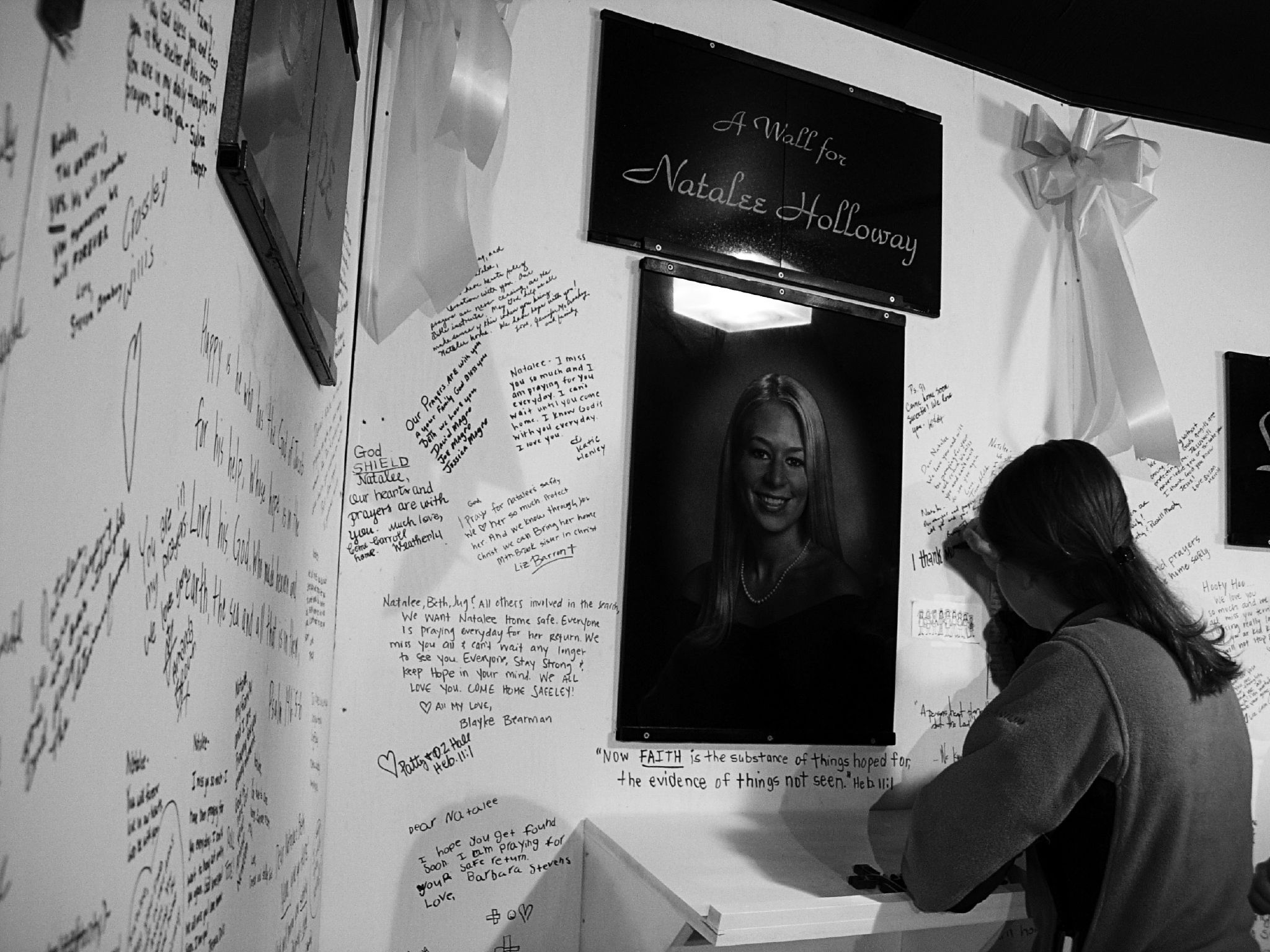
For the island itself, the case left scars that tourism brochures cannot paper over. Aruba's economy took a measurable hit in the years following the disappearance, as some American visitors boycotted the island and travel advisories circulated. The Los Angeles Times reported that Aruba "also suffers" -- a destination whose identity as a safe, sun-soaked paradise had been punctured by a single case. Locals expressed frustration at the perception that their home had become synonymous with danger, when Aruba's crime rate was, by Caribbean standards, remarkably low. The case raised uncomfortable questions about jurisdiction, about the limits of international cooperation in criminal investigations, and about whose disappearance merits a nation's attention. Natalee Holloway was a real person -- a daughter, a student, someone with plans she never got to carry out. The machinery of media and justice that surrounded her name sometimes obscured that simple, irreducible fact.
From the Air
The location (12.519N, 70.036W) is in downtown Oranjestad, Aruba's capital, along the waterfront tourist district. The area is visible when flying over Aruba's southwestern coast. Nearby airport: Queen Beatrix International Airport (TNCA), approximately 3 km southeast. Best viewed at 1,500-2,500 ft AGL for detail of the Oranjestad waterfront and harbor area. The nightclub district sits near the cruise ship terminal, identifiable by the long pier extending into the harbor.