Discovery Park (Seattle)
In September 2009, Seattle closed its largest public park because a cougar had taken up residence. Wildlife officials eventually trapped the animal and drove it to the Cascade Mountains, theorizing it had reached the 534-acre peninsula by walking along the shoreline at low tide or following the railroad tracks. That a mountain lion could navigate miles of urban terrain to reach a park inside city limits says something about Discovery Park: it is wild enough that a predator felt at home there. Forests, beaches, prairies, and bluffs dominate a landscape that most visitors experience on the 2.8-mile Loop Trail, designated a National Recreation Trail in 1975.
From Fort to Forest
Discovery Park exists because the Army changed its mind. In 1898, the Seattle Chamber of Commerce solicited donations of approximately 703 acres on the Magnolia peninsula for what became Fort Lawton. The fort opened in 1900 and served through two world wars. In 1938, the Army offered to sell it back to the city for a single dollar, but Seattle declined, citing maintenance costs. By 1971, the military finally surplused the land. The city accepted it in 1972 and dedicated it as Discovery Park in 1973, naming it for HMS Discovery, the British sloop that Captain George Vancouver commanded during the first European exploration of Puget Sound in 1792. Fort Lawton continued as an Army Reserve facility until its official closure on February 25, 2012. Most of the Fort Lawton Historic District now falls within the park, and both the district and the West Point Lighthouse are listed on the National Register of Historic Places.
At the Edge of the City
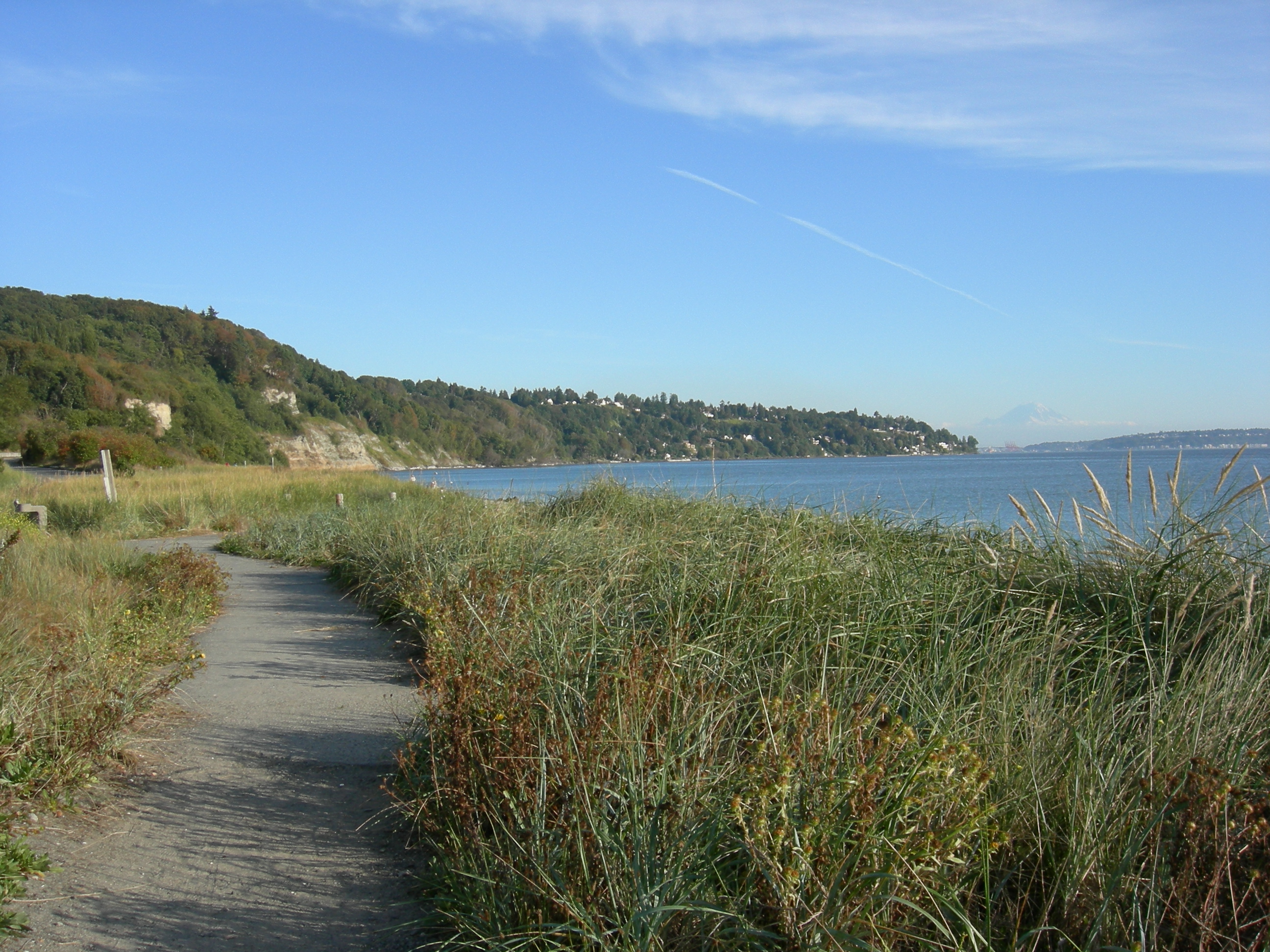
The park occupies a peninsula where Puget Sound meets the Magnolia neighborhood, and its geography creates an extraordinary diversity of habitats within city limits. The Seattle Audubon Society has documented 270 bird species in the park and nearby waters. Elliott and Shilshole Bays support harbor seals and California sea lions, while Townsend's chipmunks inhabit the wooded areas. The south beach faces windward toward Elliott Bay; the north beach sits on the leeward side with views of Shilshole Bay. Between them, at the westernmost point of the entire city of Seattle, stands West Point and its lighthouse. Bigleaf maple, red alder, Douglas-fir, western red cedar, and western hemlock form the tree canopy, though invasive species -- Himalayan blackberry, Scot's broom, English ivy -- require constant management. A black bear appeared in May 2009. Coyotes are semi-regular visitors.
Contested Ground
The park's former military land has attracted competing visions since the Army left. In 1970, Native American activists led by Bernie Whitebear occupied part of Fort Lawton, eventually winning 20 acres for the Daybreak Star Cultural Center, which opened in 1977 and remains a major nucleus of Native cultural activity. In 2008, plans to close Fort Lawton entirely reopened old debates: housing advocates wanted affordable units built on the surplus property, while neighborhood groups opposed the idea. The City Council approved up to 216 housing units, triggering a lawsuit. HUD weighed in, declaring that the need for homeless housing outweighed other proposals. The same year, a group of homeless people and their advocates set up camp in the park before the city forced them out. Discovery Park's identity has always been negotiated between those who see it as pristine nature and those who see undeveloped urban land as a resource for human needs.
Where the Music Echoed
In the early 1990s, Temple of the Dog -- the grunge supergroup featuring Chris Cornell and Eddie Vedder -- filmed the music video for "Hunger Strike" on the shores of Discovery Park. The footage captured the park's particular mood: gray water, weathered driftwood, a sky that can't decide between rain and light. It was a fitting setting for a song about compassion and deprivation, filmed in a park that was itself a story of surplus and scarcity, of land offered and refused and offered again. The park serves over 45,000 people annually through its environmental education programs, though a proposed 50 percent budget cut threatens to close the Visitor Center and eliminate nine staff positions. Community advocates are urging the city to restore funding, arguing that a park this size and this ecologically significant requires human stewards, not just trails.
From the Air
Located at 47.657N, 122.418W on the Magnolia peninsula in west Seattle. Discovery Park's 534 acres form a distinctive forested headland jutting into Puget Sound, easily identifiable from the air. The West Point Lighthouse marks the tip of the peninsula. The park is bounded by Elliott Bay to the south and Shilshole Bay to the north. The Ballard Locks are visible to the northeast. Nearest airports: Boeing Field/King County International (KBFI), 7 nm south-southeast; Seattle-Tacoma International (KSEA), 13 nm south.