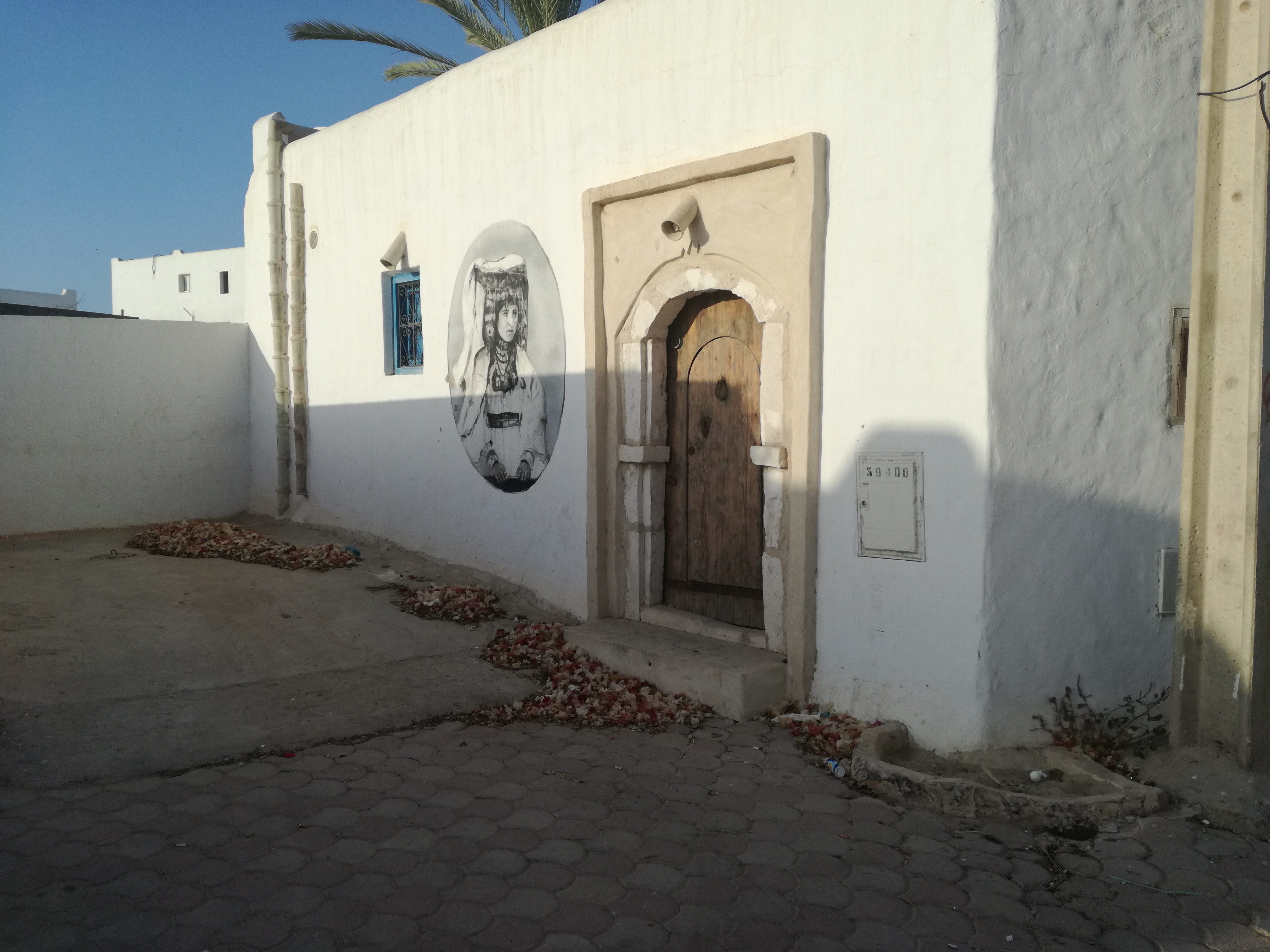
Djerbahood
The giant letters spelling THE HOOD appeared first, installed by the artist Rodolphe Cintorino at the entrance to Erriadh, a village on the Tunisian island of Djerba also known as El Hara Sghira, meaning "the small neighborhood" in Arabic. The letters named the project before the organizers had settled on one. In June 2014, 150 street artists from 30 countries arrived in this ancient village, and by the time they left, they had consumed 4,500 cans of spray paint and created 250 murals across the walls of a community that had been struggling for attention since Tunisia's 2011 revolution.
A Gallery Without Doors
The project was the brainchild of Mehdi Ben Cheikh, founder and director of the Itinerrance gallery in Paris. He chose Erriadh for its traditional architecture, the white and blue-washed buildings common to Djerba, which offered both a sympathetic canvas and a visual contrast that made the artwork pop. The concept was simple but ambitious: turn an entire village into an open-air museum. Street artists from Portugal, Egypt, South Africa, Chile, Belgium, Australia, and dozens of other countries worked side by side, painting individual and collaborative pieces that ranged from hyperrealistic portraits to abstract calligraphy to surrealist animal compositions. Among the participating artists were internationally recognized names: ROA from Belgium, known for his monumental animal murals; eL Seed, the French-Tunisian calligraffiti artist; Swoon from the United States; and Faith47 from South Africa.
Walls That Welcomed Strangers
The human story of Djerbahood runs deeper than its visual spectacle. Ben Cheikh had to persuade the residents of Erriadh to offer their walls to the artists, a proposition that initially met resistance. Villagers who had lived their entire lives behind those walls were being asked to surrender them to strangers with spray cans. But something shifted during the project. Residents who were reluctant at first began approaching the organizing committee, asking the artists to paint on their walls too. Citizens and merchants supported the teams with installations and materials. The project became a collaboration between the global art world and a local community, each side discovering something unexpected in the other. For a village on an island that had suffered from neglected infrastructure after the revolution, the murals became a source of pride and visibility.
The World Came Looking
Media coverage was immediate and enormous. Hundreds of articles appeared in outlets from seventy countries within months of the project's completion: The New York Times, The Guardian, Le Monde, Liberation, The Huffington Post, La Repubblica, Vogue Italia, Al Jazeera, and BBC News all published features. A ten-episode documentary web series was produced for the ARTE platform, showing behind-the-scenes footage of the artists at work. A virtual tour of the village streets, created with the support of Tunisian phone operator Ooredoo, made the murals accessible to anyone with an internet connection. In 2015, a book published by Albin Michel documented the project. For Djerba, the attention was transformative. An island that had been losing tourist traffic gained a compelling new reason for visitors to come.
Art Against Amnesia
Djerbahood sits at the intersection of several larger stories. It is a story about street art's migration from urban rebellion to sanctioned cultural production. It is a story about post-revolutionary Tunisia searching for new identities and new economies. And it is a story about a village called El Hara Sghira, whose name carries the weight of centuries of Jewish and Muslim coexistence on Djerba, finding a new chapter through contemporary art. The murals are not permanent. Sun, wind, and rain will fade them. Some have already been painted over or have deteriorated. But the project demonstrated something durable: that art can revitalize a place not by erasing its history but by adding a new layer to it, as every civilization that has passed through Djerba has done for three thousand years.
From the Air
Located at 33.82°N, 10.85°E in the village of Erriadh on the island of Djerba, Tunisia. The village sits in the interior of the island, several kilometers southwest of Houmt Souk, the main town. Djerba-Zarzis International Airport (DTTJ) is on the island's northwest coast. From the air, Erriadh appears as a cluster of low whitewashed buildings; the murals are best appreciated at ground level. Overfly at 2,000-3,000 ft AGL for orientation before landing.