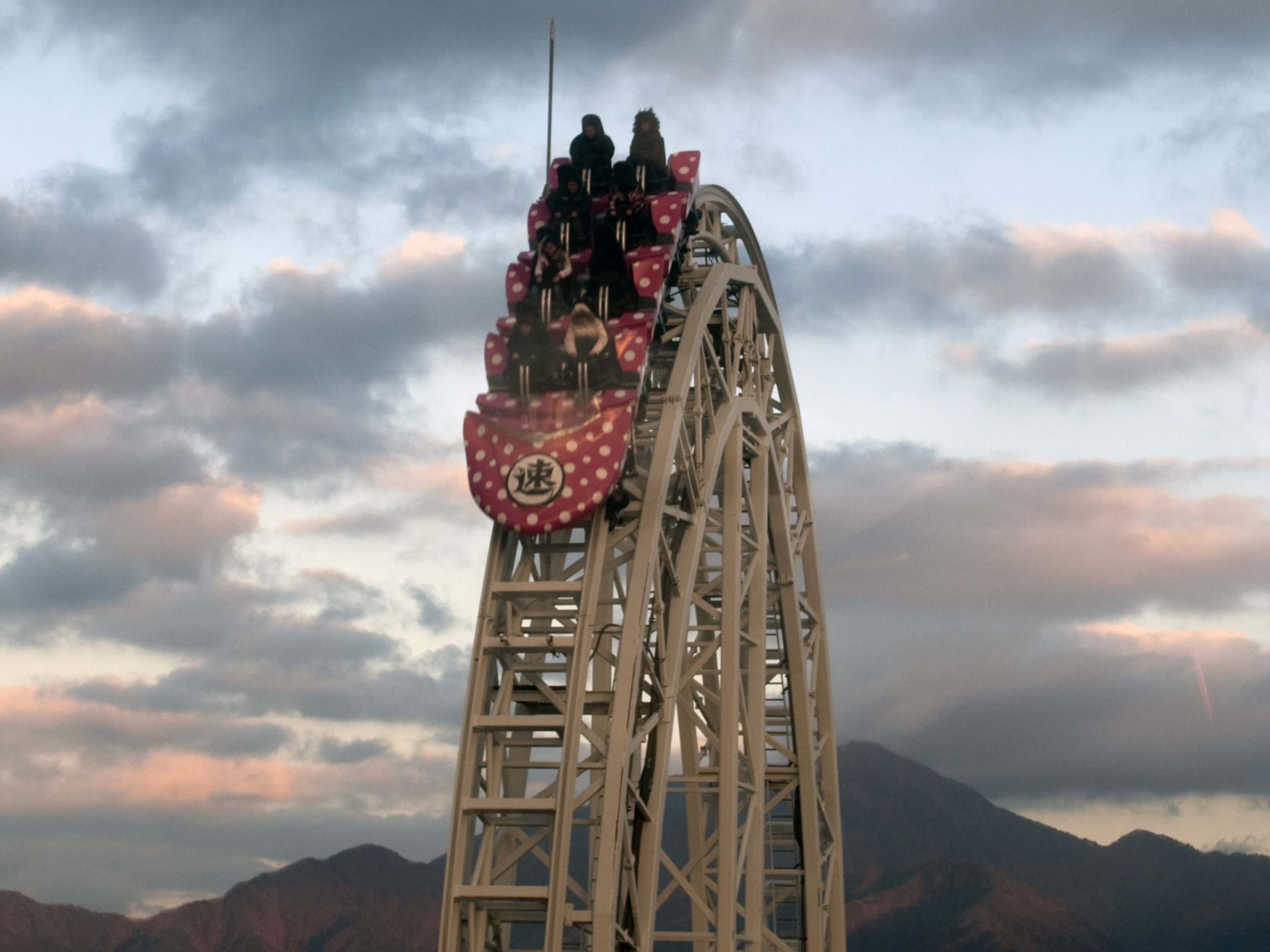
Do-Dodonpa
The countdown was in English. "Launch time!" followed by three seconds of silence, followed by a wall of compressed air slamming into the back of a train and hurling it from zero to 172 kilometers per hour in 1.8 seconds. When Dodonpa opened at Fuji-Q Highland in Fujiyoshida on December 21, 2001, it was the fastest roller coaster on the planet, and its name told you what to expect. "Dodonpa" comes from the sound of taiko drums once used in warfare to rally troops and terrify enemies with their thundering beat. For riders pinned against their seats by forces exceeding what astronauts experience at liftoff, the name was apt.
The Sound Barrier on Rails
Manufactured by S&S Sansei Technologies, Dodonpa used massive tanks of compressed air to launch its trains down the track. At the time of its debut, only two roller coasters in the world had ever broken the 160 km/h barrier. Dodonpa did not just break it; it exploded past it. The 55-second ride covered 1,244 meters of steel track, reaching a maximum height of 49 meters and subjecting riders to approximately 3.3 g at launch. By comparison, astronauts experience about 3 g during a rocket launch, though sustained over far longer than 1.6 seconds. Dodonpa held the world speed title for nearly eighteen months before Cedar Point's Top Thrill Dragster overtook it in May 2003. Even after losing the crown, the ride remained one of the most intense launch coasters ever built.
Reborn With a Loop
On July 15, 2017, the ride reopened as Do-Dodonpa after a significant renovation. Engineers removed the original top hat element and replaced it with a towering vertical loop, making it the world's first air-powered coaster to feature an inversion. The acceleration was pushed even harder, now reaching 180 km/h in 1.56 seconds. The track length was extended and the overall experience intensified. Fuji-Q Highland marketed it as the fastest coaster in the world with an inversion, a carefully worded claim that distinguished it from straight-line speed kings like Formula Rossa. The rubber tires that propelled the train had always struggled with reliability at peak speeds, and engineers had capped the original ride's velocity below its theoretical maximum. The 2017 rebuild addressed those mechanical limits while adding a dramatic new centerpiece.
Broken Bones and a Reckoning
The trouble began in December 2020 and did not stop. Between then and August 2021, eighteen riders were injured on Do-Dodonpa, nine of them sustaining broken bones. The forces involved in a 1.56-second acceleration to 180 km/h are extreme, and something about the ride's dynamics was causing injuries that went beyond normal thrill-ride discomfort. On August 31, 2021, Fuji-Q Highland owner Hiroaki Iwata publicly apologized at a press conference, acknowledging that an investigation had been underway since the first reports. The ride was shut down indefinitely. For nearly three years, the coaster sat silent at the base of Mount Fuji while the park and regulators assessed what had gone wrong.
The Final Thunder
On March 13, 2024, Fuji-Q Highland made it official: Do-Dodonpa would never run again. The permanent closure ended a twenty-two-year run that began with a world record and finished with a safety crisis. In the wider world of extreme coasters, the ride's legacy is complicated. It proved that compressed-air launch technology could deliver staggering acceleration, and it pioneered the combination of air-powered launch and inversion. But it also demonstrated the limits of pushing human bodies to extremes in the name of entertainment. As of 2024, only five operating coasters have ever matched or exceeded the speeds Dodonpa reached in 2001: Superman: Escape from Krypton, Red Force, Top Thrill 2, Kingda Ka, and Formula Rossa. The thunder has stopped at Fujiyoshida, but the records still echo.
From the Air
Located at 35.49N, 138.78E within the Fuji-Q Highland amusement park at the northern base of Mount Fuji. The park's roller coasters are visible from the air as a tangle of steel track adjacent to the town of Fujiyoshida. Mount Fuji dominates the southern horizon. Nearest airports include RJAH (Ibaraki) approximately 180 km northeast and RJTT (Tokyo Haneda) approximately 100 km east. Best viewed at 2,000-4,000 feet AGL where the coaster layout and the dramatic backdrop of Mount Fuji are both visible.