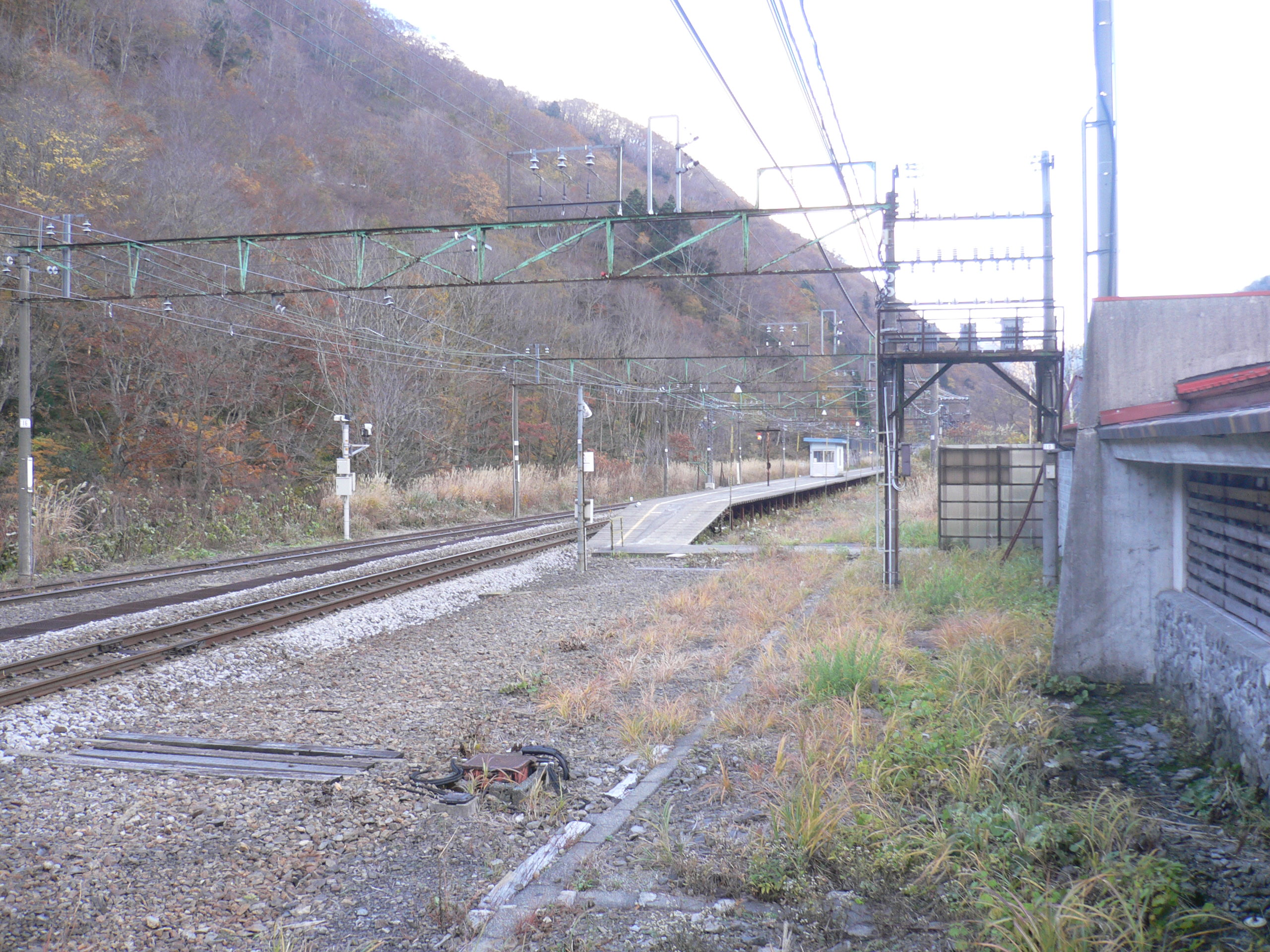
Doai Station
The ticket gate looks ordinary enough. A small, unmanned station building perched beside a mountain road in the town of Minakami, Gunma Prefecture. But step through and follow the covered passageway, and ordinary disappears fast. The path crosses National Route 291, bridges the Yuhiso River, enters a tunnel mouth, and then begins to descend. And descend. And descend. Four hundred and eighty-six steps carry you 70 meters underground to a dimly lit platform inside the Shin-Shimizu Tunnel, where northbound trains rumble through on their way to the Sea of Japan coast. The journey from ticket gate to platform takes ten minutes on foot. Doai Station is the deepest railway station in Japan, and the Japanese have given it a perfectly descriptive nickname: Nippon Ichi no Mogura Eki -- Japan's Number One Mole Station.
Two Platforms, Two Worlds
Doai Station is a station split in half by geology. The southbound platform sits at ground level, an unremarkable concrete slab beside the original Shimizu Tunnel, completed in 1931. Passengers heading toward Takasaki and Tokyo wait in open air, watching the Tanigawa mountain slopes above. But the northbound platform -- the one heading toward Nagaoka and the Niigata coast -- exists in an entirely different dimension. When the Joetsu Line was converted from single track to double track in 1967, engineers bored a new tunnel, the Shin-Shimizu, on a more direct but far deeper route through the mountain. The northbound platform was placed inside this new bore, roughly 70 meters below the station entrance and approximately 400 meters from the southbound platform. The two platforms share a station name and a ticket gate, but almost nothing else. One belongs to the surface world. The other belongs to the mountain.
The Descent
The staircase is the main event. From the ticket gate, a covered passageway with two short flights of 12 steps each leads to the tunnel entrance. Then the real descent begins: 462 additional steps dropping steadily into the earth, the air growing cooler and damper with each landing. The walls are raw concrete, lit by fluorescent tubes that cast a pale, industrial glow. Sound changes underground -- footsteps echo, the hum of ventilation fans replaces birdsong, and the distant rumble of an approaching train arrives long before the headlight appears. At the bottom, a small waiting room offers a bench and minimal shelter. There are no ticket machines. The station has been unmanned since March 14, 1985. A boarding certificate machine is the only concession to passenger service. The whole experience feels less like catching a commuter train and more like entering a Bond villain's lair.
In the Shadow of the Deadliest Mountain
Doai Station exists because of Mount Tanigawa. The 1,977-meter peak looming above the station is one of Japan's Hyakumeizan -- the 100 Famous Mountains -- and hikers heading for its trails have long used the station as a jumping-off point. But Tanigawa carries a darker reputation. Since the 1930s, more than 800 climbers have died on its slopes and precipitous rock walls, making it the deadliest mountain in the world by recorded fatalities. The mountain's combination of severe weather, treacherous rock faces, and accessibility from Tokyo -- close enough for day-trippers who underestimate the conditions -- has proven lethal again and again. The station, opened on December 19, 1936, was built partly to serve these mountaineers. The irony is sharp: one of Japan's most dramatic descents leads to the base of one of its most dangerous ascents.
A Second Life as a Destination
For decades, Doai Station was a curiosity known mainly to railway enthusiasts and hikers. Fewer than a dozen passengers a day used its platforms. But the internet changed that. Videos of the eerie underground descent went viral, and the station became a destination in its own right -- a place people travel to specifically to experience the staircase. In November 2020, a glamping facility called DOAI VILLAGE opened near the station, converting the remote mountain outpost into an unlikely overnight attraction. Visitors now camp in heated dome tents beside the station, explore the underground platform after dark, and wake to views of the Tanigawa range. The trains still stop here, still mostly empty, still running their scheduled service through the deep tunnel below. But the station that was once a footnote on the Joetsu Line has become proof that sometimes the journey -- or in this case, the descent -- is the destination.
From the Air
Located at 36.83N, 138.97E in the town of Minakami, Gunma Prefecture, at the base of Mount Tanigawa (1,977m). The surface station building is visible beside National Route 291 near the Yuhiso River, though the underground platform is entirely hidden within the mountain. The Shin-Shimizu Tunnel portal is visible from the air as a dark opening in the mountainside. The surrounding terrain is steep and forested, with Mount Tanigawa's distinctive rocky ridgeline rising sharply to the northwest. Nearest airports: Niigata (RJSN) approximately 100 km north, Matsumoto (RJAF) approximately 90 km southwest. Mountain turbulence and rapid weather changes are common in this area. Winter brings heavy snowfall.