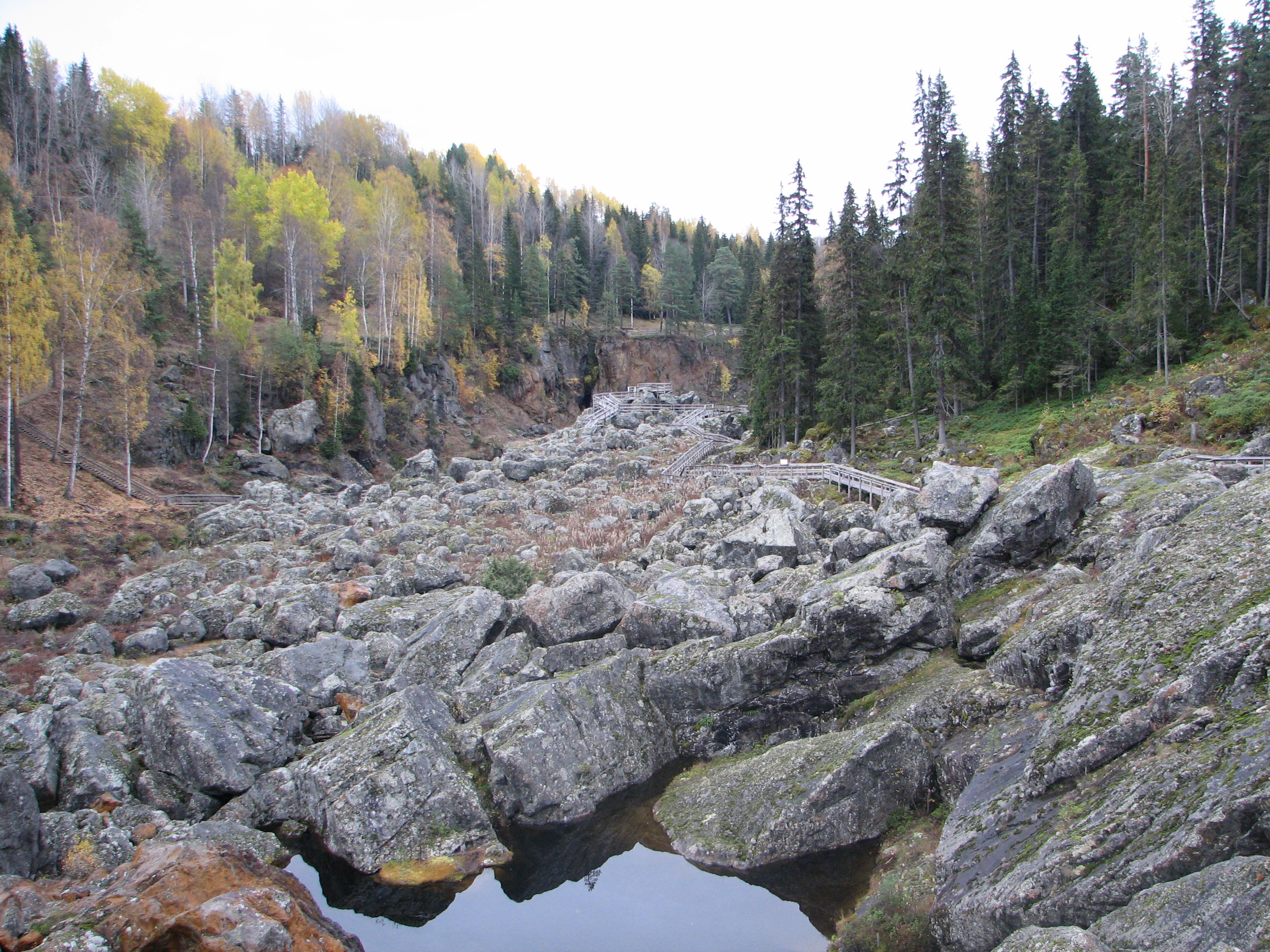
Döda fallet
The name translates to "the Dead Fall," and it means exactly what it says. In the province of Jämtland, in central Sweden, a set of rapids that once thundered with some of the country's most powerful whitewater now stands silent -- a dry, rocky scar in the landscape. The rapids did not erode away over millennia or get dammed by engineers with careful blueprints. They died in a single catastrophic night in 1796, when human ambition collided with glacial geology and lost.
The Lake That Shouldn't Have Been Touched
For thousands of years, a wall of glacial debris had blocked the river Indalsälven, creating a reservoir called Ragundasjön -- Ragunda Lake -- that stretched 25 kilometers through the valley. The lake overflowed across a natural spillway in a spectacular cascade known as Storforsen, the "great whitewater rapid," dropping roughly 35 meters in a steep, roaring descent. It was one of the most impressive falls in Sweden. But a local farmer named Magnus Huss, later nicknamed "Wild Huss" for his reckless ambition, saw the rapids as an obstacle. He wanted the Indalsälven to be navigable, and he dug a small bypass canal through the soft glacial sediments beside the falls. The earth was porous, the engineering was crude, and the canal sat like a loaded gun pointed at the lake.
Four Hours That Remade a Valley
The spring flood of 1796 was unusually heavy. On the evening of June 6, water began leaking into the canal, and the soft ground beneath it could not hold. At nine o'clock, the earth gave way. The two guards on site ran for the high ground of Boberget hill as a thunderous roar -- audible miles away -- signaled the river carving a new channel through deep, unconsolidated glacial deposits. In four hours, Ragundasjön drained completely. A 25-meter flood wave surged downriver, smashing through forests, sawmills, barns, and fields. Though it was one of Sweden's largest environmental disasters, no one died that night -- the houses stood on high ground, and the hour was late. But dead salmon lay scattered across meadows and hung in the trees, and what had been a lake became a stinking expanse of mud with unstable cliffs of soft sediment rising ten meters high. In the years that followed, at least twelve people died when those cliffs collapsed beneath their feet.
Wild Huss and the River's Revenge
Magnus Huss did not learn from the disaster he had triggered. An 1864 account describes how, still boasting that the Indalsälven was now navigable, he set out in a small boat to prove it -- planning to travel all the way to the Baltic Sea and on to Stockholm. He made it only a few kilometers before reaching Svarthålsforsen waterfall. Some versions say he tried to portage around it but launched back into the current too soon. Others claim angry farmers set him adrift on the falls without oars. What is certain is that Wild Huss was found drowned further down the Indalsälven, killed by the very river he had tried to tame. The Indalsälven never became navigable. The salmon returned after fifteen to twenty years. The old lakebed became fertile farmland, and young forest slowly covered the erosion scars.
Written in the Sediment
The disaster had an unexpected scientific legacy. Before 1796, thin seasonal layers of sediment called varves had accumulated on the floor of Ragundasjön. When Swedish geologist Gerard de Geer studied these deposits, the known date of the lake's final varve gave him the anchor point he needed to correlate varve sequences across Sweden, establishing what became known as the Swedish Time Scale. In October 2022, the International Union of Geological Sciences recognized the Quaternary glacial varves of Ragunda as one of its 100 geological heritage sites worldwide. Meanwhile, the sediments washed downriver redeposited at the Indalsälven's delta in the Baltic Sea, creating new land north of Sundsvall -- land on which Sundsvall-Timra Airport would eventually be built.
A Memorial in Stone and Silence
Today Döda fallet is a nature reserve and one of Ragunda Municipality's major tourist attractions. The dry riverbed, with its exposed rock and silent cascades of stone, tells the story without embellishment. Every year a theatrical performance re-enacts the events of that June night in 1796. In the nearby town of Hammarstrand -- itself built on the former bed of Ragundasjön -- a statue of Magnus Huss stands as a monument to ambition gone wrong. The legal aftermath outlasted several human lifetimes: the final court judgment on losses from the flood, specifically for destroyed fishing rights, was not handed down until 1975 -- 179 years after the water broke free.
From the Air
Located at 63.05°N, 16.52°E in Jämtland, Sweden. The dry riverbed and exposed glacial features are visible from moderate altitude. The valley of the former Ragundasjön stretches roughly 25 km along the Indalsälven. Nearest airport is Sundsvall-Timrå Airport (ESNN), approximately 100 km southeast. The town of Hammarstrand sits on the former lakebed nearby. Best viewed at 3,000-5,000 ft in clear conditions to appreciate the dramatic difference between the old dry channel and the river's current course.