Dodan Barracks
The name comes from a battlefield halfway around the world. During World War II, soldiers of the 81st West African Division fought in the Burma campaign, and one of their engagements lent its name to a military compound in Ikoyi, Lagos. For a quarter century, Dodan Barracks was where Nigeria was governed -- not from a parliament or a presidential palace, but from an officer's mess inside a military installation. Every coup, counter-coup, and power transfer between 1966 and 1991 either began at Dodan Barracks, ended there, or passed through it on the way to somewhere else.
Where Coups Come Home
In January 1966, a group of Nigerian Army majors overthrew the First Republic, and Dodan Barracks was one of their staging grounds. The army's commander, Major General Johnson Aguiyi-Ironsi, suppressed the plot and assumed power himself. Six months later, a counter-coup killed Ironsi, and General Yakubu Gowon moved into the Federal Guard officer's mess at the barracks. It was there, in January 1970, that Gowon received the formal Biafran surrender at the end of the Nigerian Civil War -- a ceremony that closed one of Africa's most devastating conflicts. From that point forward, successive military rulers kept their base at Dodan Barracks. The compound had become more than a military installation; it was the nerve center of Nigerian power.
Coffins, Presidents, and a Palace Coup
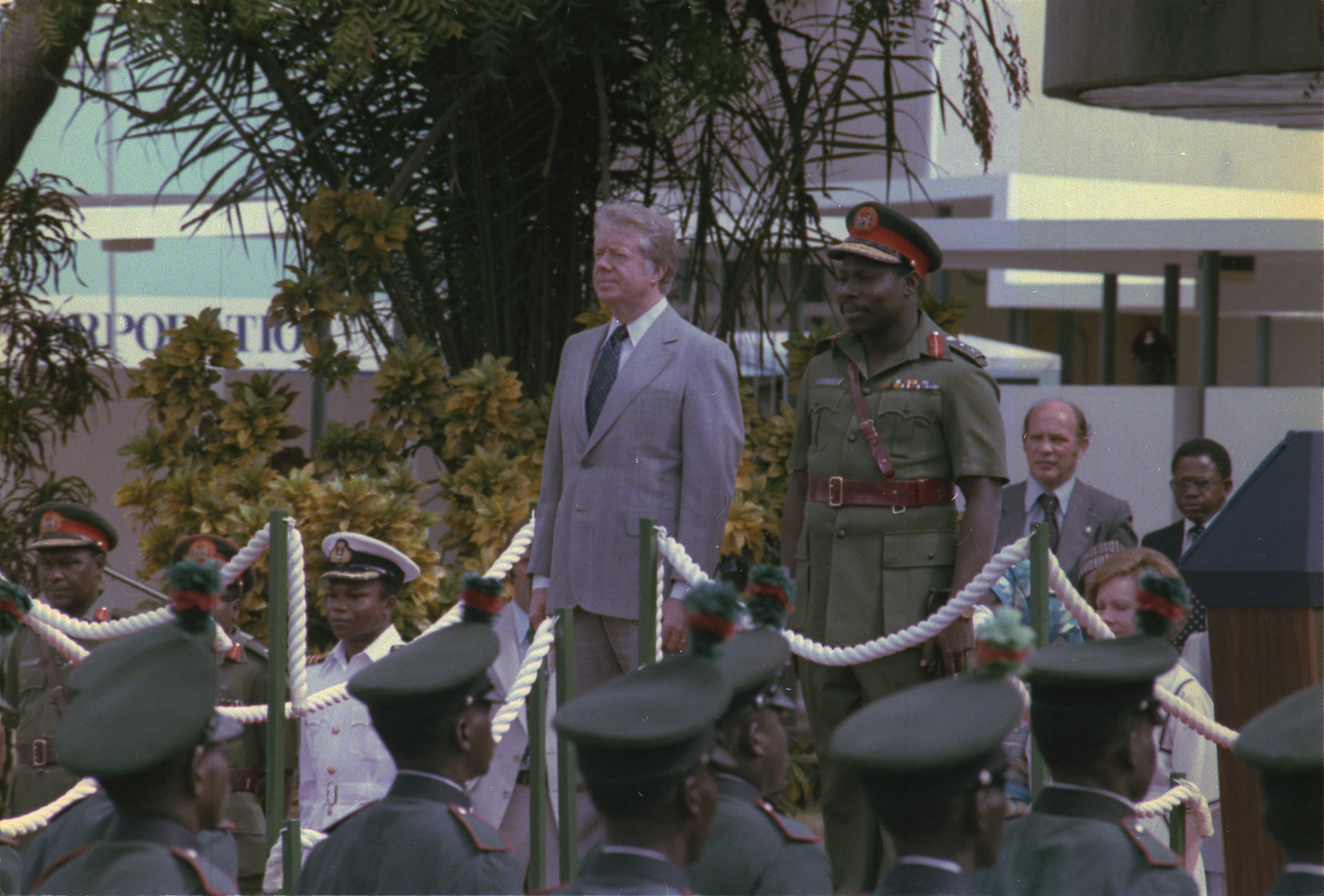
Gowon fell in a July 1975 coup, replaced by General Murtala Mohammed. Seven months later, Murtala was assassinated when his convoy was ambushed. His successor, Olusegun Obasanjo, relocated to the barracks for security. That decision brought an unexpected visitor to the gates: the musician Fela Kuti, who marched his mother's empty coffin to Dodan Barracks and left it there in protest -- a gesture of defiance that became one of the most iconic moments in Nigerian political theater. In April 1978, the barracks hosted a more conventional guest when U.S. President Jimmy Carter met with Obasanjo inside the compound. Five years later, in December 1983, General Muhammadu Buhari seized power from civilian President Shehu Shagari; the troops inside the barracks initially resisted before yielding the following day. Then in August 1985, General Ibrahim Babangida orchestrated a palace coup that toppled Buhari from within.
Under Fire at Dawn
The most dramatic chapter came on April 22, 1990, when Major Gideon Orkar launched a coup attempt against Babangida. Dodan Barracks was one of the key positions his forces seized. Babangida was in residence when the attack began, but he escaped through a back route while guards fought to defend the compound, losing five men in the process. Babangida's wife, Maryam, was also present with her children. She later recalled that when she first moved into the barracks in 1985, the facilities were so austere she had to arrange considerable renovations to make the rooms suitable for formal receptions. In January 1986, the barracks had served a grimmer purpose: a Special Military Tribunal convened there to try suspects accused of plotting against Babangida, finding seventeen defendants guilty of treason.
The Slow Fade
When military headquarters moved to Abuja in 1991, the barracks began a long decline. Civilian rule returned in 1999, and with it came drastic cuts to maintenance funding. By 2003, the grounds were dirty and overgrown, sewage leaked from broken pipes, and the walls of most buildings were cracked. Many structures sat abandoned. In 2004, President Obasanjo -- the same man who had once governed from inside the compound -- ordered Dodan Barracks and other disused military installations handed over to the Nigerian Police as a deliberate symbolic break from military dictatorship. Environmental surveys in 2006 and 2007 found heavily contaminated drainage channels behind the barracks, with water laced with fecal material posing disease risks to anyone nearby. The seat of Nigerian power had become a health hazard -- a fate that, for those who remembered the coups and coffins, carried its own bitter poetry.
From the Air
Located at 6.449N, 3.417E in the Ikoyi district of Lagos. The barracks compound sits on Lagos Island's eastern side, near the Lagos Lagoon. From 2,000-3,000 feet AGL, the military compound is distinguishable from the surrounding residential neighborhoods. The Third Mainland Bridge and Falomo Bridge are visible nearby. Nearest airport: Murtala Muhammed International Airport (DNMM), approximately 13 nm to the north.