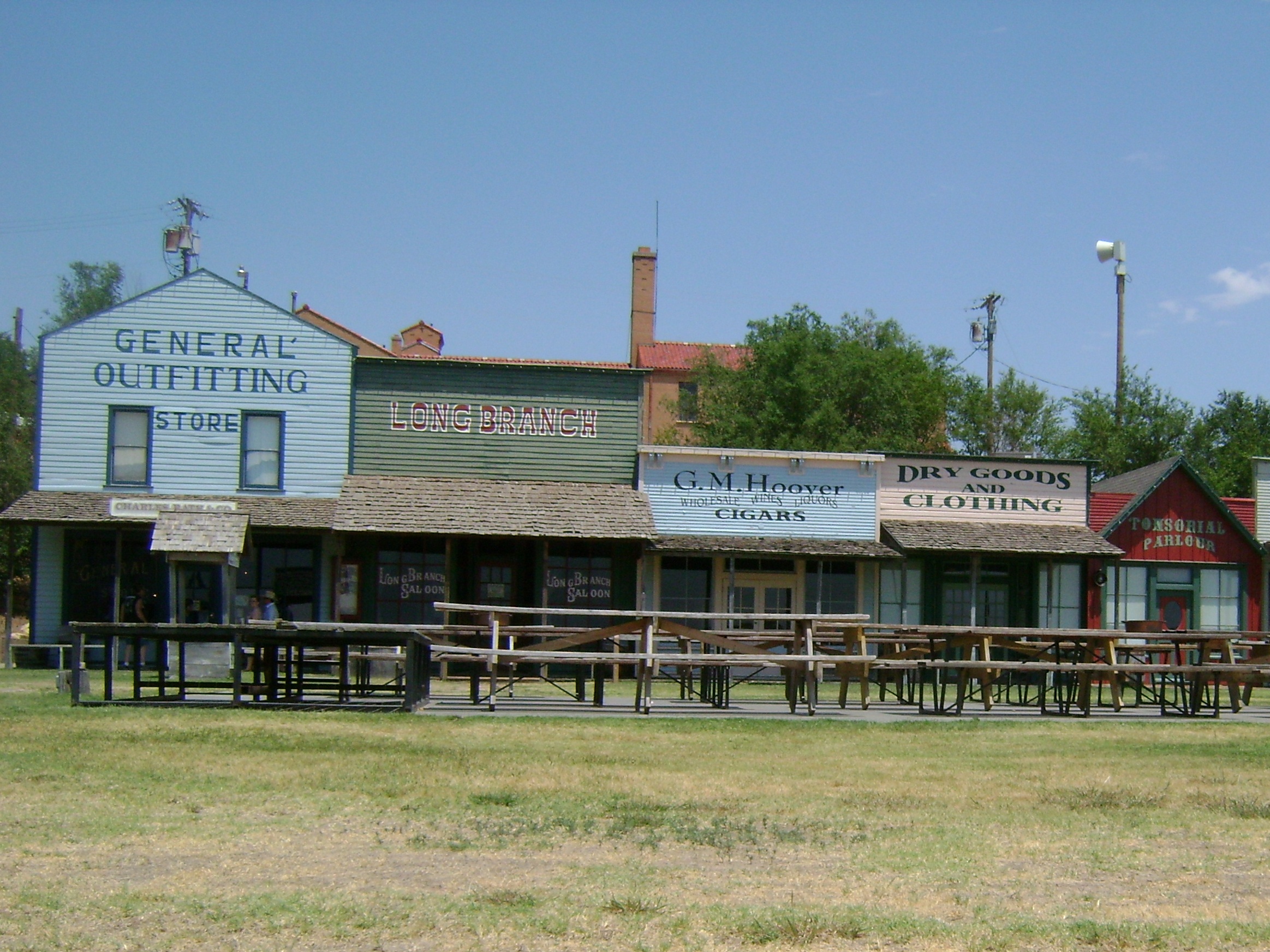
Boot Hill Cemetery, Dodge City
Dodge City's Boot Hill Cemetery is America's most famous Western graveyard, the place where outlaws, cowboys, and dance hall girls were supposedly buried 'with their boots on' after gunfights on Front Street. There's just one problem: it's mostly fake. The original Boot Hill existed from 1872 to 1878, when Dodge City was genuinely one of the wildest towns in the West. But in 1879, the city dug up the bodies and moved them (probably) to Prairie Grove Cemetery to build a school. The famous hilltop with its rustic wooden markers is a 1958 reconstruction, a tourist attraction built when the TV series 'Gunsmoke' made Dodge City legendary again. The real Boot Hill is under a concrete foundation. But the mythology persists, and the fake cemetery has become real in a way - a monument to the West that never quite was.
The Wild Years
Dodge City earned its reputation between 1876 and 1885, when cattle drives brought Texas longhorns and the cowboys who drove them up the Western Trail. The town made its money off the cattle trade - and off the cowboys' desire to spend their wages on whiskey, gambling, and women. Front Street was lined with saloons and dance halls. Wyatt Earp, Bat Masterson, and other lawmen struggled to maintain order. People died - from gunfights, from drunken accidents, from disease. The dead needed somewhere to go. Boot Hill, on a rise overlooking town, became that place.
The Cemetery
The original Boot Hill operated from 1872 to 1878. It was never a proper cemetery - no records were kept, graves were shallow, markers were wooden and quickly rotted. Those buried there included outlaws, victims of violence, and the poor who couldn't afford Prairie Grove Cemetery. The 'boots on' legend comes from the custom of burying victims of sudden death without removing their footwear - they died and were buried as they fell. Exactly how many people were interred there is unknown; estimates range from 30 to over 100. The romance of the name obscured the grim reality of unmarked prairie graves.
The Removal
In 1879, Dodge City needed a school, and Boot Hill had the best location. The city ordered the cemetery cleared. Bodies were supposedly moved to Prairie Grove Cemetery, but records are unclear about how thorough the exhumation was. By the time the school was built, the original cemetery had effectively vanished. For decades, the site was just a school ground. The old wooden markers had long since rotted. If graves were missed during the removal, they lay forgotten under classrooms and playgrounds. Boot Hill became a memory, then a legend, then something that never quite existed.
The Reconstruction
When 'Gunsmoke' made Dodge City famous in the 1950s, tourism possibilities became obvious. In 1958, the city built Boot Hill Museum and reconstructed the cemetery on its supposed original site. Wooden markers with colorful epitaphs appeared: 'He played five aces / Now he's playing the harp.' The markers are inventions - clever tourist attractions, not historical artifacts. Some are loosely based on local legends; most are pure fiction. The reconstructed Boot Hill is what tourists expect: picturesque, evocative, and almost entirely imaginary. It's a monument to mythology, which may be more honest than pretending authenticity.
Visiting Boot Hill
Boot Hill Museum is located at 500 West Wyatt Earp Boulevard in Dodge City, Kansas. The reconstructed cemetery is part of a larger museum complex including Front Street exhibits, a Long Branch Saloon recreation, and gunfight reenactments in summer. The wooden grave markers are photo opportunities rather than historical sites. For actual Dodge City history, Prairie Grove Cemetery (south of town) contains some relocated Boot Hill graves. The original Boot Hill site is approximately beneath the current educational facilities near the museum. Dodge City Regional Airport has limited service; Wichita's Eisenhower National Airport is 150 miles east. The town embraces its mythology enthusiastically.
From the Air
Located at 37.75°N, 100.02°W in southwestern Kansas. From altitude, Dodge City appears as a small city on the Arkansas River amid the flat Kansas plains. The Boot Hill Museum area is visible near downtown. The terrain is classic Great Plains - flat agricultural land extending to the horizon. Dodge City Regional Airport is northwest of town. Wichita lies 150 miles to the east. The cattle trail history is invisible now - the open range is fenced farmland - but the flat, featureless landscape explains why Dodge City became a cattle town: it was simply where the trail reached the railroad.