Dodona
Before Delphi became the center of the prophetic world, there was an oak tree in a remote valley of Epirus. No temple surrounded it -- not at first. Priests called the Selloi slept on the ground with unwashed feet, listening. What they listened for was the voice of Zeus, carried in the movement of leaves, the creak of branches, the wind passing through a tree that may have stood in that valley since the Bronze Age. Dodona, in the mountains of northwestern Greece, was the oldest Hellenic oracle, possibly dating to the 2nd millennium BCE. For over two thousand years, people traveled to this isolated place to ask questions of a god who answered through nature itself.
The God in the Leaves
Homer mentions Dodona in the Iliad, where Achilles prays to "High Zeus, Lord of Dodona, Pelasgian, living afar off, brooding over wintry Dodona." No buildings appear in Homer's account -- just the tree, the open sky, and the Selloi, those strange bare-footed priests who maintained direct contact with the earth. The oracle may have begun as a shrine to a Mother Goddess, identified elsewhere as Rhea or Gaia but known here as Dione. Zeus arrived later, joining and partly supplanting her. Unlike at other sites, Dione was never fully displaced at Dodona. Dedicatory inscriptions found at the site mention both "Dione" and "Zeus Naios" -- Zeus of the spring that flowed beneath the oak. A newer interpretation suggests that the prophetic sounds came not just from rustling leaves but from bronze objects hung from the branches, ringing in the wind like a vast chime. The sacred tree spoke in metal and wood together.
Doves and Distant Origins
The prophetesses at Dodona were called peleiades -- doves. Herodotus, visiting in the 5th century BCE, recorded a story told by Egyptian priests at Thebes: two priestesses had been carried away by Phoenicians, one sold in Libya and the other in Greece, and these women founded the oracles at Siwa and Dodona respectively. The prophetesses at Dodona told Herodotus a different version involving actual black doves that flew from Egypt and spoke with human voices. Was the dove connection a folk etymology, an attempt to explain an archaic title whose meaning had been lost? The pel- element in the name may connect to words meaning "dark" or "old" -- the same root found in names like Peleus and Pelops. Whatever its origin, the dove imagery persisted, and the women who interpreted the oak's messages held an authority that preceded even the more famous Pythia at Delphi.
Tablets of Ordinary Need
Over 4,200 oracular tablets have been recovered from Dodona, dating roughly from the mid-6th to early 2nd centuries BCE. All were written in Greek, attesting to more than 1,200 personal names from across the Greek world. Non-Greek names -- Thracian, Illyrian -- make up around one percent of the total. The questions scratched into these thin lead sheets are overwhelmingly practical: Should I marry? Will my business prosper? Is the child mine? Am I going to recover from this illness? The great oracle of Zeus, second only to Delphi in prestige, spent most of its time answering the anxieties of ordinary people. Aristotle considered the region around Dodona to be where the Hellenes originated, noting that the Selloi "were formerly called Graikoi, but now Hellenes." Some scholars believe the very words "Hellas" and "Greece" trace their origins to this valley.
A King's Grand Ambition
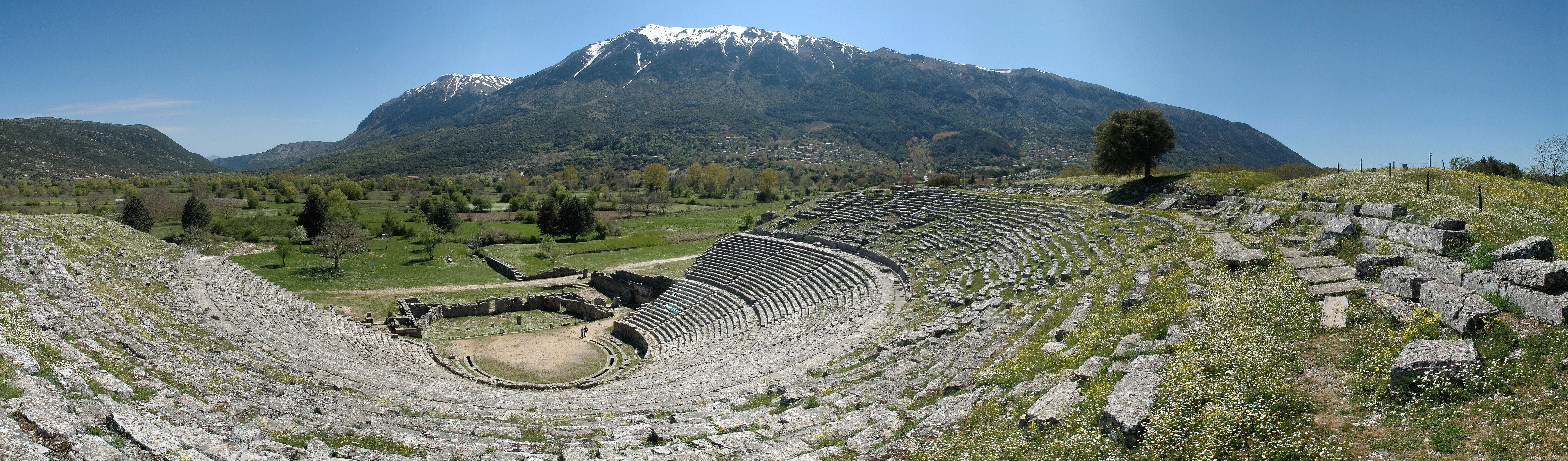
Dodona remained relatively modest in its built environment until King Pyrrhus of Epirus transformed it around 290 BCE. He made it the religious capital of his domain, grandly rebuilding the Temple of Zeus, adding a theater for dramatic performances, and establishing a festival with athletic games and musical contests. Later, Philip V of Macedon reconstructed the buildings again in the late 3rd century BCE. Roman destruction followed in 167 BCE when Aemilius Paulus razed the Molossian cities. Thracian soldiers under King Mithridates sacked the sanctuary around 88 BCE. Yet Dodona kept reviving. Under Augustus, it was prominent enough to merit an honorary statue of Livia. The traveler Pausanias noted the sacred oak still standing in the 2nd century CE. As late as 362 CE, Emperor Julian consulted the oracle before his Persian campaigns.
The Last Silence
In 391 CE, Emperor Theodosius ordered all pagan temples closed and all pagan religious activities banned. At Dodona, the ancient oak tree -- the one through which Zeus had spoken for perhaps two millennia -- was cut down. The oracle fell silent for the last time. Yet even this ending was not total. The site retained enough significance that a bishop of Dodona named Theodorus attended the First Council of Ephesus in 431 CE, suggesting that the Christian community recognized the power of the place even as it rejected the god who had inhabited it. Today, the remains lie in a valley beneath Mount Tomaros, south of the city of Ioannina. The theater Pyrrhus built still arcs against the hillside. The foundations of Zeus's temple still mark the ground. The sacred oak is gone, but the wind still moves through the valley, and if you listen carefully enough, you might understand why people once believed it carried a voice.
From the Air
Dodona lies at approximately 39.546N, 20.788E in a valley south of Ioannina in the Epirus region of northwestern Greece. The site sits at the base of Mount Tomaros. From the air, look for the arc of the ancient theater cut into the hillside -- it is the most visible structure. Ioannina National Airport (ICAO: LGIO) is approximately 22 km to the north. The surrounding landscape is mountainous and green, with the city of Ioannina and Lake Pamvotis visible to the northeast. The site is modest in scale compared to Delphi but clearly defined against the pastoral valley floor.