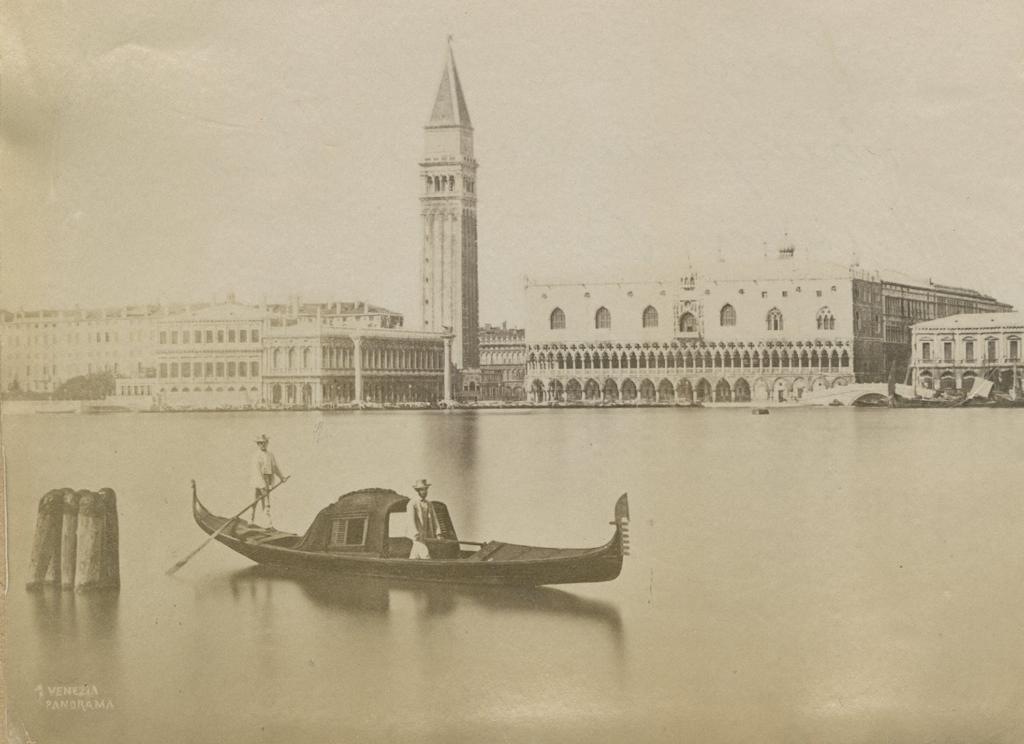
Doge's Palace
On the night of October 9, 1991, a man named Vincenzo Pipino lagged behind a tour group and hid inside a cell in the New Prisons. After dark, he crossed the Bridge of Sighs alone, entered the Sala di Censori, and removed a fifteenth-century Madonna from the wall. By morning, the painting was in the hands of the Mala del Brenta crime syndicate. It was recovered a month later. The episode is a footnote in the palace's history, but it captures something essential about the building: even its crimes have cinematic ambition. The Doge's Palace has served Venice as fortress, residence, courthouse, parliament, and prison since the ninth century. It was rebuilt after fires, expanded after political reforms, and decorated by the greatest painters of the Venetian Renaissance, accumulating layers of power and beauty that make it one of the most complex buildings in Europe.
A Palace That Kept Burning Down
The first ducal palace on this site was built around 810, when Doge Agnello Participazio moved the seat of Venetian government from the island of Malamocco to the Rialto area. Nothing remains of that structure. A fire set by citizens rebelling against Doge Pietro IV Candiano destroyed much of it in the tenth century. Doge Sebastiano Ziani undertook a major reconstruction between 1172 and 1178, reshaping the entire layout of St. Mark's Square in the process. His palace had fortified facades facing both the Piazzetta and the Basin of St. Mark, with traces of its Byzantine-Venetian character still visible in the ground-floor Istrian stone. But political change demanded architectural change. When the Great Council's membership expanded dramatically in the mid-thirteenth century, the palace needed more space. Construction of the current Gothic structure began around 1340, starting with the lagoon-facing wing. It was not until 1424 that Doge Francesco Foscari extended the rebuilding to the Piazzetta wing, finally completing the palace that visitors see today.
Giants at the Gate
Approaching the palace from St. Mark's Square, visitors passed through the Porta della Carta, the ceremonial entrance built between 1438 and 1442 by Giovanni and Bartolomeo Bon. The name may derive from the public scribes who set up desks nearby, or from the cartabum — the state archives kept close at hand. Gothic pinnacles frame the gateway, flanked by figures of the Cardinal Virtues, crowned by a bust of Saint Mark and a statue of Justice holding her sword and scales. Above the cornice, a sculptural portrait shows Doge Foscari kneeling before the Lion of Saint Mark — though the original was destroyed in 1797, and the current version is a nineteenth-century replacement by Luigi Ferrari. Once inside the courtyard, the approach continued along a straight axis through the Foscari Arch to the Giants' Staircase, where since 1567 two colossal statues by Jacopo Sansovino — Mars and Neptune — have guarded the ascent. They represent Venice's dominion over land and sea, and it was at the top of this staircase that newly elected Doges received the corno, the ducal cap.
Rooms Where Republics Governed
The palace's interior is a sequence of increasingly grand rooms, each designed to project the power and legitimacy of the Venetian state. The Four Doors Room, the formal antechamber, features doorframes of precious Eastern marble, each surmounted by allegorical sculptures representing virtues expected of those who governed. Andrea Palladio and Giovan Antonio Rusconi designed the room's decoration; Tintoretto painted the ceiling frescoes from 1578 onward, depicting mythological subjects and the cities under Venetian rule. Among the wall paintings, Titian's portrait of Doge Antonio Grimani stands out, alongside a Tiepolo showing Venice receiving the sea's tribute from Neptune. The Hall of the Full College, where the Doge met ambassadors and foreign delegations, pushed the decorative program further — every surface reinforced the message that Venice's authority was ancient, divinely sanctioned, and supreme. The Great Council Hall, where the full assembly of Venetian nobles met, was one of the largest rooms in Europe, its walls and ceilings bearing an encyclopedic program of Venetian history painted by the workshop of the republic's finest artists.
From Gothic Icon to Global Template
The Doge's Palace became a museum in 1923, one of eleven now managed by the Fondazione Musei Civici di Venezia. But its influence had been radiating outward for centuries. In the 1850s, John Ruskin published The Stones of Venice, a three-volume love letter to Venetian Gothic architecture that triggered a wave of imitations across the English-speaking world. The Wool Exchange in Bradford, the Templeton Carpet Factory in Glasgow, and the Scottish National Portrait Gallery in Edinburgh all borrowed the palace's pointed arches and ornamental arcades. In the United States, the facade of the Chicago Athletic Association building was modeled on the palace in 1893, and the Bush Street Temple in San Francisco replicated it in painted redwood in 1895. The Venetian Las Vegas and The Venetian Macao reproduce its exterior alongside other Venetian landmarks. Even Assassin's Creed II digitally recreated it in 2009. A building conceived as the fortress-home of an elected ruler became, over a thousand years, one of the most copied structures on Earth.
From the Air
Located at 45.434°N, 12.340°E on the waterfront of Venice, adjacent to St. Mark's Basilica and facing the Bacino di San Marco. From 3,000–5,000 feet AGL, the palace's distinctive pink-and-white facade and its position at the corner of the Piazzetta are clearly visible alongside the basilica's domes. The Bridge of Sighs connects the palace to the New Prisons across a narrow canal. Venice Marco Polo Airport (LIPZ) is approximately 5 miles north. Venice Lido Airport (LIDO) is 2 miles southeast. The lagoon setting provides excellent visibility on clear days but fog is common in autumn and winter.