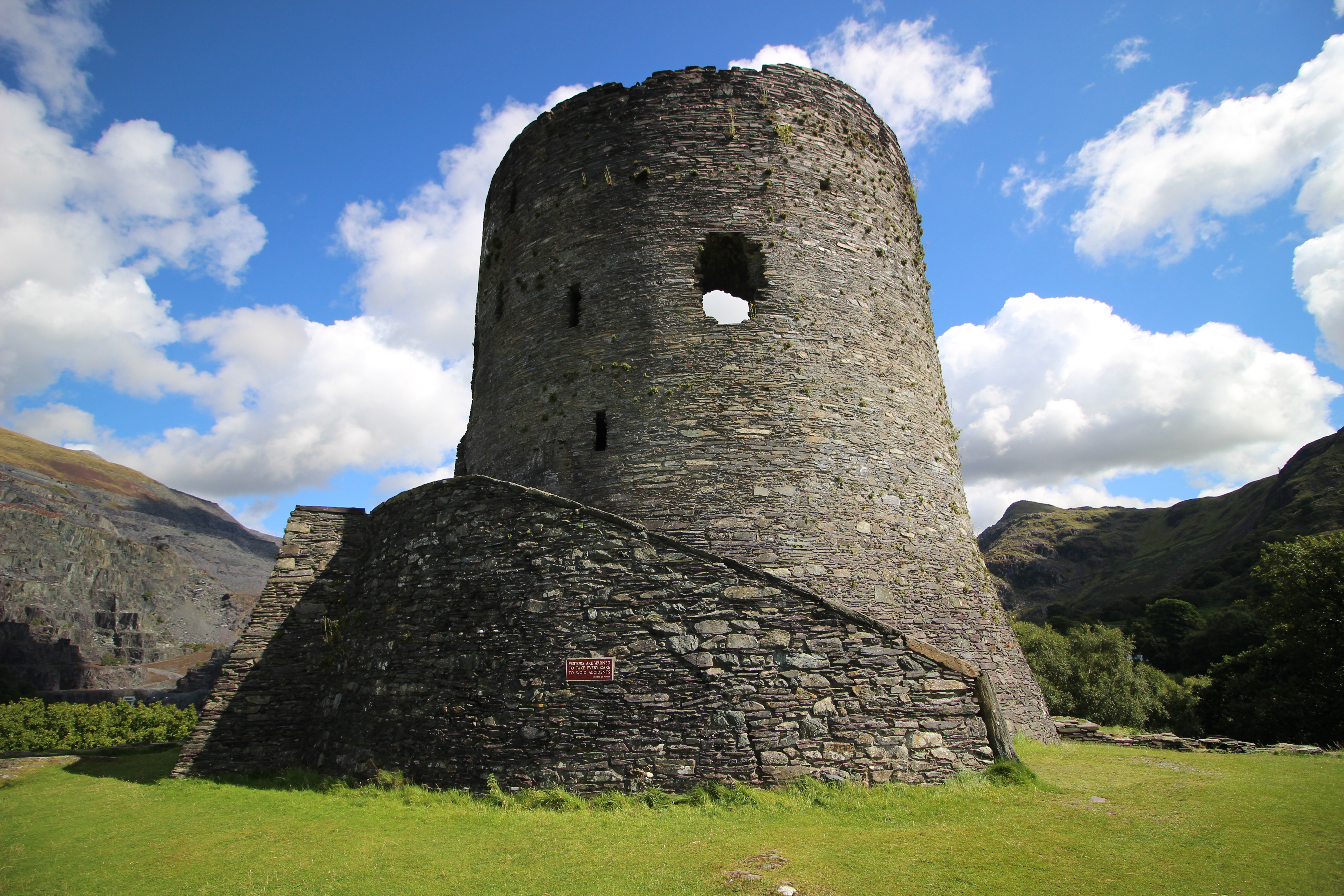
Dolbadarn Castle
J. M. W. Turner painted Dolbadarn Castle in 1800, its round tower back-lit against the mountains of Snowdonia, looming over the landscape with a brooding grandeur the actual ruin does not quite possess. Turner was not the first to embellish it, and he would not be the last. For painters of the Sublime and the Picturesque, Dolbadarn was irresistible: a Welsh prince's fortress, framed by lakes and peaks, crumbling just enough to suggest the passage of power and the indifference of nature. The real story, however, needs no embellishment.
A Prince's Statement in Stone
Llywelyn the Great built Dolbadarn in the early thirteenth century, at a moment when Welsh rulers were just beginning to adopt the castle-building traditions of their Norman enemies. The Welsh princes had traditionally governed from undefended palaces called llysoedd -- open courts that spoke of confidence rather than fear. But the Normans had pushed deep into Wales, and confidence alone would not hold them back. Llywelyn constructed the castle at the base of the Llanberis Pass, where it commanded a critical mountain route through Snowdonia. The location was strategic, but it was also symbolic. Llywelyn styled himself lord of the mountains and coasts of Wales, and his castles were placed to underscore that claim.
The Round Tower
The keep at Dolbadarn is what historians call the finest surviving example of a Welsh round tower. Built from purple and green slate, it rises forty-six feet and was modeled on early thirteenth-century English round towers from the Welsh Marches -- evidence that Llywelyn was learning from his adversaries even as he fought them. Unlike most of the castle, the keep was constructed with mortar rather than dry stone, a mark of its importance. The entrance sits on the first story, not at ground level, a defensive feature common to Welsh-built towers. Inside, the second story held the main chamber with a large fireplace and a latrine. The rest of the castle -- courtyard walls, square towers, a hall -- was built in dry stone and has largely collapsed, leaving the round keep standing alone.
A Brother's Prison
Dolbadarn's most haunting chapter belongs to Owain ap Gruffudd, brother of Llywelyn ap Gruffudd -- Llywelyn the Great's grandson. After Llywelyn ap Gruffudd seized power in 1255, he imprisoned Owain in the castle's keep. The length of Owain's captivity is uncertain, but it lasted years, perhaps decades. The round tower that visitors climb today is the same one that held a Welsh prince in darkness while his brother extended his rule across Wales. When Turner chose to paint the castle, he subtitled his work with a reference to this imprisonment, understanding that the ruin's emotional power lay not just in its landscape but in its human cruelty.
The Last Campaign
The end came swiftly. In 1282, Llywelyn ap Gruffudd fought a final campaign against Edward I of England, dying near Builth that December. His brother Dafydd ap Gruffydd assumed leadership of the Welsh resistance, retreating south into Snowdonia. By May 1283, Dafydd's government was operating from Dolbadarn, a last refuge in the mountains. It was not enough. Edward's forces closed in, and Dafydd was captured and executed. Within two years, timber from Dolbadarn was being stripped and hauled away for use in the construction of Edward's own fortress at Caernarfon -- the conqueror recycling the conquered prince's castle into an instrument of English dominion.
Ruin as Canvas
From the 1760s onward, Dolbadarn attracted painters drawn to the fashionable aesthetics of the Sublime and the Picturesque. They positioned the tower in the middle ground of their compositions, letting the viewer's eye move from the ruin to the lakes and mountains beyond. Many artists freely rearranged the landscape, shifting peaks and exaggerating distances to create more dramatic effects. Richard Wilson and Paul Sandby both produced notable works here, but it was Turner's 1800 painting -- presented as his diploma piece when elected to the Royal Academy in 1802 -- that made Dolbadarn famous. Today the castle stands in the care of Cadw, the Welsh government's heritage agency, its purple and green stonework still catching the light above Llyn Padarn, the lake that reflects both the keep and the mountain behind it.
From the Air
Dolbadarn Castle is located at 53.1166N, 4.1142W, at the base of the Llanberis Pass in Snowdonia. From the air, the round tower is visible beside Llyn Padarn and Llyn Peris, the twin lakes that fill the valley. The castle sits on a ridge between the two lakes. Nearest airports: Caernarfon (EGCK), RAF Valley (EGOV). Recommended altitude: 2,000-3,000 ft AGL for context with Snowdon and the surrounding peaks. The Llanberis Pass leading southeast toward Pen-y-Pass is a dramatic visual corridor.