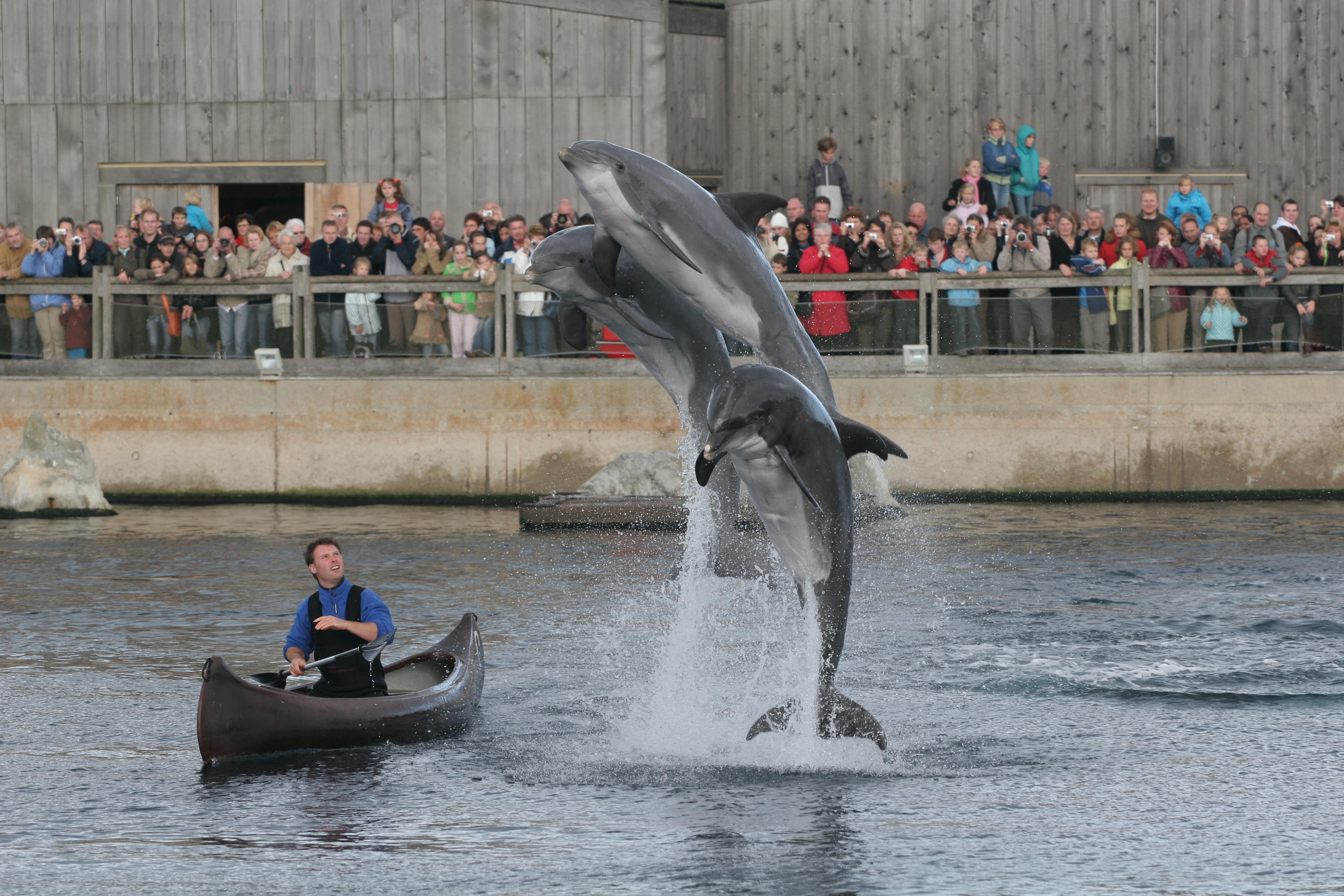
Dolfinarium Harderwijk
In 1955, two brothers in a small Dutch lakeside town decided to start collecting sea mammals. Frits den Herder ran a business; his brother Coen owned a local shipping company and a playground. They built a tank, then a bigger tank, and in 1965 opened the doors to the public. Within a year the Dolfinarium had welcomed its millionth visitor. Within four years it had grown a blue geodesic dome that became the visual signature of Harderwijk - a building you can pick out from the air, perched at the edge of the Wolderwijd. Sixty years later that same dome still holds 15 million liters of water and a show that 2,000 spectators at a time can watch. But the question of what it means to watch is no longer the question Frits den Herder thought he was answering.
The Brothers and the Dome
Frits den Herder said his goal was to make the Dutch people show respect and awe for sea mammals - creatures he called the most special and mythical of animals. In the 1950s, this was a radical pitch. The North Sea was still primarily a place for fishing fleets, not for wonder. The brothers' early collection was modest: a few harbor porpoises, a small concrete pool, an admission booth. The 1965 opening drew curious crowds. The 1969 dome made the park a destination. DolfijndoMijn, the main show area, became the largest indoor dolphin facility in Europe, and through the 1970s and 80s the Dolfinarium expanded into walruses, sea lions, and seals. Visitor numbers held remarkably steady from 2005 to 2011 - between 700,000 and 800,000 every year - making it one of the most-visited attractions in the Netherlands.
Morgan
In June 2010 a young orca was found drifting in the Wadden Sea, emaciated and dehydrated, separated from her pod. Dutch rescuers brought her to the Dolfinarium. She was named Morgan. Over months, she gained weight, recovered her strength, and became the subject of an international debate. Some argued she should be returned to the ocean and given the chance to reunite with her family. Others, including the Dolfinarium and several marine biologists, argued she could not survive on her own. The Orca Coalition formed to fight for her release. The case went to a Dutch court. In November 2011, the judge ruled that Morgan should be sent to Loro Parque in Tenerife, where she could be kept among other captive orcas. On 29 November 2011 she was loaded onto a transport plane at Schiphol Airport under police escort, with the date kept secret because Harderwijk feared protests. The city had issued an emergency ban on Free Morgan demonstrations. The whole rescue and transport cost the Dolfinarium more than a million euros. Morgan is still at Loro Parque today. The Dolfinarium has not held an orca since.
The Animals at the Park
Walk the grounds and the species names are all in Dutch - Bruinvisbaai for the harbor porpoises, Walrussenwal for the walruses, Zeehondenzand for the seals. The walrus Igor lived in Walrussenwal until his death in 2013. Bottlenose dolphins still perform in the DolfijndoMijn dome. Steller sea lions, California sea lions, and grey seals occupy their own pools. The Roggenrif aquarium holds rays, sharks, and species like European seabass and thicklip grey mullet, along with sea anemones in the tide-pool exhibits. In 2016, the park announced it would reduce its dolphin population, saying the group had grown too large. The number of visitors dropped that year too - to 586,300, well below the 800,000 of the previous decade. Public sentiment about marine mammal parks had begun to shift. Documentaries like Blackfish had reframed the conversation. Aspro Parks, the Spanish company that took ownership in 2014, faced a question the den Herder brothers never had to answer: what does this place become next?
SOS Dolfijn
For decades, the Dolfinarium also operated as the Netherlands' main rescue and rehabilitation center for stranded cetaceans. SOS Dolfijn, an independent foundation working out of the park's facilities, treated stranded porpoises - 85 percent of its patients - along with the occasional dolphin or beached whale. The goal was always release. Animals that recovered enough were returned to the sea; those that could not survive in the wild were sent to the Bruinvisbaai exhibit or to facilities at Ecomare on the island of Texel. In 2016, the same year visitor numbers fell, SOS Dolfijn ended its partnership with the Dolfinarium and began searching for a new location. The split was the end of a long collaboration and a sign of how much the world around the park had changed.
What the Dome Means Now
The blue dome is still there, still visible from the air as you cross the Veluwe heath. The lake water of the Wolderwijd laps against the park's beach. Restaurants and shops fill the spaces between the pools, and on a summer afternoon the crowds still arrive. But the park exists now in a different conversation than the one it was built for. Marine mammal welfare is a live debate in European policy circles. France has voted to phase out dolphin shows. Other countries are studying similar restrictions. The Dolfinarium has shifted some of its language toward education and conservation. Whether the dome can carry that meaning forward, for the animals inside it and the visitors outside it, is a question the park is still working out - the latest chapter in a story that began with two brothers in 1955 who simply wanted the Dutch public to look at a dolphin and feel awe.
From the Air
The Dolfinarium sits at 52.35 degrees north, 5.62 degrees east, on the western edge of Harderwijk at the eastern shore of the Veluwemeer-Wolderwijd lake system. From the air, the most distinctive feature is the blue geodesic dome of DolfijndoMijn, set among a cluster of pools and walkways. The historic town of Harderwijk lies just east of the park, with the Veluwe heath and forest beyond. Nearest airports: Lelystad (EHLE) lies 25 km northwest across the Veluwemeer and is the closest general aviation field, Teuge (EHTE) sits 40 km east, and Schiphol (EHAM) is 65 km west. Recommended viewing altitude 2,000 to 3,500 feet for a clear read of the dome and lake. Light is best mid-morning when the dome reflects the sky and the lake water turns silver.