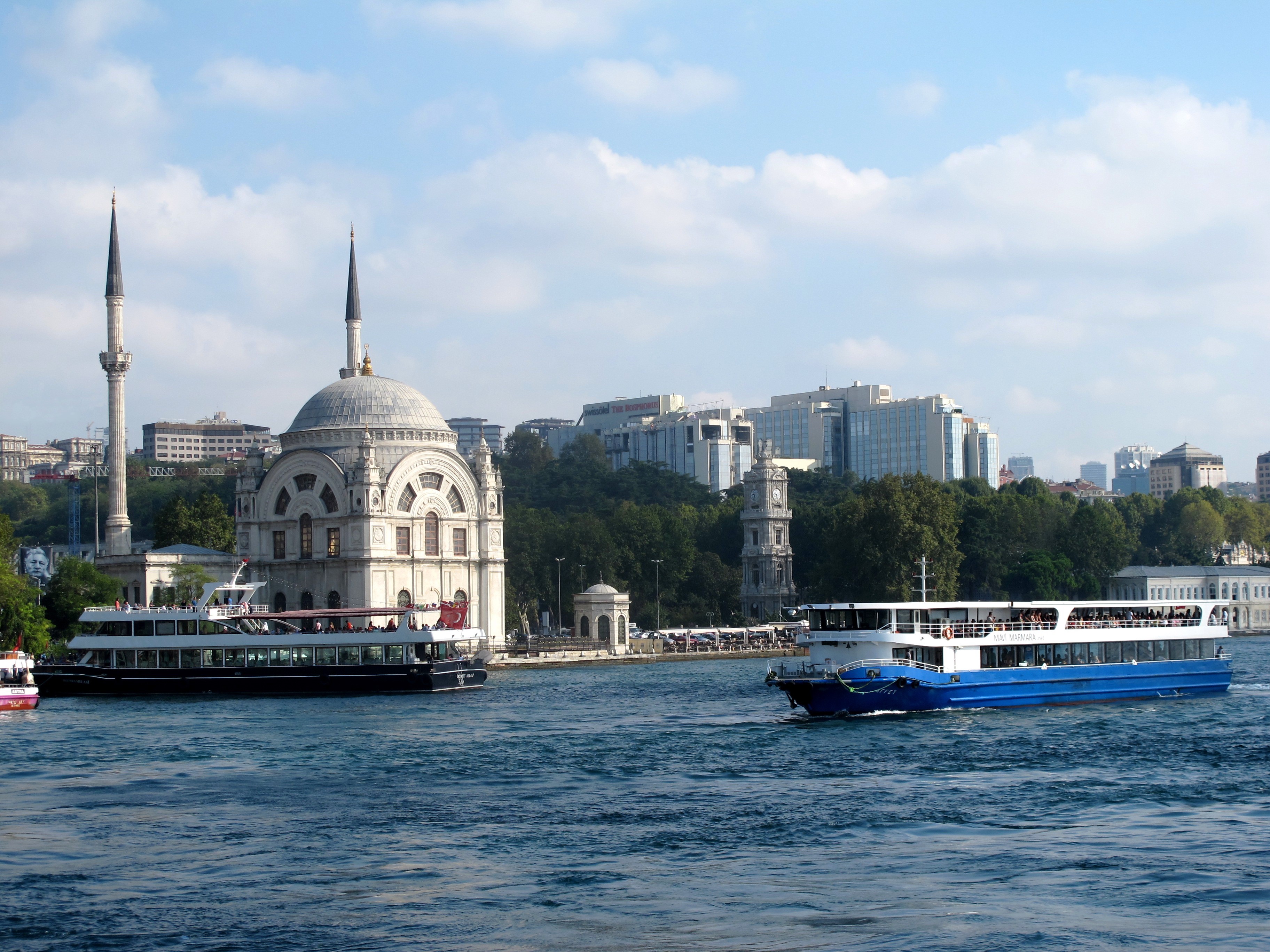
Dolmabahçe Mosque
Bezmialem Valide Sultan never saw the mosque she commissioned. She laid out the plans in 1853, hired Garabet Balyan to draw them, and chose a site on the Bosphorus shore where the salt air would carry the call to prayer across the water. Then she died, and her son Sultan Abdülmecid finished the work in her name. Two years later, in 1855, the Dolmabahçe Mosque opened its huge windows to the light off the strait. The result is unlike most Ottoman mosques: not the heavy stacked domes of the classical age, but a lighter baroque silhouette, twin minarets rising slim and tall behind a single luminous dome, the whole building seemingly designed to float on its own reflection.
A Mother's Mosque
Bezmialem was one of the most powerful women in the late Ottoman world, a Valide Sultan whose son sat on the throne and whose charitable foundations built schools, hospitals, and fountains across the empire. The mosque on the Bosphorus was meant to be her final, most visible gift to Istanbul, a place where the Sultan himself could perform the Friday noon prayer in full public view. She did not live to see the cornerstone fully settle. Abdülmecid, who was simultaneously building the vast Dolmabahçe Palace next door, completed his mother's commission as a tribute. The mosque carries her name in Turkish to this day - Bezm-i Âlem Valide Sultan Camii - though most visitors know it simply as the mosque of Dolmabahçe.
Light and Stone
Walk inside and the first thing that strikes you is the light. Garabet Balyan, the Armenian architect who would go on to shape so much of nineteenth-century Istanbul, cut huge stone arches into every facade and filled them with windows. The Bosphorus throws its blue back through the glass, and the gold calligraphy on the walls catches it like coins on a riverbed. The two great inscriptions in the prayer hall name God and Muhammad in yellow against deep green. The ceiling blooms with floral medallions. A single chandelier hangs at the center, dwarfing the worshippers below. The marble floor lies hidden beneath red carpet, kept warm for the foreheads of those bowing toward Mecca. After the heavy stone solemnity of older imperial mosques, the place feels almost weightless.
A Building Shoved Around
The mosque has not had an easy life as a place of worship. From 1956 to 1960 it was not a mosque at all, but a wing of the Naval Museum, its prayer hall hung with ship models and naval flags after the political shake-ups of the era. It returned to religious use in 1967. Road-widening through Kabataş erased its original courtyard and the sebil - the ornamental fountain that had once offered cool water to passersby - leaving the mosque sitting starkly between traffic and tide. The west minaret cracked under earthquakes in this seismic city and was painstakingly restored. None of it diminishes the building. If anything, its battered survival makes it feel more human.
On the Sultan's Doorstep
Stand at the waterside and you see why the location matters. The mosque sits within sight of Dolmabahçe Palace, the gleaming European-style palace that replaced Topkapi as the seat of the Ottoman court in 1856. For seventy years, foreign ambassadors arriving by boat would see this baroque mosque first, then the palace gates, then the long marble facade of the Sultan's residence. The mosque was the imperial frontispiece, the announcement that the Ottoman Empire could match Europe at its own ornamental game while remaining itself. Today, the cruise ships and ferries still pass on the same water, and the call to prayer still rolls out across the strait toward Asia.
The Mosque on the Strait
Most visitors come for the palace next door and discover the mosque almost by accident. That is part of its charm. Unlike Sultanahmet or Süleymaniye, the Dolmabahçe Mosque does not dominate its skyline; it shares it. The Bosphorus has the last word. From the water, the mosque is one element in a long composition of gates, fountains, the clock tower, and the palace itself, all of them facing east into the morning sun. From the shore, looking out, you see the same view the Sultan saw from his prayer balcony - the strait unrolling toward the Black Sea, freighters working their way up the channel, gulls riding the wind. A queen mother chose this view. Her son finished the job. The mosque is what they left behind.
From the Air
Dolmabahçe Mosque sits at 41.04°N, 28.99°E on the European shore of the Bosphorus, just south of Dolmabahçe Palace and the Bosphorus Bridge. From a left-seat downwind into Istanbul Airport (LTFM, ~35 km west), the Bosphorus is the unmistakable blue ribbon dividing Europe from Asia; the mosque and palace sit on its western bank near the southern end of the strait. Sabiha Gökçen (LTFJ, Asian side) lies about 25 km southeast. Best viewed at lower altitudes in clear weather; the twin minarets and single dome are recognizable even from cruise level when sun lights the European shore.