Dolomites
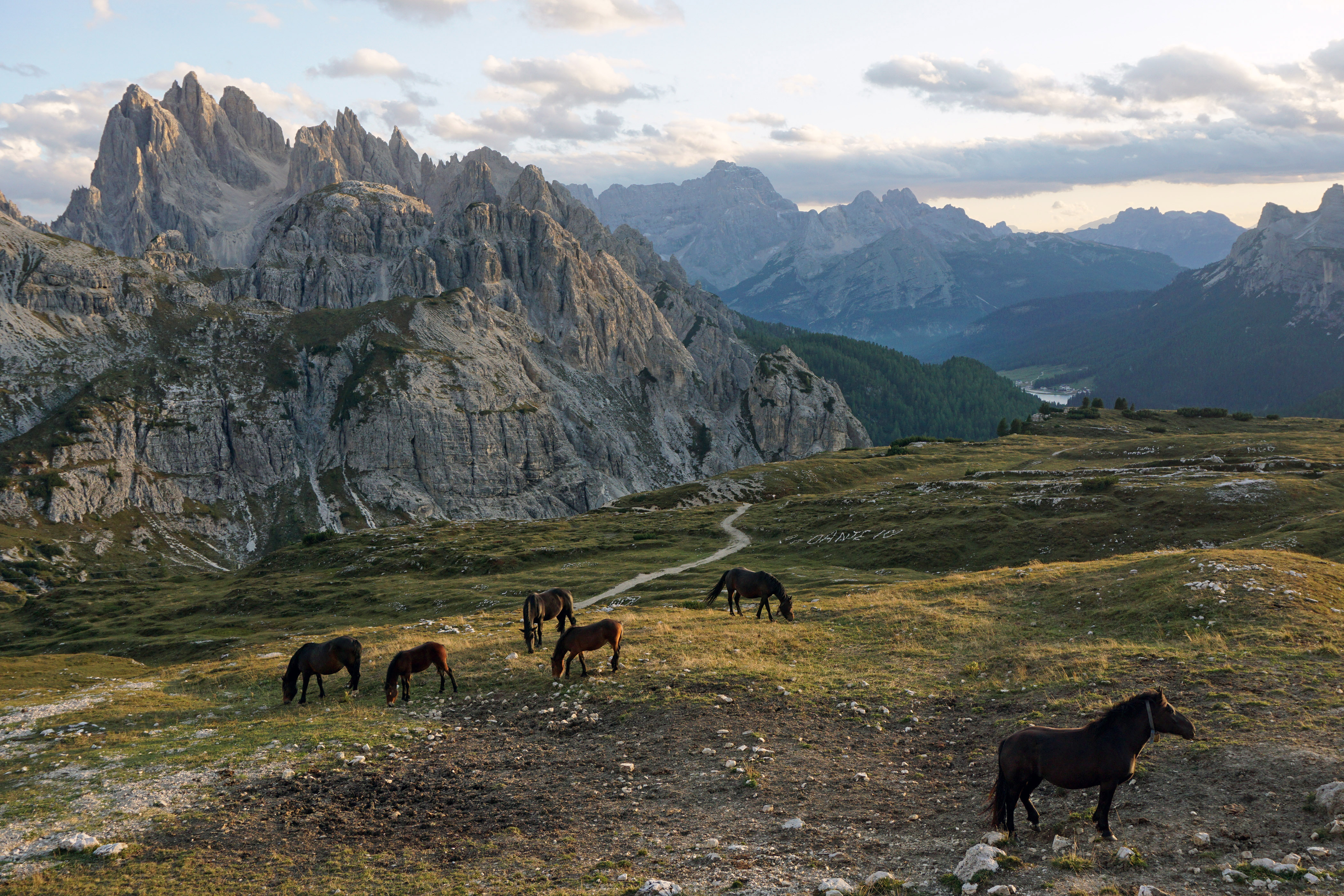
The locals called them the Monti Pallidi -- the Pale Mountains -- long before anyone understood why the rock was different. At sunset, these peaks in northeastern Italy turn from white to pink to deep amber, a phenomenon called alpenglow that occurs because the carbonate mineral dolomite reflects light differently from ordinary limestone. The mountains took their scientific name from Deodat Gratet de Dolomieu, an 18th-century French mineralogist who first described the rock in the 1790s. But the Ladin-speaking communities of these valleys had been watching the mountains blush at dusk for centuries before Dolomieu arrived with his hammer and his notebooks.
Ancient Coral, Modern Towers
The Dolomites are a UNESCO World Heritage Site, recognized in 2009 for their geological significance and their sheer visual drama. The pale towers and pinnacles that define the skyline are the remains of ancient coral reefs, formed in tropical seas roughly 250 million years ago and pushed skyward by the collision of tectonic plates. The result is a landscape unlike any other mountain range in Europe: vertical walls of pale rock rising abruptly from green valleys, their forms more suggestive of ruined cathedrals than of conventional alpine peaks. The range extends from the River Adige in the west to the Piave Valley in the east, spanning the Italian provinces of Belluno, South Tyrol, and Trentino, along with parts of Veneto and Friuli-Venezia Giulia.
The Climbers Who Came First
Evidence suggests that a Jesuit priest named Franz von Wulfen climbed the Lungkofel and the Durrenstein as early as the 1790s, but the golden age of Dolomite climbing began in 1857, when the Irishman John Ball made the first known ascent of Monte Pelmo. After Ball came Paul Grohmann, an Austrian who ticked off peak after peak -- Antelao, Marmolada, Tofana, Monte Cristallo, the Boe. Around 1860, the local mountaineer Simone de Silvestro became the first person to stand on the Civetta. Michael Innerkofler tackled the Tre Cime di Lavaredo. Free climbing took root here in 1887 when seventeen-year-old Georg Winkler soloed the first ascent of a pinnacle on the Vajolet Towers. The tradition of bold, sometimes reckless alpine ambition has never left these peaks.
A War in the Vertical
During the First World War, the front line between Italy and Austria-Hungary ran directly through the Dolomites, and both armies fought a war unlike any other in military history. Soldiers tunneled into the rock, blasting galleries and fortifications at altitudes where the cold was as lethal as the shelling. Both sides used mines extensively, detonating massive charges beneath enemy positions in attacks that reshaped the mountains themselves. The vie ferrate -- iron paths bolted into cliff faces -- were originally military infrastructure, ways to move troops and supplies across vertical terrain. Today, open-air war museums at Cinque Torri, Monte Piana, and Mount Lagazuoi preserve the trenches and tunnels. The Strada delle 52 Gallerie on Mount Pasubio, a military mule road threaded through 52 tunnels, remains one of the most extraordinary engineering feats of the conflict.
Peaks, Passes, and the Sella Ronda
The Dolomites are divided into Western and Eastern ranges along the Val Badia-Campolongo Pass-Cordevole Valley axis, encompassing more than two dozen distinct mountain groups. The Marmolada, at 3,343 meters, is the highest peak, capped by the range's only remaining glacier. Below the summits, a network of ten long-distance trails called alte vie -- high paths -- traverses the range, each taking roughly a week to walk, with rifugi offering meals and beds along the way. The Alta Via 1 is the most famous. In winter, the mountains become one of Europe's premier ski destinations, with Cortina d'Ampezzo, Arabba, and the valleys of Fassa, Gardena, and Badia drawing skiers to hundreds of kilometers of interconnected runs.
The Living Range
Nine natural parks protect large swaths of the Dolomites, from the Dolomiti Bellunesi in the south to the Naturpark Sextener Dolomiten in the north. The Calà del Sasso, with 4,444 steps, holds the distinction of being the world's longest staircase open to the public. Every July, the Maratona dles Dolomites sends road cyclists over seven mountain passes in a single day. And every evening, if the clouds cooperate, the peaks perform the same trick they have performed for millions of years: catching the last light of the sun and holding it, briefly, in shades of rose and gold that make the pale rock look almost alive.
From the Air
Located at 46.61N, 12.16E in northeastern Italy. The Dolomites are an unmistakable visual landmark from any altitude, with their distinctive pale vertical towers rising sharply from green valleys. The Marmolada (3,343m / 10,968 ft) is the highest peak. Major airports: LIPZ (Venice Marco Polo), LOWI (Innsbruck), LIPB (Bolzano). Cortina d'Ampezzo sits in the heart of the range. Mountain weather can be severe with rapid cloud buildup; the vertical terrain creates strong updrafts and turbulence. Best viewed from 12,000-18,000 feet on clear days, when the full extent of the range is visible.