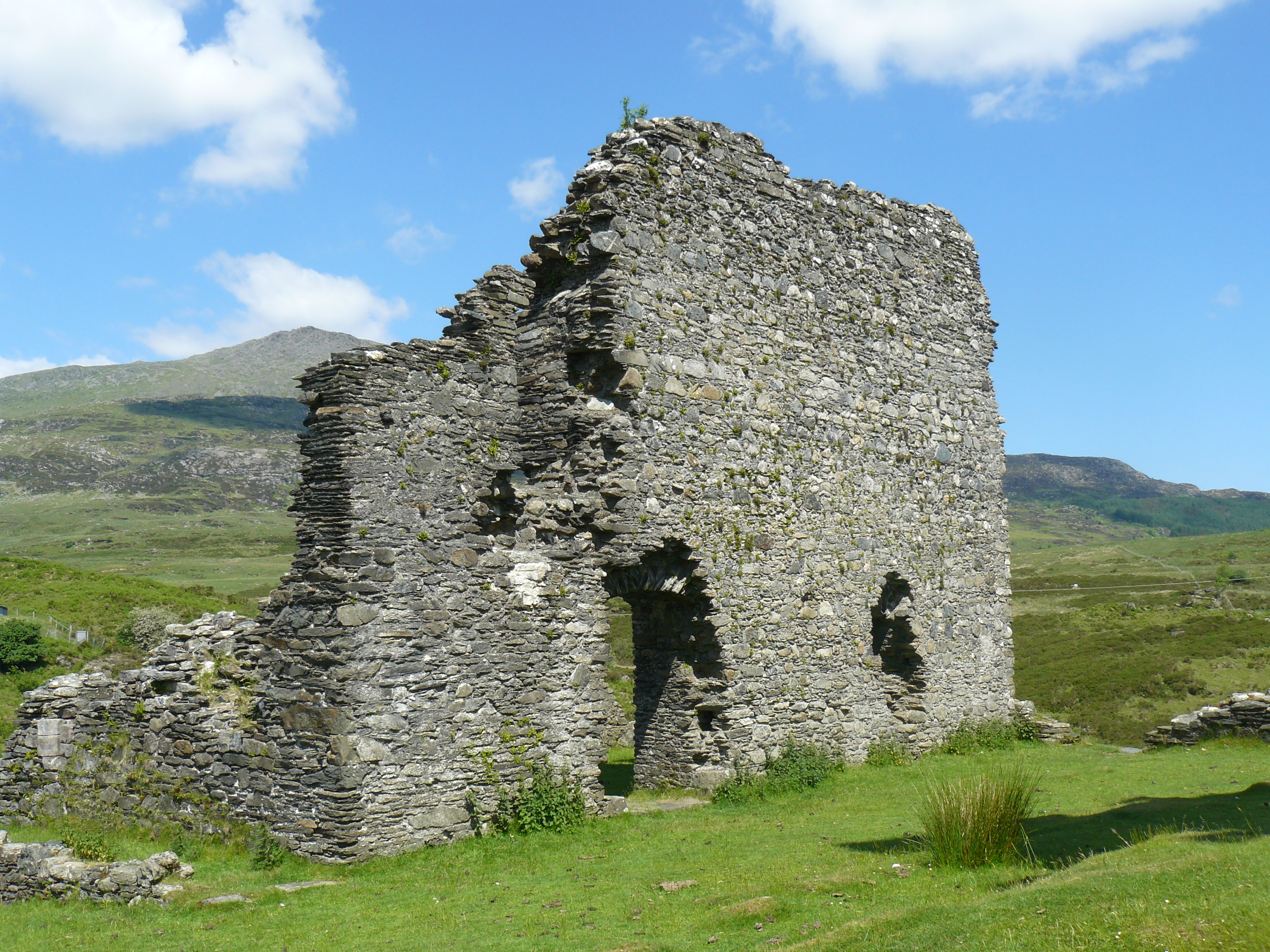
Dolwyddelan Castle
In January 1283, English soldiers stationed at Dolwyddelan Castle were issued white material from Ireland and white stockings to wear as winter camouflage in the Snowdonian mountains. It is a startlingly modern detail from a medieval campaign, and it speaks to the difficulty of holding a castle deep in the heartland of Gwynedd. Perched on a rocky knoll in the Lledr valley, Dolwyddelan was not one of Edward I's grand concentric fortresses. It was a Welsh castle, built by Welsh princes to guard Welsh roads, and the English had to fight for it.
The Prince's Birthplace
Before Dolwyddelan Castle, there was Tomen Castell -- a small tower on a rocky outcrop between the present castle and the Afon Lledr. Fragmentary remains still stand. This earlier structure is the likely birthplace of Llywelyn ab Iorwerth, Llywelyn the Great, prince of Gwynedd, despite a persistent tradition placing his birth in the later castle. Tomen Castell may have been built by Iorwerth Drwyndwn, Llywelyn's father and eldest son of Owain Gwynedd, during the period of dynastic upheaval following Owain's death in 1170. The small rectangular tower, with walls roughly one meter thick, perched above steep drops on three sides with a ditch defending the more accessible western approach. It was eventually superseded by the grander castle nearby.
Guarding the Road to Meirionydd
Llywelyn ab Iorwerth probably built Dolwyddelan between 1210 and 1240 to control the east-west route from Nant Conwy to Meirionydd. The castle occupied one of the ten hafodydd -- summer cattle grazing pastures -- belonging to the princes of Gwynedd in the Lledr valley. Its rectangular keep, typical of those built by Welsh princes in the 13th century, resembles contemporary towers at Castell y Bere and Criccieth. The keep was initially freestanding; Llywelyn added a curtain wall soon afterward. A second tower on the western side may have been added later by Llywelyn ap Gruffudd, Llywelyn the Great's grandson, who built similar structures at Criccieth and Dolforwyn.
White Stockings in the Snow
Edward I's forces captured Dolwyddelan on 18 January 1283, and the siege appears to have been brief -- the constable may have negotiated a surrender. The castle was immediately refortified and supplied with a siege engine built at nearby Betws-y-Coed. The garrison's white winter clothing is documented in surviving accounts, as is the ongoing repair and supply of the castle through 1292, including the construction of a new bridge and water mill in the valley below. A Welsh constable, Gruffudd ap Tudur, was appointed in 1284 and remained in office until at least 1290, suggesting the English recognized the value of local knowledge in holding this remote position.
The Outlaw and the Feud
After centuries of silence, the castle re-entered the historical record in 1488 when Maredudd ab Ieuan purchased the lease. According to the History of the Gwydir Family, compiled by his descendant Sir John Wynn around 1600, Maredudd came from a family in Eifionydd notorious for violent kindred feuds. He moved to Dolwyddelan partly to extend his influence and partly to put distance between himself and his relatives. The castle was partly habitable, having recently been occupied by Hywel ab Ieuan ap Rhys, described as both a "captain" and an "outlaw." The surrounding countryside was lawless enough that Maredudd may have valued the castle's defensibility even while building a new house nearby at Tai Penamnen.
Rebuilt, Painted, and Filmed
Artists and antiquarians discovered the romantic ruin in the 18th and 19th centuries. Samuel and Nathaniel Buck engraved it in 1742. Moses Griffith painted it for Thomas Pennant's A Tour in Wales in 1788. J. M. W. Turner may have sketched it in 1799. Between 1848 and 1850, Lord Willoughby de Eresby, a distant descendant of Maredudd ab Ieuan, restored and partially rebuilt the keep, raising it to its current height and adding the battlements that give it today's distinctive profile. In 1930 the castle was placed in state care, and it is now managed by Cadw. In 1981, it served as a location for the fantasy film Dragonslayer -- proof that its dramatic setting still casts a spell, whether the audience is medieval or modern.
From the Air
Located at 53.05N, 3.91W on a rocky knoll in the Lledr valley, Conwy County Borough. The castle keep is visible from the air as a small square tower on rising ground, with the village of Dolwyddelan in the valley below. The A470 road passes nearby. Surrounded by the mountains of Snowdonia. Nearest airport: Caernarfon (EGCK) approximately 15nm northwest. Recommended altitude: 2,500-3,500 ft due to mountainous terrain. Exercise caution in reduced visibility.