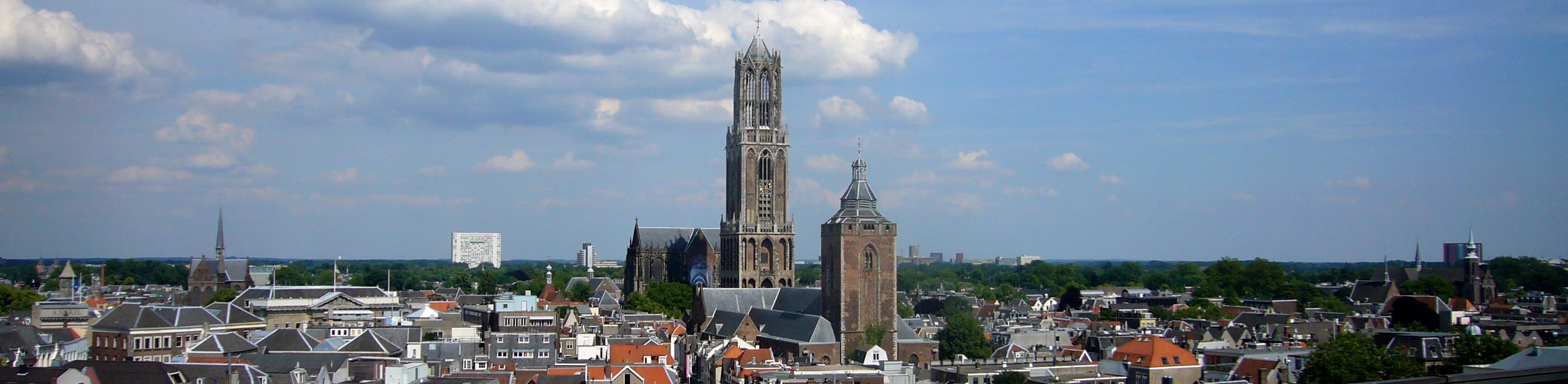
Dom Tower of Utrecht
On the night of 1 August 1674 a violent thunderstorm swept across the Low Countries. Roofs came off houses in Friesland. Trees went down in Brabant. Over Utrecht the storm produced a tornado - real, confirmed, the kind of rotating column that European meteorologists still argue about. The tornado hit the unfinished nave of the Dom church, the long stretch of stone that connected the great west tower to the choir on the east. The walls had never been properly braced because the cathedral had run out of money centuries earlier. The nave collapsed. The tower kept standing. It has stood alone ever since, three hundred and fifty-one years and counting, the tallest church tower in the Netherlands at 112.32 meters, and the spot at its foot where the city of Utrecht began two thousand years ago.
Where Utrecht Started
Long before the Dom there was a Roman fort. The legions called it Traiectum - the crossing - because this was where the imperial highway forded the Rhine in the first century AD. The fort was abandoned, replaced by a Frankish settlement, then by a bishopric founded by the missionary Willibrord around 695. The first stone church on the site went up shortly after. By the late thirteenth century the bishop and the chapter wanted something monumental: a Gothic cathedral on the scale of those rising in northern France. Construction began in 1254. The choir was finished by 1320. The tower came next, started in 1321 and topped out in 1382 at 109 meters - a single freestanding structure of two square brick blocks with a much lighter octagonal lantern on top. Look closely and you will notice something unusual: no visible buttresses anywhere on its flanks. The Dom tower carries its weight invisibly, inside the walls themselves.
The Bells
Inside the tower hang fourteen ringing bells, weighing 32 tonnes together - one of the great peals of Europe. In 1505 Geert van Wou, the most famous bell-founder in the Netherlands, cast a harmonious set of thirteen. Their seven smallest were sold in 1664 to pay for a new carillon, and those seven were replaced with fresh castings by the Eijsbouts foundry in 1982. The largest bell is called the Salvator. It weighs 8,200 kilograms and measures 227 centimeters across the lip. When it sounds, the whole Domplein vibrates. In 1625 the composer Jacob van Eyck - blind from birth, gifted with what contemporaries described as preternatural musical hearing - was appointed carillon player of the Dom Tower, the position he held while writing 'Der Fluyten Lust-hof,' one of the most important works of European Baroque solo recorder music. He climbed the same 465 steps that today's tour groups climb. From the top you can see Amsterdam on a clear day.
The Tornado and the Stripe
When the August 1674 tornado tore the nave apart, the city was left with a problem it never quite solved. The bishop had been gone since the Reformation - the cathedral had been Reformed since 1580 - and there was no money and no will to rebuild. The choir at the east end was used as a Reformed parish church. The tower stood alone at the west. Between them sat an open square, the Domplein, and the rubble of the missing nave. Eventually the rubble was cleared. The square stayed open. In the summer of 2004 the city built a temporary scaffolding nave, full-height, to give people a sense of what had been lost - the visual gap between the tower and the choir is 50 meters wide and used to be roofed in stone. A multicolored paving pattern now traces the foundations of the destroyed nave across the square. You walk over the outline of the vanished cathedral every time you cross the Domplein. In 1836 a second storm came close to finishing the job; the top floor of the tower was so badly damaged that demolition was discussed. The restoration that followed took five years and saved it.
Symbol of a City
The Dom is the symbol of Utrecht the way Big Ben is the symbol of London, except that Utrecht's symbol is older, taller for its city, and has survived more weather. Local zoning long forbade any new building from rising higher than the tower; in the 2000s plans for a 262-meter skyscraper out in the Leidsche Rijn district briefly threatened the tradition before the 2008 financial crisis killed the scheme. From 2019 to 2024 the tower was restored on its exterior - scaffolding climbed the brick, masons replaced eroded blocks, the carillon was overhauled. When the scaffolding came down it looked freshly cut. The 465 steps still wind to the top, and the small visitor center at the base, called RonDom in a pun on the Dutch word for around and the name of the cathedral, sells tickets to climb them. There is a replica of the tower at a Dutch-themed amusement park in Sasebo, Nagasaki, which is a strange thing to know and not be able to forget.
From the Air
Coordinates 52.09 N, 5.12 E - in the medieval core of Utrecht. From altitude the Dom Tower is the single tallest spire of the city, rising 112 m above a tight cluster of brick rooftops bisected by the curve of the Oudegracht canal. The tower stands free; the Domplein square is the open paved space east of it, with the much smaller Dom choir on the far side. Schiphol (EHAM) is 38 km west, Lelystad (EHLE) 35 km north. Recommended viewing altitude 1,500-3,000 ft AGL in good visibility.