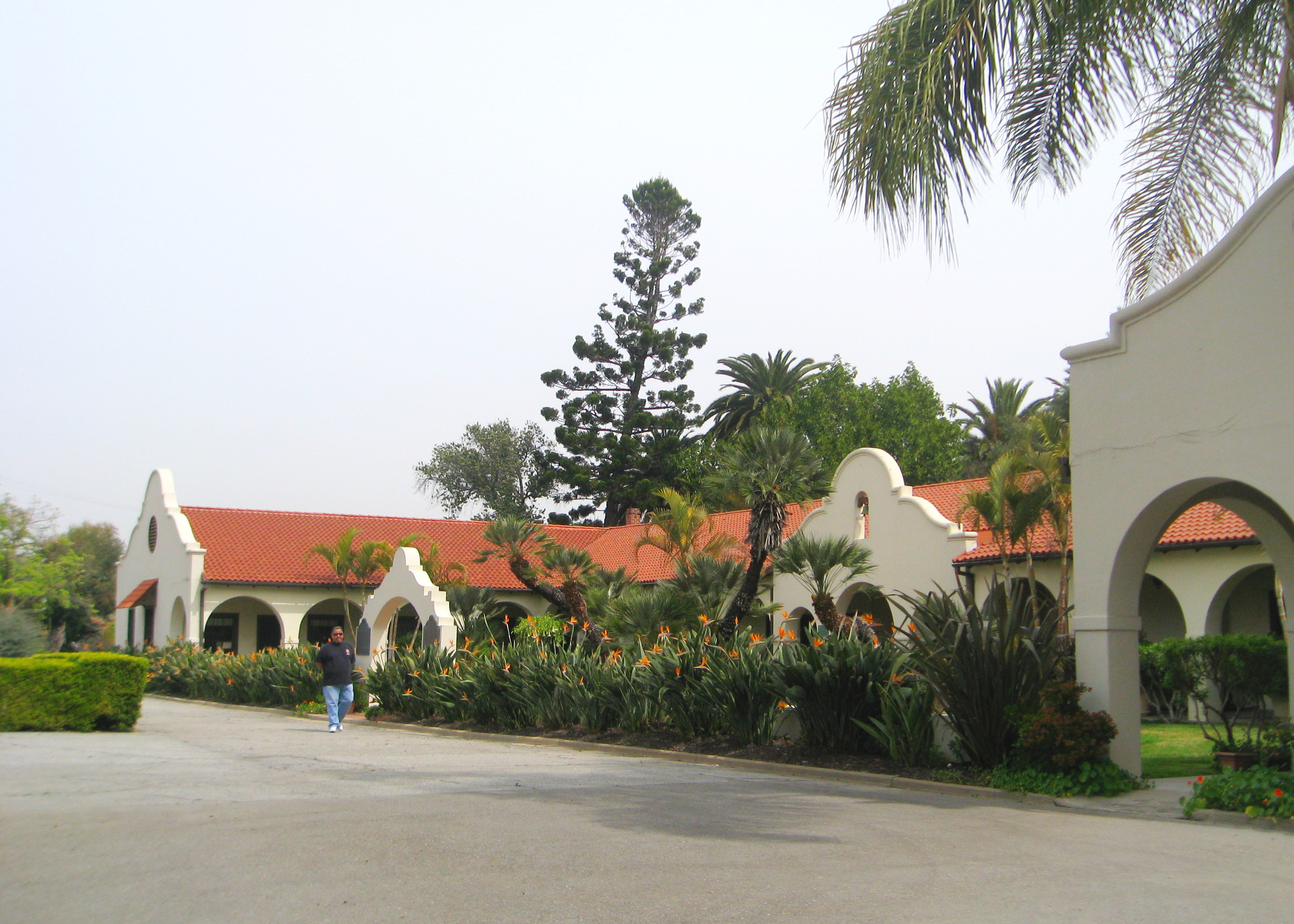
Dominguez Rancho Adobe
Juan Jose Dominguez never intended to settle here. He was a retired soldier who had accompanied the 1769 Portola expedition — the first European overland journey up the California coast — and when the Spanish Crown began offering land grants to veterans, he petitioned for the coastal plain south of Los Angeles. He received it in 1784: 75,000 acres of grassland stretching from the hills to the harbor, from what is now the city of Carson to the shore. He called it Rancho San Pedro. Dominguez died without a direct heir in 1825. His nephew Manuel completed the adobe the following year, and the family kept it for generations. Through three flags and two wars, the house stood. It stands still.
The Tongva Before the Grant
The land that became Rancho San Pedro had been home to the Tongva people for thousands of years before any Spanish expedition arrived. The Tongva built villages throughout the Los Angeles Basin, fished the harbor, burned signal fires on the hilltops visible across the water to Catalina Island. When the Spanish missions came — San Gabriel Arcangel in 1771, San Fernando Rey de Espana in 1797 — the Tongva were drawn, coerced, or forced into the mission system, their villages abandoned, their traditional way of life systematically dismantled. The 75,000-acre grant to Dominguez formalized what displacement had already accomplished: the Tongva did not appear in the transaction that transferred their homeland to a Spanish soldier.
The Adobe and the Family
Manuel Dominguez completed the adobe around 1826, and it became the center of a rancho economy that would persist through the Spanish, Mexican, and early American periods. The Dominguez family raised cattle, managed the vast rancho lands, and navigated each successive change of political authority with considerable skill. When California passed from Mexico to the United States in 1848, the family's legal position became uncertain — the new American system did not automatically honor Spanish and Mexican land grants. The Dominguez heirs hired lawyers, filed claims, and won: on December 18, 1858, they received the first US land patent issued in California, formalizing their title to the rancho under American law. The property eventually passed to the six daughters of Manuel Dominguez.
The Last Battle
On October 8 and 9, 1846, American forces under Captain William Mervine met a Mexican cavalry force commanded by Jose Antonio Carrillo on the rancho's lands. Mervine had landed from the USS Savannah to march inland toward Los Angeles, which American forces had recently captured and quickly lost again. The Battle of Dominguez Rancho was a rout: the Mexican cavalry used a bronze cannon dragged across the landscape to devastating effect, inflicting casualties on the American marines and forcing Mervine's retreat. It was the last significant Mexican military victory in the California campaign of the Mexican-American War. Within months, Stockton and Kearny would retake Los Angeles for good, but the rancho had already seen history's hinge point.
What the Sisters Built
The six Dominguez daughters who inherited the rancho shaped its legacy more permanently than any of its male owners. Through property transactions in the late nineteenth century, they disposed of portions of the land that would eventually become Long Beach, Torrance, Redondo Beach, and the site of the 1910 Los Angeles International Air Meet. A different transaction with the Sisters of St. Joseph of Carondelet in 1923 transferred the adobe and its grounds to the Catholic religious order, which maintains it to this day. The Sisters operate it as a museum and historical site, having restored the adobe to something approximating its nineteenth-century appearance. California Historical Landmark Number 152. National Register of Historic Places since 1976.
The House the Pilots Camped Beside
In January 1910, when 254,000 people descended on the adjacent fields for the Los Angeles International Air Meet — the first major air show in American history — aviators camped near the Dominguez Adobe. The family that had navigated three centuries of California history watched, from their doorstep, the first generation of American aviators demonstrate the machines that would transform the world they lived in. The adobe has seen everything: the Tongva's signal fires and the Spanish soldiers, Mexican cavalry and American marines, Victorian tourists and Hollywood film crews, and the first airplanes over Southern California. It is the oldest inhabited structure in Los Angeles County, and it is still standing.
From the Air
Located at approximately 33.87°N, 118.22°W in Rancho Dominguez, just south of the I-405 near Compton. The adobe is visible from low altitude as a historic structure surrounded by modern industrial development. Compton/Woodley Airport (KCPM) is approximately 2 miles north; Long Beach Airport (KLGB) is approximately 5 miles southeast. The site of the 1910 Los Angeles International Air Meet is immediately adjacent to the east of the adobe grounds.