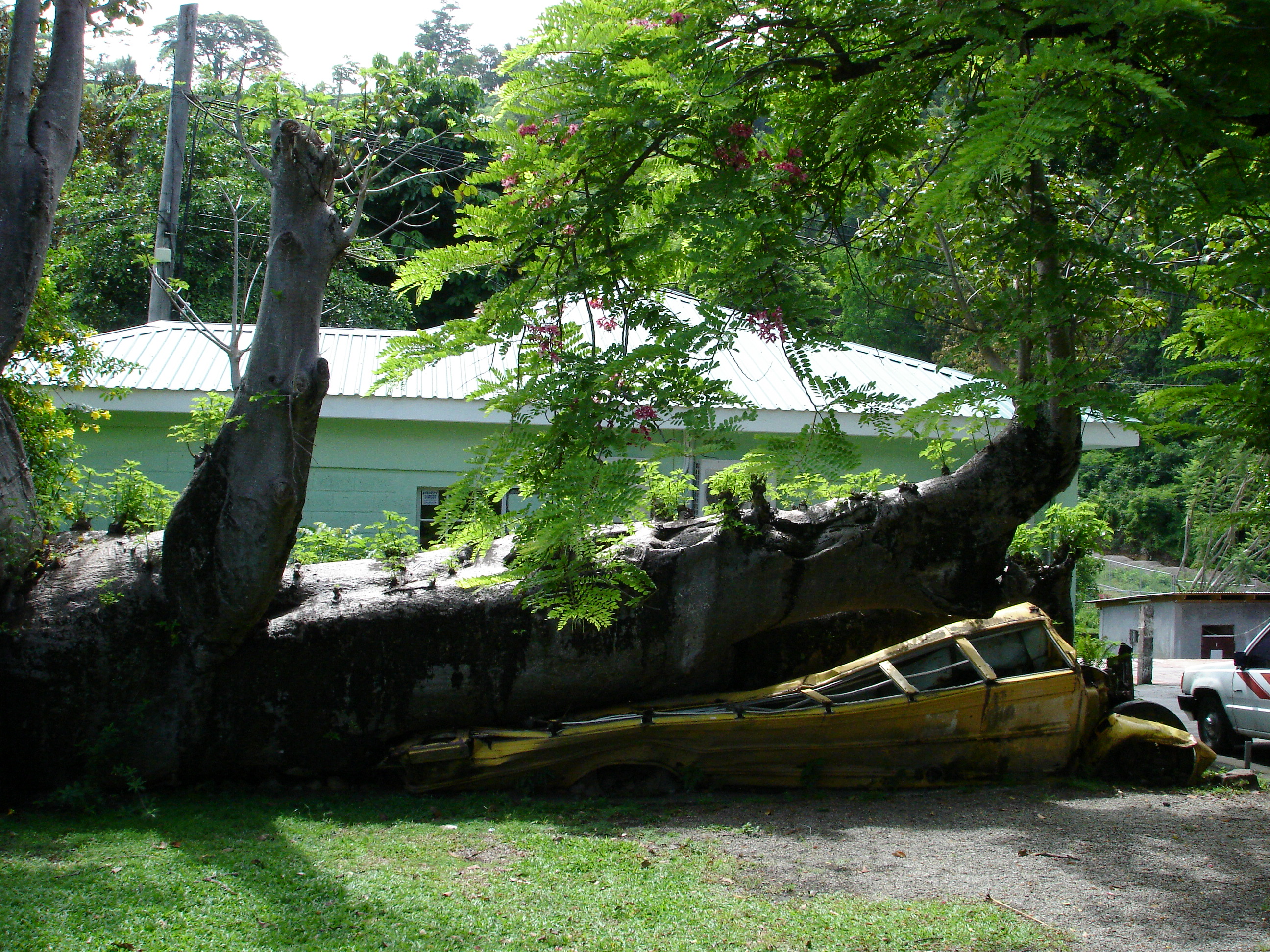
Dominica Botanical Gardens
There is a school bus in the Dominica Botanical Gardens that has not moved since 1979. It sits beneath the trunk of a gigantic African baobab tree that toppled onto it during Hurricane David, and the authorities made a decision that says something about this place: they left both where they fell. The crushed bus and the fallen tree remain as a memorial, not to the hurricane exactly, but to the fact that nature on this island operates on terms it sets for itself.
Seeds of Empire
The gardens began as a colonial project. In 1889, the Crown Government of the British Empire started planning a botanical station on 16 hectares of former sugar plantation within Bath Estate in Roseau. The land was purchased from its owner, William Davies, in 1891, and planting began the following year. The first curator, Charles Murray, came from the Royal Botanic Garden Edinburgh, but it was his successor, Henry F. Green, who designed the layout that still defines the grounds. Joseph Jones took over management in 1892 and stayed for the rest of his life. Jones became the first Superintendent of the Imperial Department of Agriculture for the West Indies in 1898, a title that reveals the gardens' original purpose: this was not a place for contemplation but for economic experimentation. Botanists from Kew Gardens in London supplied tropical species from across the globe, and the gardens served as a nursery for crop diversification, providing farmers with properly propagated seedlings.
The Finest in the West Indies
By the 1930s, the Dominica Botanical Gardens had earned a reputation as one of the finest in the Caribbean. Jones had introduced ornamental plants alongside the economic specimens, transforming a working agricultural station into something beautiful. Cannonball trees dropped their strange, heavy fruit. Banyan roots crept outward in slow-motion conquest. Century palms reached for the sky. The gardens became a gathering place for Roseau's residents, one of the few open green spaces in an increasingly dense capital city. Cricket matches were played on the grounds, and for decades it served as Dominica's main cricket pitch until Windsor Park was developed across the street in 1971.
What the Storm Left Behind
Hurricane David struck Dominica on August 29, 1979, with sustained winds near 150 miles per hour. The gardens' oldest and most impressive trees, specimens that had taken decades to reach maturity, were snapped or uprooted in hours. The baobab that fell across the school bus became the most photographed casualty, but the real loss was cumulative: an entire canopy of mature tropical specimens, irreplaceable in any human lifetime, reduced to wreckage. Hurricane Allen arrived the following year, compounding the damage before the forest could begin to recover. Restoration efforts have continued for decades since, and the gardens have regrown, but they carry the scars. The bus and baobab remain as a deliberate reminder that on a Caribbean island, nothing is permanent except the weather's capacity for destruction.
Living Collection
Today the gardens shelter Dominica's national tree and flower, the bois kwaib (Sabinea carinalis), alongside an eclectic collection of tropical species. The ylang ylang tree perfumes the air near the walkways. Two endemic lizard species, the Dominican ground lizard and the Dominican anole, are common residents, basking on warm stones and darting between plantings. Three species of hummingbird visit regularly, along with carib grackles and the green heron. The Dominica Forestry and Wildlife Division maintained offices on the grounds for fifty years before relocating in 2009. Each October, the gardens host Creole in the Park, a four-day music and cultural event tied to the World Creole Music Festival and Dominica's independence celebrations. Jack's Walk, a trail constructed in the 1880s during the gardens' establishment, begins here and climbs steeply to the top of Morne Bruce, offering a view back down over the green canopy that has, against the odds, persisted.
From the Air
Located at 15.30N, 61.38W in Roseau, Dominica's capital, on the island's southwestern coast. The gardens are a visible patch of green in the otherwise built-up area of central Roseau, adjacent to Windsor Park cricket stadium. Canefield Airport (TDCF) is approximately 2 nm north along the coast. Douglas-Charles Airport (TDPD) is on the northeast coast, roughly 25 nm away. From low altitude, Morne Bruce rises directly behind the gardens. The Roseau River and the city's waterfront provide additional visual reference points.