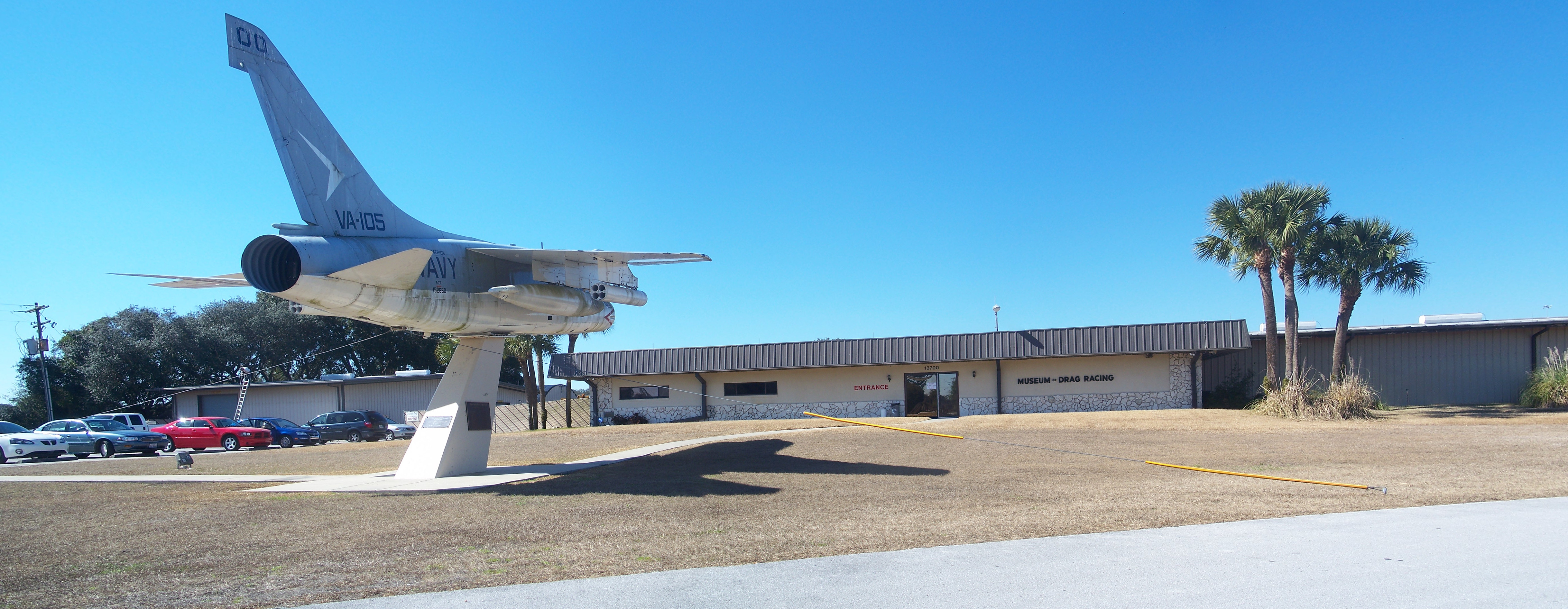
Don Garlits Museum of Drag Racing
They called him Swamp Rat. The California hot-rodders who dominated drag racing in the 1950s sneered at the lanky Floridian who hauled his home-built cars cross-country to challenge them. So Don Garlits painted the insult right on the side of his dragster and proceeded to beat them all. Today, just off Interstate 75 in Ocala, Florida, a sprawling museum holds the evidence of that defiance: over 90 racing cars, decades of trophies, and the story of how one stubborn mechanic from Tampa became the most important figure in the history of drag racing.
Quarter-Mile Revolutionaries
Don Garlits built his first race car in 1954 under an oak tree in North Tampa, cutting and welding a 1927 Ford Model T into something that could scream down a quarter-mile strip. He won the first NHRA event he entered. By 1957 he was the first to break 170 mph. The following year, 180 mph fell. In 1964, aboard Swamp Rat VI, he became the first drag racer to officially exceed 200 mph in the quarter mile. But his most consequential innovation came from catastrophe. On March 8, 1970, at Lions Drag Strip, the transmission on Swamp Rat XIII exploded, severing part of his right foot and splitting the car in half. While recovering, Garlits redesigned the entire sport. His rear-engine Swamp Rat 14, completed in 1971, moved the driver ahead of the engine instead of behind it, eliminating the deadliest hazard in Top Fuel racing. Every modern dragster follows his blueprint.
A Pack Rat's Palace
Garlits opened his first museum in 1976 in a garage near Tampa, but it quickly outgrew the space. In 1984, the current museum opened on a sprawling campus in Ocala, split between two main buildings. The Drag Race building holds roughly 90 competition vehicles, while the Antique Car building displays another 50. The collection goes far beyond Garlits's own legendary Swamp Rat series. Dean Moon's iconic Mooneyes gas dragster sits alongside machines from Kenny Bernstein, Shirley Muldowney, and Raymond Beadle. The museum also houses the International Drag Racing Hall of Fame, whose inductees include Art Arfons, Sydney Allard, and Zora Arkus-Duntov, the Belgian-born engineer who became the father of the Chevrolet Corvette. One of the collection's crown jewels, Swamp Rat XXX, earned a place in the Smithsonian's National Museum of American History in 1987.
The Smell of Nitromethane
Walking through the museum is a sensory experience that photographs cannot capture. The cars are enormous up close, their aluminum bodies scarred and dented from thousands of passes at speeds that compress the quarter mile into less than five seconds. The air in the display halls carries a faint ghost of nitromethane, the volatile fuel that Top Fuel dragsters burn at a rate of roughly fifteen gallons per run. Display cases overflow with helmets, fire suits, timing slips, and the hand-drawn engineering sketches where Garlits worked out the rear-engine design that saved lives. Memorabilia from every era of the sport fills the walls, transforming a rural Florida museum into the definitive archive of American straight-line speed.
Big Daddy at Ninety
Garlits, born in 1932, has never stopped pushing. In 2019, at age 87, he set a new quarter-mile record of 189.03 mph in Swamp Rat 38, a battery-powered electric dragster. The run proved that the man who pioneered nitromethane-fueled speed was equally willing to explore its electric future. The NHRA ranked him the number-one driver on its list of the Top 50 Drivers from 1951 to 2000, ahead of every rival who ever lined up beside him. His museum in Ocala stands as both a personal monument and a public trust, preserving the raw, loud, dangerous history of a sport that was born on abandoned airstrips and grew into a billion-dollar industry.
From the Air
The Don Garlits Museum of Drag Racing sits at 29.02N, 82.15W, just south of Ocala along Interstate 75 in Marion County, Florida. The museum campus is visible from low altitude as a large building complex with a distinctive parking area off the interstate corridor. Ocala International Airport (KOCF) is approximately 5 miles to the northwest. Gainesville Regional Airport (KGNV) lies about 44 miles north. The terrain is flat central Florida landscape with scattered lakes and forest. Best viewed at 2,000-3,000 feet AGL for context of the museum relative to the I-75 corridor and surrounding Ocala area.