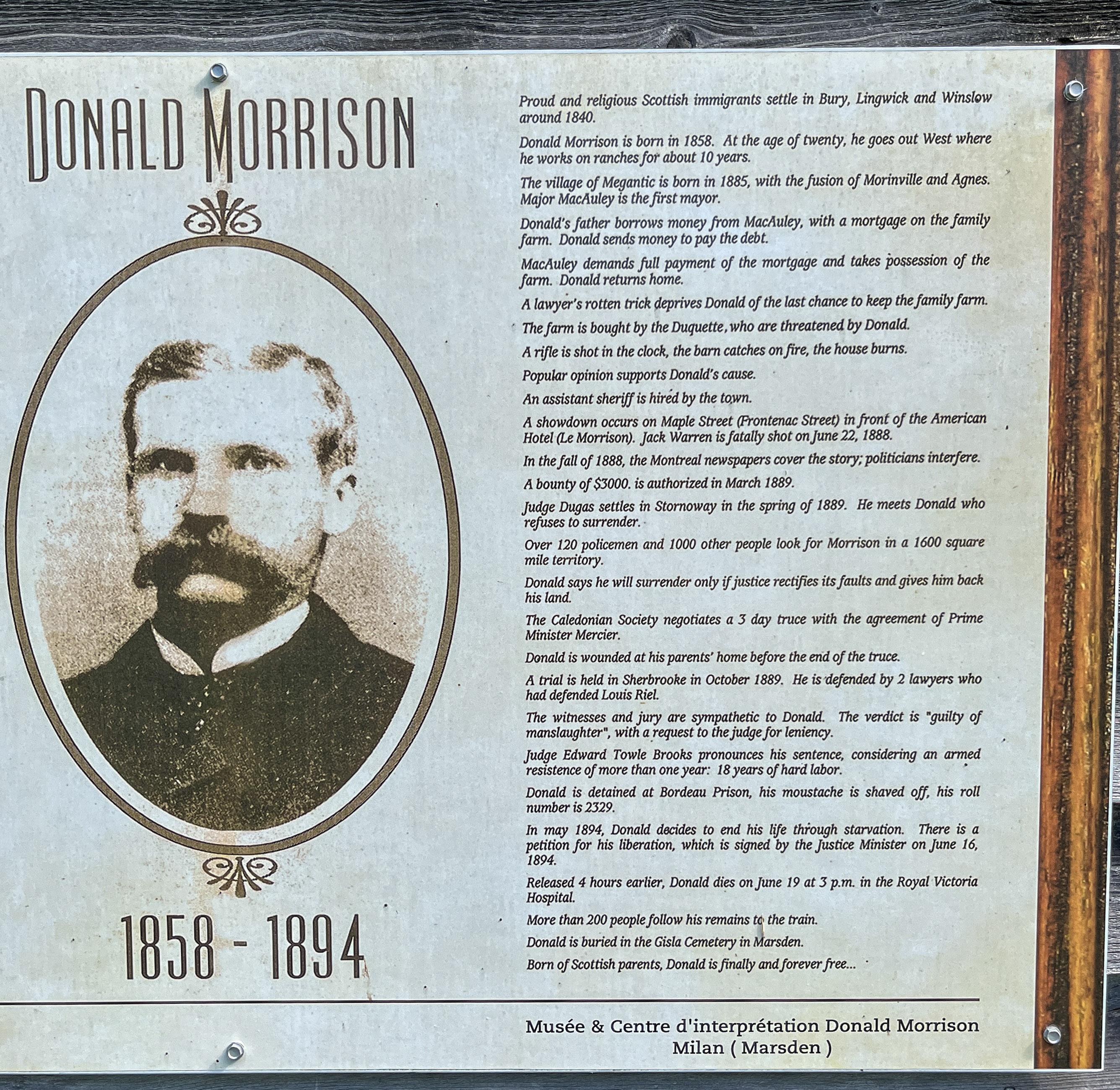
Donald Morrison (Outlaw)
They called him the Megantic Outlaw, and the Gaelic-speaking settlers of Quebec's Eastern Townships hid him for ten months. Donald Morrison was born in 1858 to Scottish immigrants from the Isle of Lewis who had built a life in the Canadian Gaelic-speaking community near Lac-Megantic. He went west as a young man, learned the cowboy trade on the prairies, and sent his wages home to help pay for the family farm. When he returned, he discovered the farm had been stolen through a mortgage swindle that exploited his father's illiteracy. What followed was a killing, the longest manhunt in Canadian history, a $1,200 bounty, and a death in prison at age 36 -- a story so deeply woven into the region's identity that it is still told in Gaelic verse and song more than a century later.
From the Isle of Lewis to Lac-Megantic
Morrison's parents were part of a wave of Scottish Gaelic-speaking immigrants who settled Quebec's Eastern Townships in the nineteenth century, bringing their language, traditions, and Presbyterian faith to the forested hills south of the St. Lawrence. The community near Lac-Megantic became one of the last outposts of Canadian Gaelic -- a language that would slowly fade over the following century but that still echoed through these valleys during Morrison's youth. Born on March 15, 1858, Donald grew up in a world caught between cultures: Highland Scottish identity transplanted into francophone Quebec, farming families carving homesteads from boreal forest. At age 20, he left for Western Canada and the American frontier, where he learned to ride, shoot, and work cattle. The wages he earned as a cowboy were dutifully sent home. The family farm was everything.
A Mortgage Signed in Ignorance
While Donald was away, his father Murdo Morrison mortgaged the family farm to a man named Malcolm MacAulay. According to contemporary newspaper accounts, MacAulay exploited Murdo's illiteracy, substituting a debt obligation far larger than the one Murdo believed he was signing. When the family could not meet the inflated repayment, the land was seized and sold to a new owner named Duquette. Donald returned from the west to find his family dispossessed -- the farm his cowboy wages had been supporting now belonged to a stranger. The injustice radicalized him. In June 1888, Morrison shot and killed a special constable named Lucius Jack Warren, a man who had been sent to arrest him. Whether the killing was self-defense or murder became the central question of the legal drama that followed, but the Gaelic community had already made up its mind: Morrison was defending what had been stolen from his family.
Ten Months in the Megantic Wilds
The manhunt that followed Morrison's killing of Warren became the longest in Canadian history. From June 1888 to April 1889, Morrison evaded lawmen in the forests and farmsteads around Lac-Megantic. In October 1888, Quebec's Attorney General Arthur Turcotte issued a proclamation offering $1,200 for his capture -- a substantial sum. But Morrison had something more valuable than money: the loyalty of his neighbors. The Scottish settlers of the Scotstown and Megantic communities sheltered him, fed him, and kept his whereabouts secret. The sympathizers saw him not as a criminal but as a victim of a rigged system -- a man whose family had been cheated by a predatory lender and abandoned by the law. For ten months, Morrison moved through a landscape he knew intimately, staying one step ahead of the authorities while an entire community conspired to protect him.
Prison, Madness, and Death
Morrison was finally captured in April 1889. He was convicted of manslaughter -- not murder -- and sent to prison. At Bordeaux Prison, his mustache was shaved off and he was assigned roll number 2329. He was later transferred to the St. Vincent de Paul Penitentiary, where his health rapidly deteriorated. By April 1890, prison officials described him as haggard and melancholy, suffering from a wounded leg that caused constant pain. He had nearly lost his sanity, stabilized only through the intervention of the prison chaplain and deputy warden. During his imprisonment, he was visited by Archibald McKillop, the Blind Bard of Megantic, who brought him spiritual counsel and a book. Morrison died on June 19, 1894, at the age of 36 -- released from prison that same day on clemency and transferred directly to Royal Victoria Hospital in Montreal, where he died four hours later. He was buried in the Gisla Cemetery in what is now Milan, Quebec.
The Outlaw Who Became a Song
Morrison's story refused to die with him. As early as 1892, Oscar Dhu -- the pen name of Angus Mackay -- published The Canadian Outlaw, a romanticized poem-cycle about Morrison's life. Henry G. Kidd followed with Donald Morrison 'The Megantic Outlaw' in 1948, and Bernard Epps wrote The Outlaw of Megantic in 1973. Ron Kelly turned the story into a television film in 1971. But perhaps the most fitting tribute came in 2007, when singer Calum Martin released a Gaelic-language concept album titled The Megantic Outlaw -- telling Morrison's story in the very language his community had spoken. A Gaelic novel, Fon Choill by Calum MacLeoid, followed in 2020. In 2016, the municipality of Milan opened the Donald Morrison Interpretation Center on Chemin Gisla, about four kilometers from the cemetery where Morrison lies. A yearly festival is held at the Donald Morrison domaine to honor both Morrison and the Scottish Gaelic-speaking pioneers who built this corner of Quebec. His headstone, they say, originally bore the wrong death date -- a final small injustice for a man whose story was always being told by others.
From the Air
Donald Morrison's story centers on the Lac-Megantic area of Quebec's Eastern Townships, at approximately 45.63N, 71.15W. The town of Milan, where Morrison is buried in the Gisla Cemetery, lies about 15 km southwest of Lac-Megantic. The landscape is rolling, forested hills typical of the Eastern Townships -- the same terrain where Morrison evaded capture for ten months. Lac-Megantic itself is a prominent visual feature from altitude. The Donald Morrison Interpretation Center is at 891 Chemin Gisla in Milan. Nearest airport: Lac-Megantic Airport (private, limited use). Sherbrooke Airport (CYSC) is approximately 100 km southwest. Best viewed at 3,000-5,000 feet AGL. The Eastern Townships' patchwork of farmland and forest is distinctive from the air.