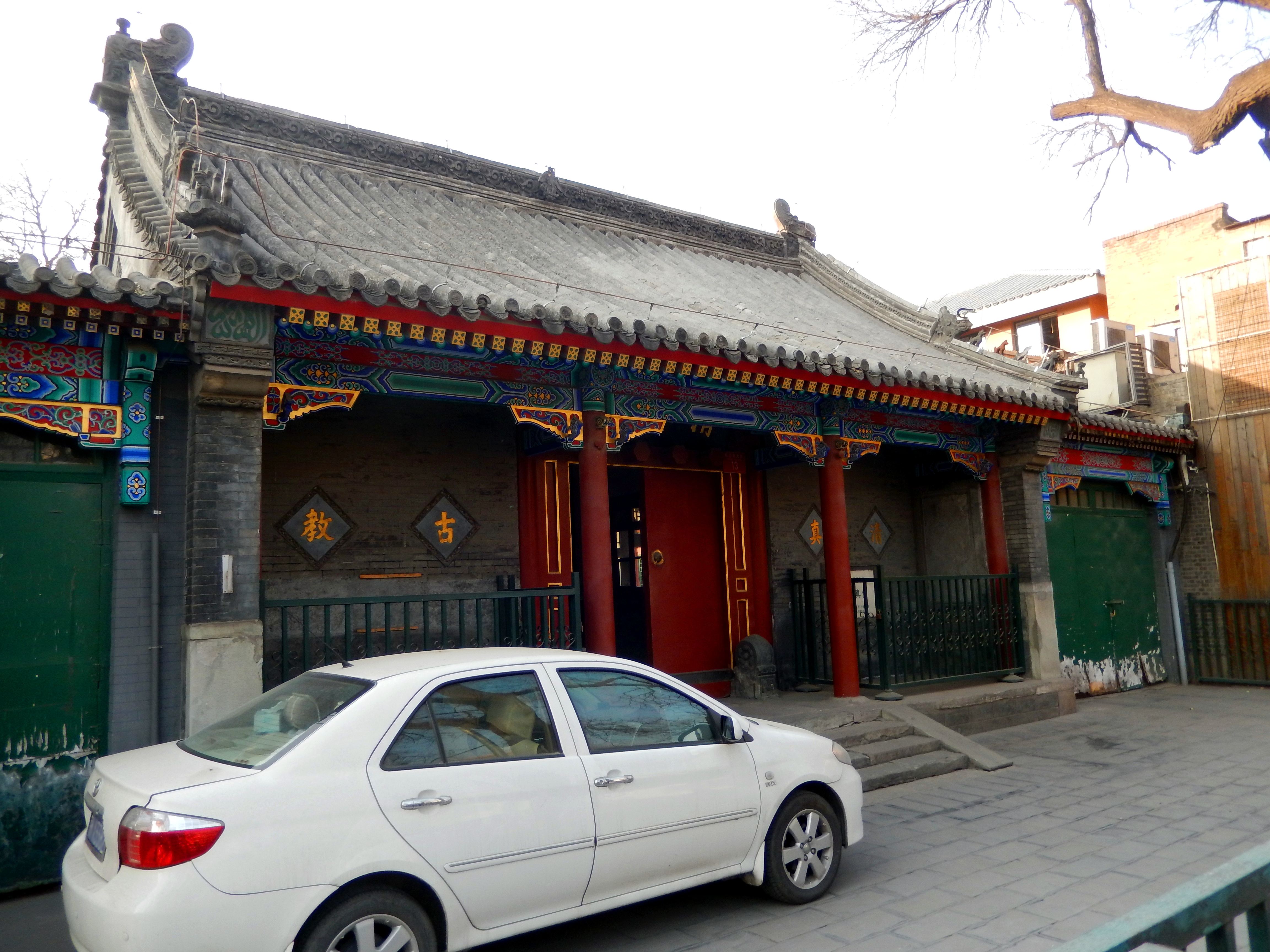
Dongsi Mosque
Local legends trace the Dongsi Mosque back to the Liao dynasty, when Beijing served as one of the Liao's secondary capitals. If true, that would place its origins before the tenth century, making it among the oldest continuously used religious sites in the city. Documentary evidence is more cautious, pointing to a construction date of 1346 during the Yuan dynasty, when Mongol rulers presided over a capital famous for its religious tolerance. Either way, the mosque has anchored the spiritual life of Beijing's Muslim community for the better part of a millennium, surviving fire, renovation, and the upheavals that reshaped every other institution in the capital.
A Mosque in Ming Dynasty Dress
The Dongsi Mosque does not look like the mosques of the Middle East or Central Asia. Its architectural style draws heavily from the Ming dynasty, when the building underwent major expansions in 1447 and 1486. The result is a structure that reads as distinctly Chinese from the outside while maintaining all the essential elements of Islamic sacred architecture within. Two iwans frame the entrance. A minaret rises above the roofline. The prayer hall, large enough to accommodate five hundred worshippers, features arches carved with verses from the Quran. On the southern side of the sahn -- the courtyard -- five wing halls extend outward, with three more on the northern side. A library on the southern part of the courtyard houses various editions of the Quran, a collection that has been maintained and expanded across centuries of use.
Surviving Through Centuries
The mosque survived a fire in the late nineteenth century, though it suffered considerable damage. Throughout the twentieth century, comprehensive repairs gradually restored the structure, maintaining its Ming dynasty character while ensuring it could continue to serve its community. Islam has been present in Beijing since at least the Yuan dynasty, when Muslim merchants, engineers, and administrators played significant roles in the cosmopolitan capital of Khanbaliq. The Muslim engineer Ikhtiyar al-Din helped design the city itself. The Dongsi Mosque is a physical trace of that long presence, a reminder that Beijing's identity has always been more religiously diverse than its political history might suggest.
Sacred Space in the Modern City
Today the mosque sits in the Dongsi Subdistrict of Dongcheng District, within walking distance south of Dongsi Station on the Beijing Subway. The surrounding neighborhood is dense with the narrow lanes and courtyard houses that characterize old Beijing, though modern development presses in from every side. The mosque functions as both a place of worship and a quiet repository of history, its library and prayer hall offering continuity in a city defined by transformation. For the worshippers who gather beneath arches inscribed with the Quran in a building styled after Ming dynasty palaces, the Dongsi Mosque embodies a synthesis that has defined Chinese Islam for centuries: faith expressed through the architectural language of the land where it took root.
From the Air
Located at 39.92N, 116.41E in Beijing's Dongcheng District. The traditional Chinese-style mosque is nestled among hutong neighborhoods. Nearest airport is Beijing Capital International Airport (ZBAA), approximately 27 km northeast. Best identified at lower altitudes.