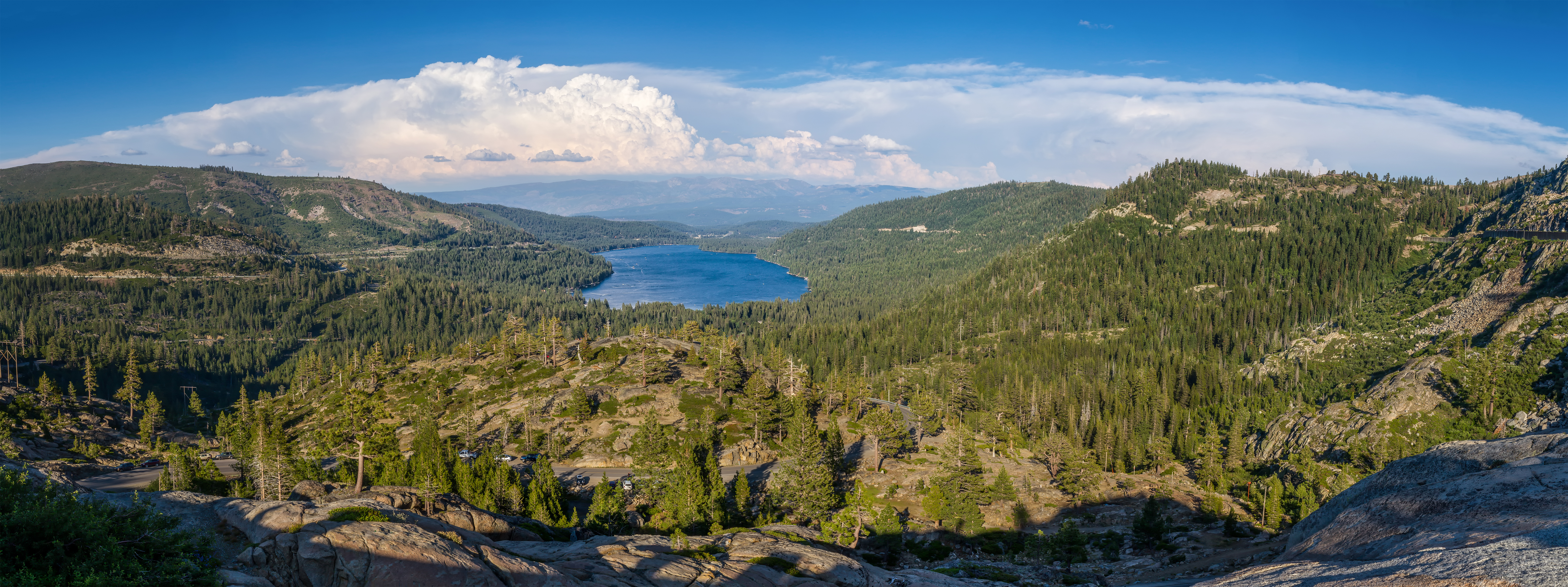
Donner Lake
Donner Lake is beautiful in summer: a blue alpine jewel surrounded by granite peaks, popular with swimmers and boaters. But in winter, when storms pile snow twenty feet deep and temperatures plunge below zero, the lake reveals why it bears its infamous name. Here, in the winter of 1846-47, eighty-one emigrants bound for California became trapped by early snowfall. They built crude shelters and waited for rescue. When their food ran out, they ate their oxen, then their dogs, then boiled hides and bones. When those ran out, they ate their dead. Of the eighty-one who were trapped, only forty-five survived. The Donner Party became America's most notorious tale of frontier disaster, a story of poor planning, bad luck, and the terrible choices humans make when facing starvation. The lake's name commemorates George and Jacob Donner, the expedition's nominal leaders, both of whom died in the mountains.
The Fatal Shortcut
The Donner Party's tragedy began with a shortcut. In 1846, a new route to California promised to save hundreds of miles by cutting south of the Great Salt Lake. Lansford Hastings, who had never actually traveled the route with wagons, promoted it aggressively. Against advice from experienced guides, the Donner-Reed party took the 'Hastings Cutoff.' It was a disaster. They spent weeks hacking through the Wasatch Mountains, crossed the Salt Lake Desert with insufficient water, and lost oxen and wagons. By the time they reached the Sierra Nevada in late October, they were a month behind schedule, exhausted, and dangerously low on supplies. Then the snow began.
Trapped
The party reached Truckee Lake (now Donner Lake) on October 31, 1846, hoping to cross the pass before winter. A storm buried the trail under five feet of snow. They tried three times to cross; each attempt failed. With no choice, they made camp. The Breen family occupied an abandoned cabin; others built lean-tos against boulders or dug into the snow. Six miles away at Alder Creek, the Donner families constructed tent shelters. November brought more snow. December brought more. By January, drifts reached the rooftops. The emigrants killed and ate their remaining cattle, which had frozen in the snow. When the meat ran out, they boiled hides and bones into glue-like soup.
The Forlorn Hope
On December 16, fifteen of the strongest emigrants - ten men and five women - set out on makeshift snowshoes to cross the mountains and get help. They carried six days' rations for a journey that would take thirty-three days. After a week, their food was gone. They drew lots to determine who would be killed for food; no one could do it. Then men began dying - from exhaustion, exposure, starvation. The survivors ate them. Only one refused: Luis and Salvador, two Miwok guides, who were later shot and eaten. On January 17, 1847, the seven survivors stumbled into a California settlement. Only two of the ten men had survived; all five women lived.
Rescue and Aftermath
Four rescue parties reached the lake camps between February and April 1847. Each found horrific scenes: emaciated survivors surrounded by human remains, some too weak to walk, some showing signs of severe psychological breakdown. The rescuers faced impossible choices about who could be saved. Children were carried out on the backs of rescuers. The last survivor, Lewis Keseberg, was found alone in a cabin among dismembered bodies; he would face accusations of murder and worse for the rest of his life. Of the eighty-one trapped, forty-five survived. Most of those who died were men; most survivors were women and children. The Donner brothers and their wives all perished.
Visiting Donner Lake
Donner Memorial State Park preserves the eastern shore of Donner Lake, near the town of Truckee, California. The Emigrant Trail Museum tells the Donner Party's story through artifacts recovered from the camps, including fragments of the china and goods they carried west. The Pioneer Monument, completed in 1918, stands on a base exactly twenty-two feet high - the depth of snow that winter. A short trail leads to the Murphy cabin site, where one group sheltered; a large boulder with a bronze plaque marks the location. The Alder Creek site, where the Donner families camped, is six miles away and accessible in summer. The lake itself is now a resort destination - swimming, boating, hiking in summer; skiing in winter. Reno-Tahoe International Airport (RNO) is 35 miles east. Interstate 80 crosses Donner Pass just west of the lake.
From the Air
Located at 39.32°N, 120.24°W in the Sierra Nevada mountains of California, near Truckee. From altitude, Donner Lake appears as a small blue lake in a granite basin just east of Donner Pass. Interstate 80 and the railroad are visible crossing the pass. Lake Tahoe lies 12 miles to the south. The rugged terrain explains why the Donner Party couldn't escape.