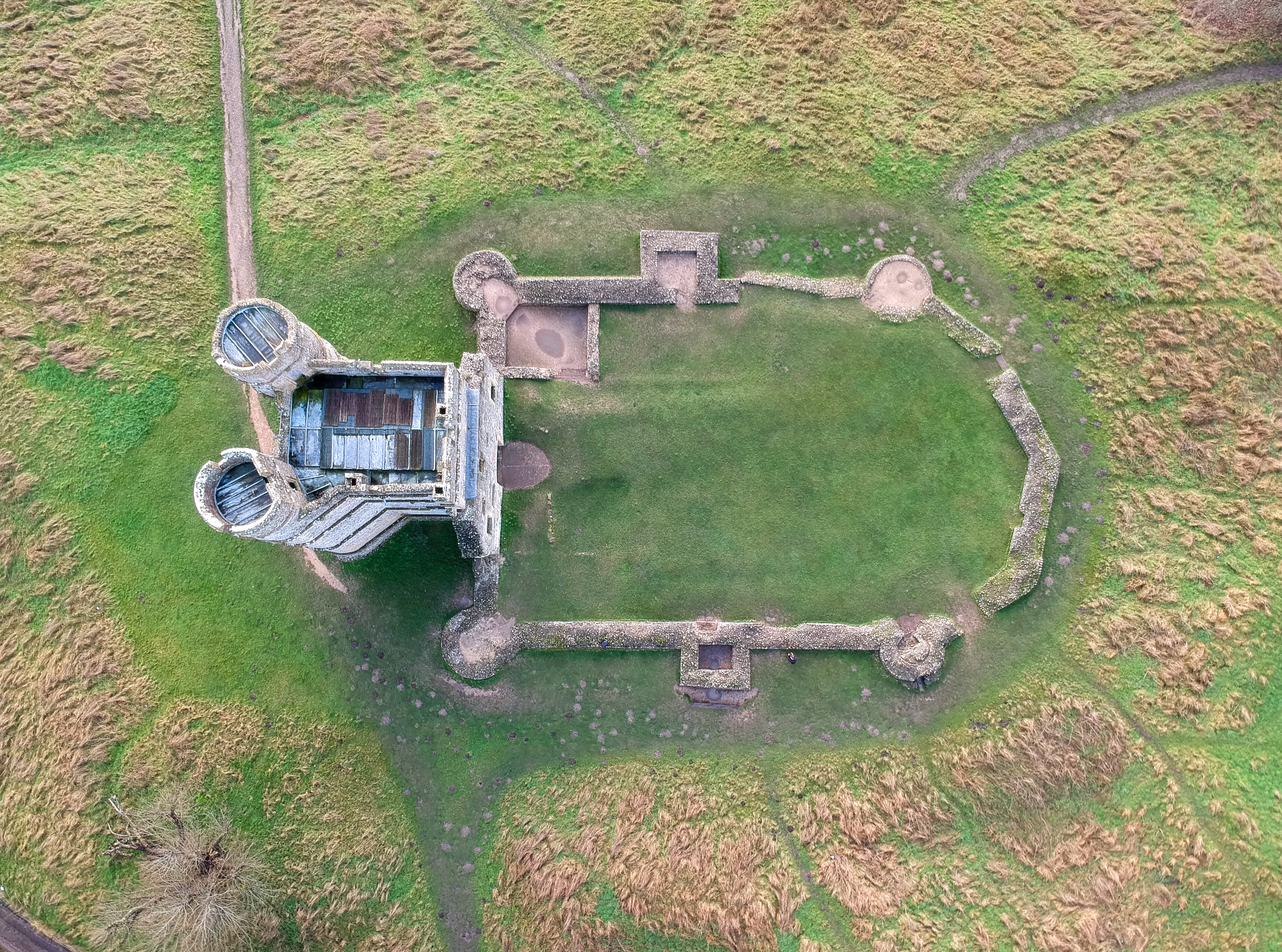
Donnington Castle
Only the gatehouse survives. Two round towers flanking a pointed arch, built of flint and stone in 1386, standing on a hilltop north of Newbury in Berkshire with nothing behind them but grass and earthworks and sky. Everything else -- the curtain walls, the courtyard buildings, the apartments where Tudor monarchs stayed -- was demolished by order of Parliament in 1646, punishment for the castle's stubborn refusal to surrender during twenty months of Civil War siege. That twin-towered gatehouse, somehow, they left standing.
The Poet's Granddaughter
Donnington Castle was built by Sir Richard Abberbury the Elder under a licence granted by Richard II in 1386. The Abberbury family had held the manor since 1292, but it was the castle's second owner who gave it a literary connection that endures. In 1398, Abberbury sold Donnington to Thomas Chaucer -- son of Geoffrey Chaucer, the poet of The Canterbury Tales. Thomas acquired it as a residence for his daughter Alice, who later married William de la Pole, Duke of Suffolk. The duke made Donnington his occasional home and considerably enlarged the buildings. When the de la Pole family later fell out with the Tudor monarchs, the castle passed to the Crown. Henry VIII visited in 1539, Edward VI in 1552, and Elizabeth I in 1568.
The First Woman Keeper
In 1590, Elizabeth I granted keepership of Donnington Castle to Elizabeth Cooke, Lady Russell -- making her the first woman to hold such a title in England. Lady Russell was one of the formidably educated Cooke sisters, fluent in Latin and Greek, a woman whose intellectual accomplishments were remarkable even by the standards of the Elizabethan court. Ten years later, Elizabeth I gave the castle and surrounding manor to Charles Howard, 1st Earl of Nottingham, the admiral who had commanded the English fleet against the Spanish Armada. By the time the English Civil War erupted in the 1640s, the castle had passed to the Parliamentarian Packer family -- but it would not remain in Parliamentarian hands for long.
The Siege That Refused to End
After the First Battle of Newbury in September 1643, Royalist forces seized Donnington Castle and placed it under the command of Sir John Boys. The garrison quickly transformed the medieval fortress into a modern defensive position, constructing star-shaped earthworks around the walls to provide gun emplacements. The courtyard, measured from the inner curtain walls, was modest -- just 67 feet north to south and 108 feet east to west -- but Boys and his men held it against repeated Parliamentarian assaults for twenty months, from July 1644 until their surrender in April 1646. The castle endured bombardment, blockade, and direct attacks. When the garrison finally surrendered, Parliament voted to slight the castle -- the systematic demolition that was standard punishment for Royalist strongholds. The earthworks Boys had built are still visible as undulations in the hilltop turf, a ghostly star pattern that aerial photography reveals more clearly than any walk across the ground.
What Remains
The gatehouse that Parliament spared is now a scheduled monument under the care of English Heritage, and it remains one of the most evocative medieval ruins in southern England. The twin towers frame nothing but open ground where the castle once stood, but the quality of the fourteenth-century stonework -- the dressed flint, the carefully shaped arch -- speaks to the ambitions of Abberbury and the Chaucer family who followed him. The earthwork defences from the Civil War add a second layer of history to the hilltop, visible as banks and ditches that trace the outline of Boys's desperate star fort. From Newbury below, the gatehouse catches the light on the ridge, two towers still standing guard over a castle that has been gone for nearly four centuries.
From the Air
Located at 51.42N, 1.34W on a hilltop just north of Newbury, Berkshire. The twin-towered gatehouse is visible from the air as an isolated stone structure on a grassy hilltop, with the star-shaped Civil War earthworks traceable around it. The A34 runs nearby. Nearest airports: EGTK (Oxford Kidlington, 25nm north), EGLF (Farnborough, 22nm east). The battlefield of the First Battle of Newbury (1643) lies to the south.